Can You Put Water on an Electrical Fire?
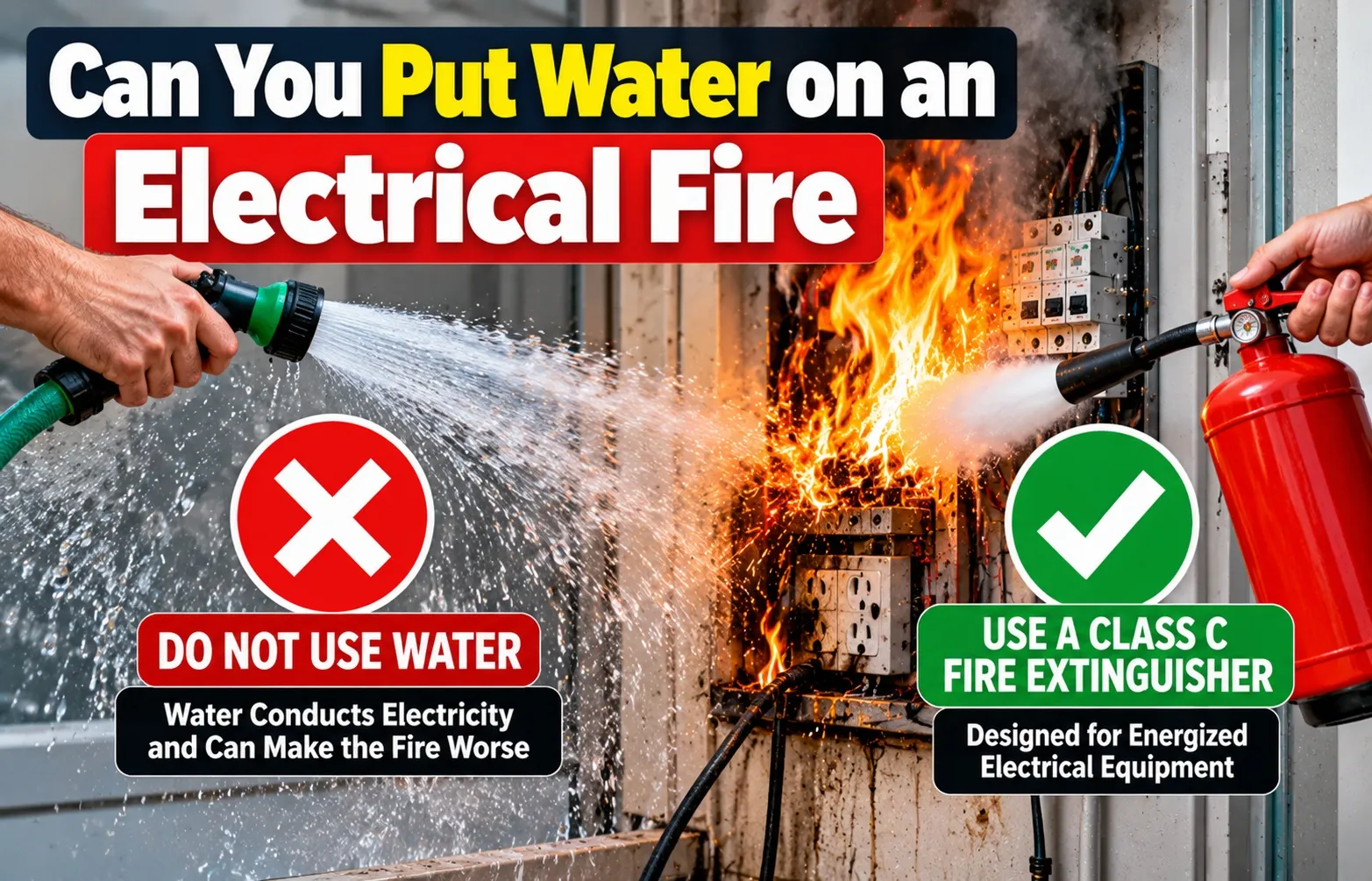 No, you must never put water on an active electrical fire. Standard tap water contains dissolved minerals and ions that turn it into an active conductor of electricity. Pouring water onto live electrical equipment instantly creates a continuous circuit, sending electrical current directly up the stream to shock or electrocute you.
Introducing water to a energized circuit triggers immediate safety hazards:
- Fatal Electrocution: Electric current travels instantly back along the liquid stream, delivering a potentially fatal electric shock.
- Violent Electrical Arcing: Moisture causes sudden short circuits, triggering explosive arcs that hurl sparks, molten metal, and burning debris across the room.
- Rapid Fire Spread: The force of throwing water can shatter burning electrical components, scattering ignited insulation and live electrical sparks to adjacent materials.
At a Glance: 4 Immediate Action Steps When an Electrical Fire Starts
When an active electrical fire occurs, follow these critical emergency steps immediately to protect yourself and contain the hazard:
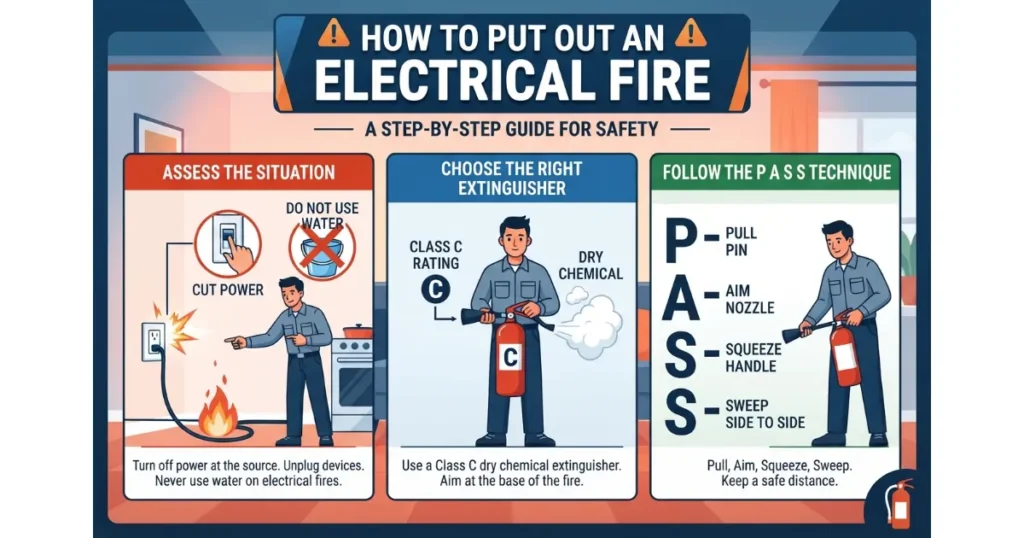
- Cut the Main Power Source: Immediately switch off the main circuit breaker or unplug the device if you can safely reach the switch without touching exposed, burning wires or standing in water.
- Use a Class C Fire Extinguisher: If the fire is small and manageable, discharge a Class C, carbon dioxide (CO₂), or multi-purpose dry chemical (ABC) fire extinguisher from a safe distance. Never use water-based Class A extinguishers.
- Smother Small Disconnected Fires: If the power source is completely disconnected and verified off, you can smother small, localized flames using liberal amounts of baking soda (sodium bicarbonate).
- Evacuate and Call Emergency Services: If the fire grows rapidly, generates dense smoke, or you cannot safely cut the power, initiate an immediate evacuation and dial 911 or your local emergency number.
What to Do During an Electrical Fire: Safe Step-by-Step Guidance
The absolute priority during an electrical fire is eliminating the live electrical current. If you can safely reach the main circuit breaker or fuse box without stepping in water or touching exposed wiring, shut off power to the affected area immediately.
- Never touch burning appliances or cords directly with your bare hands.
- Avoid standing in water while attempting to reach a circuit breaker or switchboard.
- Kill the master breaker if you are unsure which specific circuit controls the malfunctioning outlet or appliance.
Step 2: Select and Discharge the Correct Fire Extinguisher (Class C CO₂ or ABC)
Once power is cut, or if you must act before reaching the breaker, you must use a specialized non-conductive fire suppression tool. Never use standard water-based extinguishers, which instantly conduct electricity back to your body.
- Class C Extinguishers: Specifically rated for energized electrical equipment using non-conductive suppression agents.
- CO₂ Extinguishers: Smother the fire by displacing oxygen with carbon dioxide, leaving no corrosive chemical residue on sensitive equipment.
- ABC Multi-Purpose Dry Chemical: Safe for electrical fires, though the chemical powder can damage sensitive electronics.
- The PASS Method: Remember to Pull the pin, Aim low at the base of the fire, Squeeze the handle, and Sweep side to side.
Step 3: Smothering Small Fires Safely (When and How to Use Baking Soda)
If you do not have a fire extinguisher and the electrical source is 100% verified dead, you can combat tiny, localized flames using baking soda (sodium bicarbonate). When heated, sodium bicarbonate releases carbon dioxide gas, which helps starve the fire of oxygen.
- Verify Power Off: Never apply baking soda if any possibility of live current remains in the circuit.
- Generous Application: Pour or throw liberal amounts directly over the base of the small flame.
- Avoid Kitchen Substitutes: Never use flour, sugar, or wet kitchen towels, as they create severe dust explosion or shock hazards.
Step 4: Knowing When to Evacuate and Call 911 Immediately
Electrical fires can travel rapidly behind walls and release toxic smoke. Property can always be replaced, but human life cannot—know when to abandon firefighting efforts and evacuate.
- Rapid Fire Growth: If the fire spreads beyond a small localized area or ignites surrounding furniture or drywall.
- Inaccessible Breaker: If smoke or flames block your safe path to the main circuit breaker or exit door.
- Heavy Smoke & Fumes: Inhaling toxic plastic smoke can cause disorientation and unconsciousness within seconds. Evacuate immediately and dial 911.
Why Water Makes Electrical Fires Deadlier: The Physical Mechanics
While chemically pure distilled water ($H_2O$) is actually a poor conductor of electricity, standard household tap water is an efficient electrical conductor. Tap water contains high concentrations of dissolved minerals, salts, calcium, magnesium, and sodium ions. These dissolved mineral impurities create a highly charged ionic solution that facilitates rapid current transmission through liquid.
Throwing water on live electrical components creates severe secondary risks:
- Continuous Current Path: The stream of poured water forms an uninterrupted liquid bridge connecting the live high-voltage source directly to your body, completing the circuit to ground.
- Instantaneous Shock Transmission: Electrical current travels through this conductive pathway in milliseconds, bypassing clothing and causing severe internal tissue damage, ventricular fibrillation, or fatal cardiac arrest.
- Sub-Surface Circuit Expansion: Liquid flows rapidly across floors and into surrounding building materials, expanding the energized shock zone across a wider surface area.
The Danger of Violent Electrical Arcing and Thermal Explosions
When cold, conductive tap water impacts an energized electrical fire, it triggers immediate physical and chemical reactions. The sudden bridge between positive and negative connections creates a severe short circuit, lowering electrical resistance to near zero and generating massive surges of current.
This rapid energy release causes dangerous physical phenomena:
- Arc Flash & Blasts: The massive short circuit generates a high-temperature arc flash that can reach temperatures exceeding several thousand degrees, instantly igniting nearby combustible materials.
- Rapid Steam Expansion: Water hitting extreme electrical heat vaporizes instantly, expanding in volume by approximately 1,600 times. This sudden thermal expansion acts like a pressure explosion.
- Shrapnel Projection: The force of the steam explosion sprays burning insulation, hot liquid plastic, molten copper wire fragments, and ignited debris across the surrounding room, rapidly spreading the fire.
Can You Put Water on an Electrical Fire After Unplugging? (The Stored Energy Danger)
Water can only be safely applied to an electrical fire when two strict conditions are met: the main power supply to the entire circuit is completely cut, and the electrical apparatus itself is no longer energized or holding a charge. Once the current is verified dead, the event transitions from a Class C electrical fire to a Class A structural fire involving surrounding combustible materials like wood, drywall, or curtains.
Before applying water during this specific transition, keep these core rules in mind:
- Verify Complete Disconnection: Disconnect the master circuit breaker rather than relying solely on a wall switch or individual appliance plug.
- Target Surrounding Materials: Apply water only to burning external materials (e.g., upholstery, paper, or carpet) ignited by the initial electrical surge, rather than directly soaking complex electronics.
- Follow Standard Safety Frameworks: Adhere to established safety protocols, such as those outlined in the National Fire Protection Association (NFPA) safety guidelines, to ensure proper hazard management before attempting suppression.
The Hidden Hazard: Stored Energy in Capacitors and Battery Backups
Unplugging an appliance from a wall outlet does not guarantee that the device is safe to douse with water. Modern electronics and household appliances contain internal electrical capacitors and reserve battery cells capable of storing lethal high-voltage charges long after being disconnected from the grid.
High-risk devices that retain dangerous residual voltage include:
- Microwaves and HV Transformers: Contain high-voltage capacitors that store thousands of volts, presenting severe shock risks even when unplugged.
- Power Supply Units (PSUs) & Monitors: Computer power supplies, televisions, and desktop monitors hold charge retention across large smoothing capacitors for extended periods.
- Uninterruptible Power Supplies (UPS) & AC Units: Internal battery backups and compressor start capacitors maintain active voltage independently of wall power.
As a practical rule of thumb: never assume an unplugged electronic device is zero-volt safe. Always treat internal components as live, stored energy hazards and avoid using water directly on electronics regardless of plug status.
Household Myths vs. Reality: Can You Use Flour Salt or Baking Soda?
Throwing flour onto an active flame is one of the most dangerous fire safety mistakes you can make in a kitchen. Flour consists of organic carbohydrate particles ground into a fine powder. When tossed into the air over an open flame or intense heat source, these microscopic particles disperse into an airborne cloud, dramatically increasing their exposure to oxygen.
This suspension creates an immediate hazard known as a flour dust explosion (deflagration):
- Rapid Flame Spread: The high surface area of suspended combustible dust causes near-instantaneous ignition, transforming a small localized fire into a fireball.
- Shockwave & Thermal Wave: The rapid combustion creates a sudden expansion of hot gases that can inflict severe facial burns and spread flames throughout the kitchen.
- Other Starch Hazards: Cornstarch, powdered sugar, baking powder, and grain-based starches exhibit identical combustible dust properties and must never touch a fire.
Safe vs. Dangerous Kitchen Materials for Fire Suppression
Understanding which household substances safely suppress fires—and which accelerate them—can save lives during an emergency. Never use materials containing organic compounds or liquid moisture on energized circuits.
Avoid using wet or damp towels on live electrical fires. While a wet cloth can smother a grease fire, moisture turns cloth into a conductive pathway on live electronics, causing shock instantly upon contact.
Early Warning Signs of an Electrical Fire (How to Stop It Before It Starts)
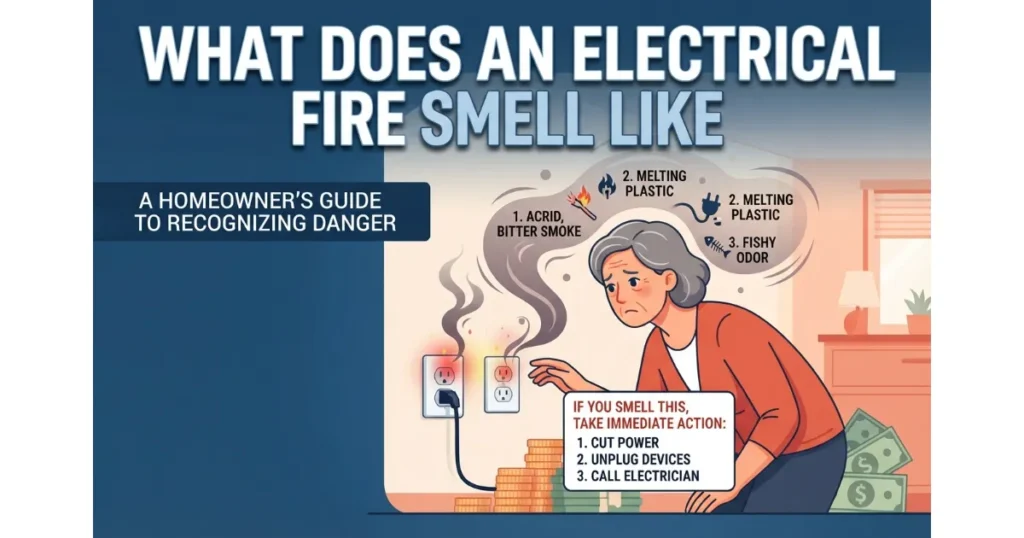
Spotting electrical hazards before ignition prevents catastrophic emergencies. Warning signs include a persistent burning plastic odor, discolored or charred wall outlets, buzzing light switches, warm faceplates, and frequently tripping breakers.
Monitor these critical physical indicators closely:
- Burning Plastic or Fishy Odor: A strange chemical or fish-like smell often indicates that wire insulation is melting under high heat.
- Discolored or Charred Outlets: Black or brown scorch marks around plug slots signify severe localized heat from a short circuit or loose wire.
- Buzzing or Humming Noises: Audible hums from switches or outlets point to an arc fault where electricity jumps across loose gaps.
- Warm or Hot Faceplates: Outlets or wall plates that feel warm to the touch highlight dangerous overloads or internal resistance.
- Frequently Tripping Breakers: Circuit breakers that trip repeatedly signal constant electrical overloads, short circuits, or ground faults.
Can an Outlet Start a Fire When Nothing Is Plugged In?
An electrical outlet or junction box can start a fire even when no appliance is plugged into it. Internal structural issues like loose terminal screws, wire insulation failure, or an ungrounded outlet setup generate continuous heat hidden behind drywall.
Hidden electrical hazards inside walls include:
- Loose Terminal Screws: Terminal connections that loosen over time create high electrical resistance points, generating intense heat inside the box.
- Wire Insulation Failure: Age, moisture, or thermal stress can degrade wire coatings, leading to bare copper contact and spontaneous short circuits.
- Rodent Activity: Mice or rats chewing on electrical wire insulation expose copper conductors, increasing the risk of sparking and arc faults.
- Unprotected Circuits: Older ungrounded wiring systems lack modern safety features. Installing an arc-fault circuit interrupter (AFCI) breaker provides advanced protection against hidden internal arcing.
Frequently Asked Questions About Electrical Fires
What should you NEVER use to put out an electrical fire?
You must never use water, Class A water-based extinguishers, kitchen flour, sugar, or wet towels to suppress an active electrical fire. Water and damp cloths conduct electricity directly to your hands, while flour and sugar create an explosive airborne dust hazard when exposed to open flames.
- Avoid Water-Based Extinguishers: Liquid agents create a current path back to the user.
- Avoid Combustible Kitchen Powders: Flour and starch cause explosive dust deflagration.
- Avoid Damp Smothering Cloths: Moisture absorbs heat and acts as a conductor on energized equipment.
Can water in a plug socket cause a fire?
Yes, water entering a plug socket or outlet box creates an immediate short circuit spark. Moisture bridges the narrow gap between the live line and neutral terminals, drastically dropping resistance and generating intense localized heat that can ignite nearby wall insulation or dry wood studs inside the wall framing.
Can an unplugged appliance start a fire?
Yes, an unplugged appliance can still ignite if it contains high-capacity capacitors, internal battery reserves, or degraded lithium-ion battery cells. Thermal runaway in damaged lithium-ion packs or residual electrical discharge across stored-energy capacitors can spark adjacent plastic housings even when disconnected from wall power.
How long does it take for an electrical fire to spread?
An electrical fire can spread across internal wall wiring and surrounding materials in as little as 30 to 90 seconds. Because arc faults generate intense thermal energy inside concealed spaces, toxic smoke generation and structural flame propagation occur rapidly before visible flames break through the drywall.

Oscar Vance | Master Plumber & Drainage Expert
Meet Oscar Vance, a licensed master plumber sharing practical solutions on residential repairs, preventive maintenance, and thoughtful home upkeep.