What Class of Fire Involves Energized Electrical Equipment?
 Under North American standards established by the National Fire Protection Association (NFPA) and OSHA compliance regulations, fires involving energized electrical equipment are classified strictly as Class C fires. These incidents involve live electrical gear such as circuit breakers, wiring, transformers, and electrical appliances where an active electrical shock hazard is present.
NFPA & OSHA Fire Classification
Proper identification of electrical fires is vital for worker safety and facility protection. When dealing with live electrical currents, standard extinguishing agents can introduce fatal risks.
- Official Classification: Designated as Class C under NFPA 10 and OSHA safety guidelines.
- Common Fuel Sources: Live power distribution panels, computer servers, electronic systems, electric motors, and energized wiring.
- Primary Hazard: High risk of severe electrical shock or electrocution if conductive extinguishing agents are applied.
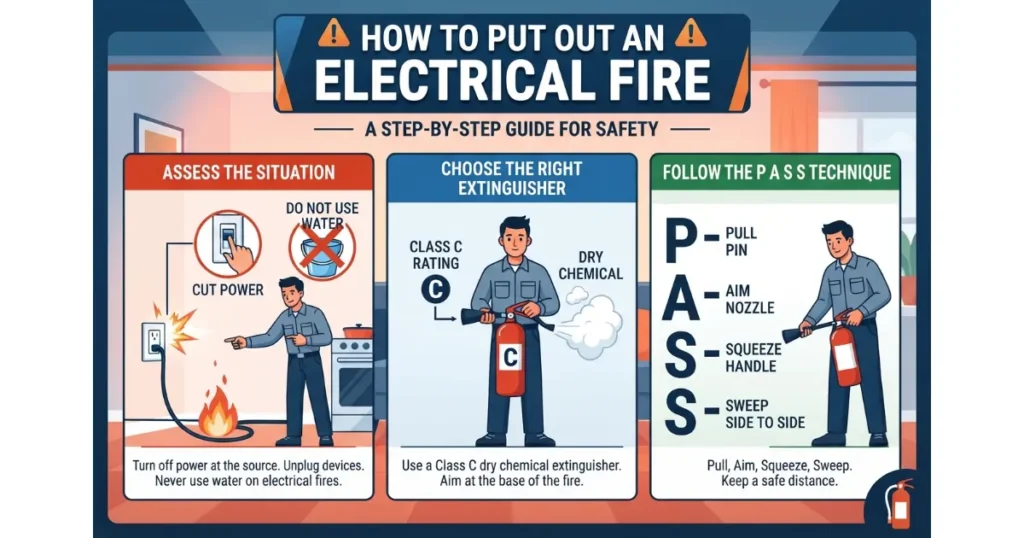
- Required Agent: Must be suppressed using a non-conductive extinguishing agent such as carbon dioxide or dry chemicals.
Complete Fire Class Breakdown (Class A B C D and K)
Understanding the specific fuel source involved in a fire is essential for choosing the correct extinguishing method. Fire protection standards group fires into five distinct categories based on the burning material and the hazards they present.
Master Fire Classification Matrix
Each fire classification requires a specific extinguishing agent to safely neutralize the threat without causing severe injury or secondary hazards.
How Class C Differs from Class A, B, D, and K
The key characteristic that sets a Class C fire apart from all other classifications is the presence of an active electrical current. Applying an improper extinguishing agent can result in shock, explosion, or chemical acceleration.
- Class A vs. Class C: Class A fires involve ordinary solid combustibles like wood, paper, and cloth, which require water or cooling agents to extinguish. Applying Class A water agents to a Class C electrical fire creates an immediate shock hazard.
- Class B vs. Class C: Class B fires involve flammable liquids like gasoline, grease, or oil. While both Class B and Class C fires can be suppressed using CO₂ or dry powder, Class B agents do not guarantee non-conductivity if they are liquid-based foams.
- Class D vs. Class C: Class D fires involve volatile combustible metals such as magnesium, sodium, or titanium. These require specialized dry powder agents to smother intensely hot chemical reaction fires, whereas Class C focuses on non-conductive electrical suppression.
- Class K vs. Class C: Class K fires occur in commercial kitchens involving high-temperature cooking oils and fats. They require wet chemical fire suppression systems to cool and saponify fat fires, which should never be used on live electrical circuits.
Common Causes and Examples of Class C Electrical Fires
Electrical fires account for thousands of emergency incidents annually across residential, commercial, and industrial facilities. Understanding the specific equipment and failure modes that ignite Class C fires is crucial for early detection, proper hazard mitigation, and effective safety planning.
High-Risk Household & Office Appliances
In residential and standard office environments, Class C fires are most frequently triggered by overloaded circuits, degraded insulation, or faulty consumer electronics.
- Frayed Wiring & Damaged Cordage: Physical wear, tight bends, or rodent damage expose live conductors, causing electrical arcing across compromised insulation.
- Overloaded Extension Cords & Power Strips: Connecting high-draw appliances to lightweight extension cords causes resistance heating, melting the vinyl housing and igniting nearby combustibles while remaining energized.
- Faulty Power Tools & Appliances: Internal short circuits in high-wattage devices like heaters, power tools, or kitchen appliances create intense localized thermal spikes that ignite surrounding casing materials.
- Aging Outlets & Switches: Loose terminal connections create high-resistance points, generating extreme heat and localized arcing inside wall junction boxes.
Industrial & Commercial Electrical Hazards
Industrial settings feature higher voltages, heavier currents, and continuous operational demands, significantly multiplying the potential scale of an electrical fire.
Modern Electrical Threats: Lithium-Ion Batteries & UPS Systems
Modern commercial infrastructure introduces complex electrical hazards that bridge multiple fire classifications simultaneously, requiring specialized awareness.
- Uninterruptible Power Supply (UPS) Systems & Server Racks: High-density server environments rely on continuous high-voltage direct current (DC) distribution. Internal short circuits within packed server racks or power distribution units (PDUs) generate sustained electrical arcing that rapidly ignites cable insulation.
- Lithium-Ion Battery Banks: Large-scale energy storage systems (ESS) and battery backup installations are subject to thermal runaway caused by physical damage, overcharging, or internal manufacturing defects.
- Class C to Class A/B Progression: While a battery bank or server fire initially operates as a Class C energized electrical fire, the extreme heat can rupture battery cells or ignite plastic housings, triggering off-gas combustion and secondary fuel source fires.
Regional Standard Variations: Class C (US) vs. Class E (International)
Fire classification nomenclature varies significantly depending on regional safety standards. A common source of confusion in global hazard communication arises when comparing North American safety framework designations with European, United Kingdom, and Australian standards.
North American Standard (NFPA 10 OSHA)
In the United States, Canada, and regions adhering to ANSI and OSHA regulations, electrical fires are categorized exclusively as Class C. Under these guidelines, the classification specifically indicates the presence of energized electrical equipment where electric shock risk exists.
- Governing Standard: Defined under National Fire Protection Association (NFPA) guidelines (NFPA 10) and enforced by OSHA workplace safety standards.
- Designated Symbol: Identified by a blue circle containing the letter “C” or a stylized electrical plug pictogram.
- Key Definition Focus: The Class C rating signifies that the extinguishing media is non-conductive and safe for operator use while electrical current remains active.
International Standards (BS EN 3 ISO 3941 Australia)
Under international safety conventions, including European standard BS EN 3, ISO 3941, and Australian standards (AS/NZS 1841), fire categories follow a different letter-assignment structure. In these jurisdictions, “Class C” does not refer to electrical hazards.
Across BS EN 3 and ISO 3941 frameworks, electricity is considered an ignition source or hazard environment rather than a standalone fuel class. As a result, extinguishers deemed safe for live electrical fires carry a distinct electrical spark symbol or a Class E marking rather than a Class C letter designation.
Safe Fire Extinguishers for Class C Electrical Fires
Extinguishing a Class C fire requires an agent that is strictly non-conductive to eliminate shock hazards while effectively smothering or interrupting the combustion process. Choosing the correct extinguisher depends on balancing immediate fire suppression against potential equipment damage from chemical residue.
Carbon Dioxide (CO2) Extinguishers: Best for Electronics
Carbon dioxide (CO2) extinguishers are among the most reliable choices for suppressing electrical fires in environments housing sensitive electronic hardware.
- Suppression Mechanism: Discharges cold CO2 gas under high pressure, displacing atmospheric oxygen surrounding the fire and rapidly cooling the burning area.
- Zero Residue Advantage: CO2 dissipates completely into the air without leaving liquid or solid residue, preventing damage to sensitive components.
- Ideal Applications: Server rooms, computer laboratories, electrical panels, telecommunications closets, and control rooms.
Multi-Purpose ABC Dry Chemical Extinguishers
ABC dry chemical extinguishers utilize fine powders, primarily monoammonium phosphate, to blanket burning material and break the chemical chain reaction.
- Suppression Mechanism: The non-conductive dry powder smothers the flames and melts over hot surfaces to form a barrier against oxygen.
- High Suppression Power: Provides rapid flame knockdown on mixed-hazard fires, making them ideal for general commercial and industrial settings.
- The Residue & Corrosion Drawback: Monoammonium phosphate powder settles into tight spaces and turns corrosive when exposed to ambient moisture, causing severe damage to delicate circuit boards and copper wiring even after the fire is out.
Clean Agents (Halotron FE-36 Novec 1230)
Clean agent fire extinguishers use specialized gas mixtures designed to extinguish electrical fires rapidly without thermal shock or corrosive byproduct accumulation.
- Suppression Mechanism: Discharges non-conductive, fast-evaporating gas mixtures (such as Halotron I, FE-36, or Novec 1230) that interrupt the combustion process chemically while lowering surrounding heat levels.
- Equipment Safe: Leaves no chemical residue, avoids thermal shock to hot server processors, and causes zero electrical shorting.
- Ideal Applications: Data centers, medical diagnostic facilities (MRI/CT suites), semiconductor cleanrooms, and high-value machinery installations.
Agent Selection Tool: Protect Equipment vs. Rapid Extinction
Selecting the optimal fire suppression agent requires matching the operational priority of your facility against the specific fire hazard environment.
Critical Warning: Fatal Mistakes to Avoid During an Electrical Fire
Improper firefighting tactics during an electrical emergency can escalate a localized incident into a fatal electrocution event or cause catastrophic equipment failure. Recognizing why specific conventional suppression agents fail on live currents is vital for personal safety.
Why Water and Water-Based Extinguishers Cause Fatal Electrocution
Water and water-mist fire extinguishers are designed exclusively for Class A solid combustible fires and must never be directed at live electrical gear.
- High Electrical Conductivity: Impurities and dissolved minerals in tap water make it an efficient electrical conductor, allowing high-voltage current to travel back up the discharge stream directly to the operator.
- Severe Shock & Arc Flash Hazard: Applying water to energized circuits triggers immediate short-circuiting, phase-to-phase electrical arcs, and potential explosive arc flashes that cause severe thermal burns and fatal shock.
- Equipment Destruction & Thermal Shock: Liquid contact causes sudden uneven cooling on hot electrical conductors, resulting in rapid thermal shock that cracks ceramic insulators and warps critical metal components.
The AFFF Foam Danger on Energized Equipment
Aqueous Film Forming Foam (AFFF) fire extinguishers are highly effective on Class B flammable liquid fires, but applying AFFF to a Class C electrical fire introduces severe, life-threatening hazards.
If an AFFF fire extinguisher is discharged on an energized Class C fire, the water-based chemical foam instantly conducts electricity along the stream. This creates an immediate electrocution hazard for the operator while intensifying electrical short-circuiting across the surrounding control panel or equipment housing.
What Happens When You Cut the Power?
An essential technical provision within NFPA fire protection standards dictates that electricity itself is an ignition source and hazard condition rather than an active fuel source. Once the electrical power feeding an active incident is completely isolated, the underlying fire dynamic changes fundamentally.
Re-Classification from Class C to Class A or Class B
Cutting the electrical current removes the primary shock and arc-flash hazard, instantly re-classifying the fire based strictly on the remaining burning fuel materials.
- Class A Re-Classification: If the burning components consist of solid combustible materials—such as wire insulation, plastic equipment housings, circuit board substrates, or surrounding wood and paper—the de-energized fire becomes a standard Class A fire.
- Class B Re-Classification: If the incident involves leaking transformer coolant, dielectric fluids, or synthetic lubricating oils, removing electrical energy transforms the incident into a Class B fire.
- Expanded Extinguishment Options: Once power is confirmed off, emergency responders can safely utilize conventional water mist or foam agents if necessary to extinguish deeply seated Class A or Class B embers.
Step-by-Step Emergency Execution Protocol
Following a strict, structured response procedure ensures operator safety while transitioning an active Class C incident into a manageable, de-energized state.
- Initiate Circuit Breaker Shutoff: Immediately isolate main electrical supply lines at the upstream distribution panel or emergency disconnect switch to cut live voltage.
- Confirm De-Energization: Verify power shutoff visually or via monitoring controls before introducing any secondary suppression tactics.
- Deploy Non-Conductive Extinguisher: Discharge a CO2, Clean Agent, or multi-purpose ABC extinguisher aimed at the base of the flames to knock down active fire.
- Re-evaluate Fire Classification: Assess residual burning material after current isolation to ensure secondary Class A smoldering materials or Class B liquids do not reignite.
- Ventilate and Monitor: Clear accumulated toxic off-gases from the space while maintaining a safety watch until professional emergency personnel confirm full site stabilization.
Frequently Asked Questions About Class C Electrical Fires
Quick, direct safety answers addressing common questions about electrical fire standards, proper extinguisher usage, and emergency procedures.
What is the symbol for a Class C fire extinguisher?
The standard NFPA symbol for a Class C fire extinguisher is a blue circle containing the letter “C”. Modern extinguishers may also display a stylized electrical plug pictogram indicating safety for energized electrical equipment.
Can you use a Class A extinguisher on an electrical fire?
No. Class A fire extinguishers contain water or water-based agents that conduct electricity. Using a Class A extinguisher on an energized electrical fire creates a severe and potentially lethal electrocution hazard for the operator.
What fire extinguisher is used for electrical fires in computer rooms?
Carbon dioxide (CO2) or clean agent extinguishers (such as Halotron or Novec 1230) are recommended for server room fire protection. They extinguish electrical fires rapidly without leaving corrosive powder residue that damages sensitive circuit boards.
What should you do first when an electrical fire starts?
Perform an immediate emergency power cutoff if safely accessible. Shutting off the main circuit breaker removes electrical current, eliminating the electrocution hazard and re-classifying the incident to a standard Class A or B fire.

Oscar Vance | Master Plumber & Drainage Expert
Meet Oscar Vance, a licensed master plumber sharing practical solutions on residential repairs, preventive maintenance, and thoughtful home upkeep.