How Often Should Commercial Electrical Installations Be Tested?
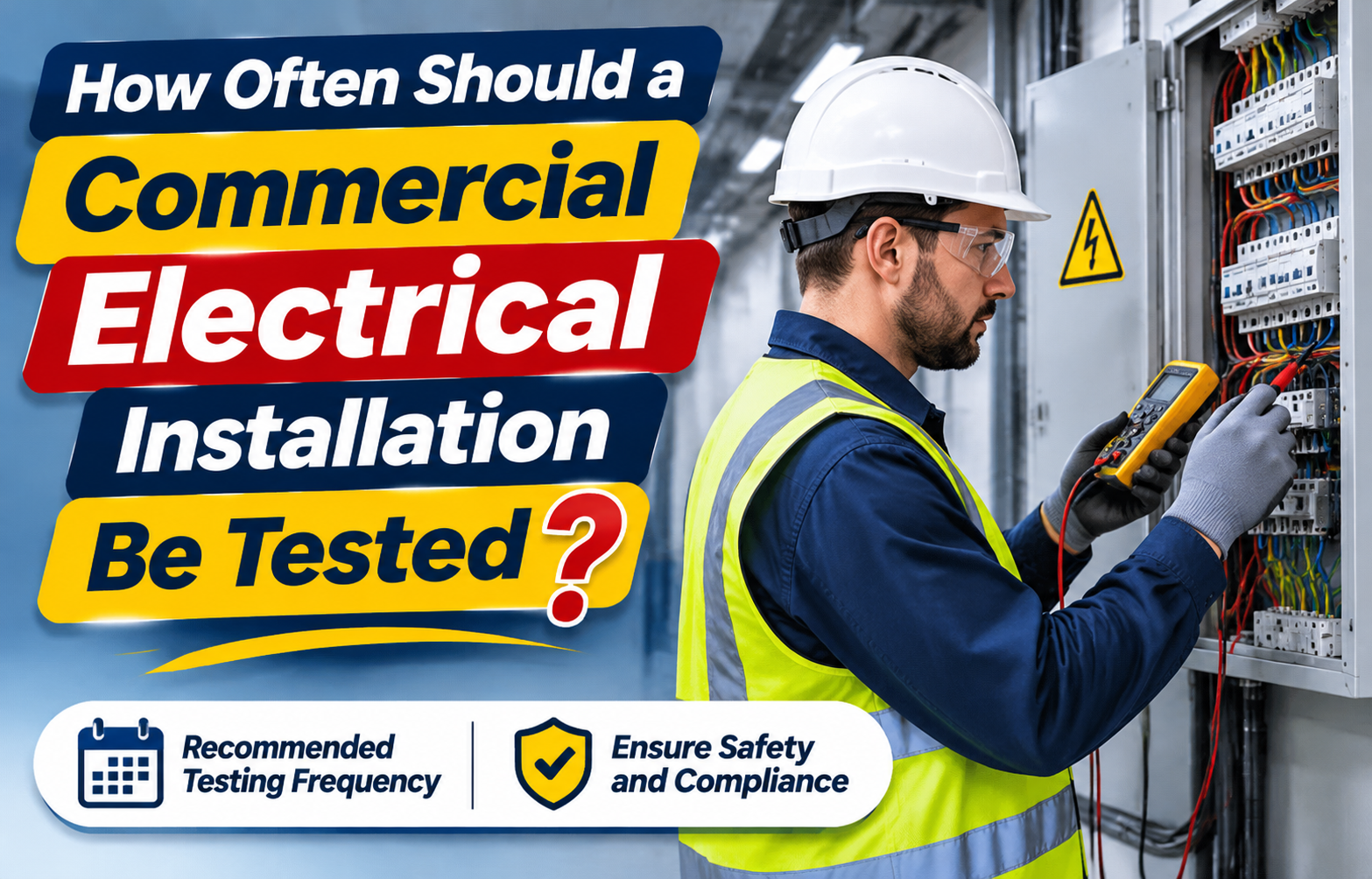 Commercial electrical installations should typically undergo rigorous testing and inspection—commonly referred to as an Electrical Installation Condition Report (EICR) or fixed wire testing—every 3 to 5 years. While a multi-year cycle is widely adopted across standard business environments, the exact testing frequency varies based on property type, operational load, and environmental wear.
The General 3-to-5-Year Benchmark for Commercial Spaces
Establishing a predictable testing schedule is essential for maintaining statutory compliance, ensuring employee safety, and protecting commercial property insurance policies. Different sectors experience distinct levels of electrical stress, which dictates their inspection intervals.
- Standard Commercial Properties: Offices, retail shops, and educational facilities generally require full electrical testing every 5 years under normal operating conditions.
- Industrial & High-Use Facilities: Warehouses, manufacturing plants, and commercial workshops typically mandate inspection every 3 years due to heavy electrical loads and machinery vibration.
- Routine Intermediate Checks: Formal periodic inspections are paired with routine visual checks performed by facility managers every 6 to 12 months to catch early signs of degradation.
Why There Is No One-Size-Fits-All Statutory Deadline
A widespread misconception in property management is the fixed five-year rule, which mistakenly assumes every commercial building automatically complies by testing every five years. Regulatory frameworks and electrical wiring standards emphasize risk-based evaluations rather than generic calendar intervals.
- Environmental Risk Factors: Facilities exposed to moisture, high ambient temperatures, excessive dust, or corrosive chemicals require shortened inspection cycles to prevent catastrophic failure.
- Change of Tenancy or Ownership: Whenever a commercial building changes occupants or undergoes significant interior restructuring, an immediate installation check is critical to verify safety for new staff.
- Competent Person Assessment: The final testing frequency must be validated and documented by a qualified electrical contractor based on the physical condition of the installation during the initial site assessment.
Commercial Electrical Testing Frequency by Property Type
Determining the correct inspection schedule depends entirely on the operational environment of the facility. Different property classifications face unique wear factors, requiring customized testing frequencies to maintain legal safety compliance.
Standard Commercial Premises (Offices, Retail Stores, Schools, & Restaurants: Every 5 Years)
Standard commercial properties such as offices, retail shops, and educational institutions require full electrical testing every five years. This baseline interval accommodates moderate wear and tear under controlled indoor conditions.
- Office Electrical Testing Focus: Routine evaluation of ring final circuits, plug socket distribution, and emergency escape lighting systems.
- Operational Continuity: Structured testing schedules prevent sudden electrical faults during peak business operating hours.
- Visual Interims: Facility teams should execute visual safety walkthroughs every 6 to 12 months between formal full-scale inspections.
Industrial and High-Risk Environments (Warehouses, Factories, Petrol Stations, & Medical Facilities: Every 1 to 3 Years)
Industrial sites and specialized high-risk environments demand accelerated testing schedules ranging from one to three years due to severe operating stressors like moisture, dust, and heavy electrical current loads.
- Industrial EICR Schedule: Manufacturing plants and distribution warehouses require testing every three years to handle intense machinery vibrations and continuous electrical draw.
- High-Risk Commercial Inspection Intervals: Hazardous locations like fuel stations, chemical storage facilities, and medical treatment rooms mandate annual inspections to eliminate spark and shock risks.
- Preventative Maintenance: Shorter inspection windows catch thermal degradation and insulation breakdown before catastrophic operational failure occurs.
Temporary and Specialized Spaces (Construction Sites and Emergency Lighting)
Temporary installations and life-safety systems operate under extreme environmental strain, necessitating highly frequent monitoring and aggressive testing protocols to safeguard workers.
- Construction Site Electrical Testing: Due to harsh outdoor conditions and mobile equipment handling, temporary site distributions require testing every 3 months.
- Emergency Lighting Protocols: Emergency escape routes and backup power packs require monthly functional tests alongside annual three-hour battery discharge assessments.
- Compliance Tracking: Maintaining dedicated inspection logs for specialized spaces satisfies local building authority mandates and insurer requirements.
Regulatory Standards and 2026 Compliance Updates
Modern electrical compliance has evolved far beyond passive adherence to rigid calendar dates. Facility managers must align facility safety frameworks with rigorous international benchmarks to satisfy statutory electrical safety legislation and insurance underwriting mandates.
Understanding BS 7671 and IET Wiring Regulations
Compliance begins with adhering to BS 7671, the national standard for electrical installations and widely recognized across global industrial frameworks. These rules outline strict installation parameters and periodic inspection obligations for commercial spaces. You can review detailed testing requirements through resources like the Bes Group EICR compliance guide to ensure proper facility classification.
- Statutory Duty of Care: Business operators carry legal accountability under safety legislation to maintain safe working environments free from electrical shock and fire hazards.
- Design and Verification: Every commercial electrical installation must be designed, erected, and verified by competent persons holding recognized qualification standards.
- Periodic Reporting: Formal inspection findings are recorded in an Electrical Installation Condition Report (EICR) detailing any observed deficiencies or non-compliance codes.
The 2026 Shift Toward Proactive Electrical Maintenance Programs (NFPA 70B)
The 2026 regulatory landscape has introduced a decisive shift toward proactive management. NFPA 70B guidelines now emphasize comprehensive, written Electrical Maintenance Programs (EMPs) rather than relying exclusively on periodic calendar testing intervals.
- Condition-Based Management: EMP frameworks prioritize equipment criticality, environmental severity, and historical operational data to dictate specialized service schedules.
- Predictive Diagnostics: Standard maintenance protocols increasingly integrate advanced thermal imaging, power quality analysis, and continuous monitoring alongside traditional physical testing.
- Documentation and Audit Trails: Maintaining thorough, digital logs of all maintenance actions ensures seamless compliance during insurance reviews and municipal safety audits.
What Are the 7 Mandatory Tests Performed During a Commercial Electrical Inspection?
Conducting a thorough commercial electrical inspection involves a series of rigorous diagnostic evaluations to verify safety and regulatory compliance. Certified technicians execute seven core statutory tests to detect hidden wiring flaws, insulation degradation, and earth fault risks before they cause equipment failure or electrical shock.
1. Continuity Testing of Protective Conductors
Continuity testing verifies that all circuit protective conductors, including main earthing and supplementary bonding leads, are unbroken and maintain a low electrical resistance path back to the distribution board. This ensures fault currents can flow safely without triggering dangerous touch voltages across metallic installations.
- Main Bonding Verification: Confirms that incoming water, gas, and structural metal services are securely connected to the main earthing terminal.
- Circuit Integrity: Ensures ring final circuit protective conductors have no breaks or high-resistance joints.
- Low Resistance Measurement: Validates that resistance values fall well within statutory thresholds for rapid circuit protection.
2. Insulation Resistance Testing
Insulation resistance testing measures the integrity of the dielectric barrier surrounding live electrical conductors. By applying an elevated direct current test voltage, electricians verify that no current leakage occurs between live cores and earth, actively preventing short circuits and electrical fires.
- Dielectric Stressing: Utilizes high-voltage testers to expose micro-cracks or moisture contamination in cable insulation.
- Leakage Prevention: Ensures that current flow between conductors remains near zero under normal operating conditions.
- Circuit Protection: Safeguards sensitive electronic equipment by temporarily disconnecting vulnerable components prior to testing.
3. Polarity Testing
Polarity testing ensures that all single-pole protective devices, switches, and socket outlets are correctly wired to the live conductor rather than the neutral or earth. Correct polarity prevents exposed appliance parts from remaining energized when a local switch is turned off.
- Switchgear Alignment: Confirms fuses and circuit breakers interrupt the live supply conductor.
- Socket Verification: Checks that phase, neutral, and earth terminals match standardized wiring configurations.
- User Protection: Eliminates hidden shock hazards caused by reversed phase and neutral connections.
4. Earth Fault Loop Impedance Testing
Earth fault loop impedance testing calculates the total resistance of the fault current path during a live-to-earth short circuit. This confirms that upstream circuit breakers or fuses will automatically disconnect the power supply within specified safety timeframes during a fault condition.
- Impedance Calculation: Measures total loop resistance including the transformer, line conductor, and protective earth path.
- Disconnection Time Validation: Ensures fault clearance occurs rapidly enough to prevent severe thermal damage or electrocution.
- Maximum Zs Limits: Compares measured values against regulatory maximum tables for specific protective device ratings.
5. RCD (Residual Current Device) Operation Testing
Residual Current Device (RCD) testing evaluates the speed and sensitivity at which safety switches disconnect power when a current imbalance is detected. Simulated fault currents ensure the device cuts off electricity rapidly to protect personnel from fatal electric shocks.
- Trip Time Evaluation: Measures how quickly the device responds to rated residual currents (e.g., within 30 milliseconds).
- Multi-Factor Testing: Tests RCD operation at both zero-degree and 180-degree current wave cycles.
- Life-Safety Assurance: Confirms fault protection mechanisms function flawlessly across high-risk commercial circuits.
6. Functional Testing of Switchgear and Controlgear
Functional testing confirms that all circuit breakers, isolators, interlocks, and control panels operate correctly under physical manipulation. Electricians manually verify that mechanical switches cleanly break circuits and automatic safety cutoffs engage precisely as engineered.
- Mechanical Operation: Ensures moving parts do not bind, stick, or suffer from corrosion-related movement restrictions.
- Interlock Verification: Confirms safety access doors cannot be opened while electrical busbars remain live.
- Control Circuit Integrity: Tests emergency stop buttons, contactors, and automatic transfer switches under operational loads.
7. Earth Electrode Resistance Testing
Earth electrode resistance testing measures the electrical effectiveness of physical earth rods or plates driven into the soil. This test ensures a low-impedance path to the general mass of earth for installations utilizing independent earthing arrangements.
- Soil Resistivity Evaluation: Assesses how efficiently earth current dissipates into the surrounding ground structure.
- Rod Integrity Checks: Identifies corrosion or physical separation of buried copper earth electrodes.
- System Stability: Guarantees stable reference voltage potentials for lightning protection and specialized industrial feeds.
Key Factors That Shorten or Alter Commercial Testing Intervals
Standard calendar intervals serve as a baseline, but specific operational conditions, environmental hazards, and facility changes can drastically shorten the safe window between electrical inspections. Evaluating these real-world risk variables protects commercial assets, prevents unexpected downtime, and ensures continuous regulatory compliance.
Environmental Hazards (Moisture, Dust, Heat, and Corrosive Elements)
Severe environmental hazards accelerate electrical wear and tear by degrading insulation integrity, corroding metallic connections, and trapping moisture inside distribution boards. Facilities operating in harsh conditions require significantly compressed testing cycles to prevent sudden equipment short circuits and electrical fires.
- Moisture & Humidity: High-humidity settings, food processing plants, or areas prone to water ingress invite insulation breakdown and ground faults.
- Dust & Airborne Contaminants: Heavy industrial dust accumulation acts as a thermal blanket, causing electrical components and transformers to overheat.
- Corrosive Atmospheres: Chemical processing, manufacturing, or marine environments rapidly corrode exposed terminal screws and protective earth paths.
Heavy Machinery Loads and High-Frequency Use
Heavy industrial machinery loads and continuous high-frequency operations generate immense thermal and mechanical stress on internal electrical wiring. Managing these dynamic electrical demands requires frequent monitoring of circuit breakers, busbars, and high-draw panels to mitigate premature infrastructure failure.
- Thermal Cycling: Continuous heavy current draws cause conductors to expand and contract, gradually loosening mechanical screw connections over time.
- Harmonic Distortion: Non-linear loads from variable frequency drives and digital equipment create excessive neutral current and damaging harmonic heating.
- Vibration Stress: Heavy plant machinery vibrations can fracture rigid conduit mounts, strain cable trays, and weaken internal panel terminations.
Change of Tenancy, Ownership, or Major Facility Renovations
Commercial tenancy changes and major facility renovations alter building occupancy profiles and electrical load demands, necessitating an immediate installation inspection. Verifying wiring integrity before new occupants move in prevents liability issues and uncovers legacy code violations left by previous operators.
- Occupancy Transition: A commercial tenancy change resets safety verification responsibilities to ensure the system safely supports incoming operations.
- Structural Remodeling: Wall alterations, sub-panel additions, or comprehensive rewiring projects demand rigorous post-construction verification testing.
- Insurance Mandates: Commercial property underwriters frequently require an up-to-date EICR whenever a building changes ownership or lease agreements.
Commercial EICR Costs, Duration, and Pre-Inspection Checklist
Commercial EICR pricing and project duration vary significantly based on property square footage, the total number of distribution boards, and overall circuit density. Facility managers can streamline the inspection process and eliminate costly operational downtime by understanding pricing variables and preparing the facility in advance.
How Much Does a Commercial Electrical Test Cost?
Commercial electrical inspection pricing typically ranges from $500 for compact retail units up to several thousand dollars for large industrial manufacturing complexes. Contractors usually calculate final quotes based on the total number of circuits, distribution boards, or a flat square footage rate rather than a single universal fee.
- Pricing Structures: Most electrical testing firms charge per circuit or per distribution board to accurately reflect the labor required.
- Property Scale Factors: Small offices and single-story retail spaces require minimal labor, whereas multi-tenant buildings demand extensive diagnostic surveys.
- Remedial Work Separations: Initial EICR survey fees cover testing and reporting only; any repair work needed to fix failed circuits is billed separately.
How Long Does a Commercial EICR Take?
Commercial electrical testing duration spans anywhere from a single day for small offices to over a week for extensive industrial plants. Comprehensive testing requires temporary power interruptions, making it necessary to schedule inspections during off-peak hours or weekends to protect business continuity.
- Testing Timeline Factors: Duration depends directly on circuit complexity, building size, and accessibility of electrical enclosures.
- Minimizing Disruption: Phased testing schedules prevent major operational downtime for active commercial businesses and staff.
- Documentation Delivery: Certified electrical testing contractors typically process and deliver the official EICR certificate within 3 to 5 business days.
Pre-Inspection Checklist for Facility Managers: Avoiding Codes C1, C2, and C3
Preparing your commercial property for an EICR prevents failed safety audits and eliminates dangerous observation codes. A structured facility manager checklist ensures all distribution boards, protective devices, and earth bonding connections are fully accessible and compliant before the testing technician arrives on-site.
- Code C1 (Danger Present): Immediate risk of injury; exposed live internal wiring or broken casing must be fixed before testing starts.
- Code C2 (Potentially Dangerous): Urgent remedial action required; covers missing RCD protection or deteriorated insulation barriers.
- Code C3 (Improvement Recommended): Non-compliance with modern standards but not immediately dangerous, such as outdated circuit labeling.
- Access Preparation: Clear all physical obstructions blocking distribution boards, switchgear rooms, and fixed machinery isolation switches.

Oscar Vance | Master Plumber & Drainage Expert
Meet Oscar Vance, a licensed master plumber sharing practical solutions on residential repairs, preventive maintenance, and thoughtful home upkeep.