Emergency Triage & Immediate Safety Protocol
 Water discharging from an electrical conduit directly into a breaker panel or junction box requires immediate intervention to mitigate severe safety hazards. Water contacting energised bus bars creates a direct risk of arc flash explosion, catastrophic short-circuiting, and fatal electric shock. Prioritise personal safety and system isolation before attempting any physical inspections or repairs.
Step 1: Shut Off Main Power Before Touching Wet Equipment
Never touch an electrical panel, conduit pipe, or surrounding enclosure while standing in water or when active moisture is visible on live components. Isolate power at the primary upstream breaker or request an emergency disconnect from your utility provider if the main panel itself is inundated.
- Assess Standing Water: If water has accumulated on the floor in front of the main service panel, do not step into the pool to reach the disconnect handle. Use a dry wooden or non-conductive fiberglass hook if available, or call an electrician.
- Equip Personal Protective Equipment (PPE): Wear rubber-soled safety boots and dry dielectric gloves before approaching the service equipment.
- Switch off Main Breaker: Firmly throw the main service disconnect switch to the “OFF” position. Stand to the side of the panel rather than directly in front of it to protect yourself from potential arc flash hazards during switching.
Step 2: Immediate Water Mitigation & Temporary Containment
Once electrical isolation is confirmed with a calibrated non-contact voltage tester, act quickly to divert incoming water away from internal circuit breakers and sensitive electronic controls.
- Form a Temporary Drip Loop: If water is running down the exterior of the incoming conduit, wrap clean absorbent cloth around the pipe standard distance above the enclosure, directing runoff into a bucket to create an exterior drip point.
- Divert Internal Ingress: Place heavy-duty absorbent pads or towels at the bottom of the enclosure cabinet to soak up pooling liquid. Keep moisture clear of the main breaker lugs and neutral bus bars.
- Do Not Spray Sealants Over Wet Equipment: Never apply aerosol foams, silicones, or putty directly into an active, pressurized stream of water or onto wet live bus bars. Dry all surfaces completely before attempting any sealing procedure.
Step 3: Assessing the Source: Active Groundwater Leak vs. Atmospheric Condensation
Determining whether moisture enters through hydrostatic ground pressure or thermal airflow is essential for selecting the correct long-term repair method.
- Active Groundwater Ingress: Characterised by a steady, continuous stream or steady dripping during rainstorms or elevated water tables. Water typically carries dirt, silt, or rust particles through underground raceways.
- Atmospheric Condensation: Characterised by fine droplets forming uniformly on internal pipe walls or cable jackets, often worsening during seasonal temperature changes. Moist air drawn from warm environments condenses upon contacting cold subterranean conduit runs (the stack effect).
- Diagnostic Action: Clean and dry the interior conduit entry point using dry rags. Observe the rate of moisture return: rapid accumulation indicates a pressurized external leak, whereas slow, fog-like moisture accumulation points to atmospheric condensation.
Why Water Enters Electrical Conduit (Root Cause Diagnosis)
Conduits accumulate water due to environmental temperature differentials, surface tension vulnerabilities, or subterranean pressure. Identifying the exact vector of moisture ingress—whether from thermal condensation, faulty exterior penetrations, or underground pipe compromises—is critical to selecting a permanent remediation strategy.
The Stack Effect: How Warm Air & Cold Underground Pipes Create Condensation
The stack effect draws warm, humid indoor air into underground conduit runs where cold subterranean temperatures cause moisture to condense rapidly. As air temperature drops below the dew point inside the pipe, water droplets form directly on wire insulation and accumulate within lower junction boxes.
- Thermal Bridging Mechanics: Air pressure differentials within multi-level structures pull ambient air through raceways like a chimney, feeding continuous humidity into cold zones.
- Dew Point Thresholds: When warm moist air meets the cold interior wall of an underground PVC conduit, relative humidity spikes to 100%, forcing liquid water to precipitate onto conductors.
- Hidden Accumulation: Unlike active leaks, condensation creates no surface mud, making it difficult to trace until water pools inside an electrical panel.
Outdoor Penetration Failures: Missing Drip Loops & Degrading Exterior Wall Seals
Exterior wall penetrations frequently fail because running water follows surface tension down the conduit directly into building entry points. Without an intentional drip loop or sealed masonry sleeve, rainwater travels along the exterior wall and enters electrical fittings unchecked.
- Surface Tension Dynamics: Rainwater flowing down outdoor walls adheres to the outer skin of PVC or rigid metal conduit, following gravity straight into poorly sealed wall entries.
- Degraded Caulking: Standard exterior sealants break down under ultraviolet (UV) radiation and thermal expansion, creating microscopic gaps where moisture seeps behind enclosures.
- Missing Drip Loops: Failing to curve exterior cabling downward before entry eliminates the natural gravitational drainage point that forces water away from the fitting.
Underground Trench Issues: Water Tables, Unsealed PVC Fittings, and Pipe Damage
Underground PVC conduit runs often flood due to high groundwater tables, cracked pipe joints, or unglued fittings in subterranean trenches. When soil saturates after heavy rainfall, hydrostatic pressure forces groundwater through minor micro-cracks or unsealed glued joints.
- Hydrostatic Head Pressure: Saturated soils exert immense upward and lateral pressure against underground conduits, driving moisture through any compromised seal or hairline fracture.
- Incomplete Solvent Welding: Skipping primer or failing to fully seat PVC conduit sections during installation leaves vulnerable joints that leak under standing water conditions.
- Ground Settling & Expansion Joints: Uncompacted trench backfill can cause underground pipes to sag or stress expansion joints, creating direct pathways for subterranean water flooding.
Choosing the Right Conduit Sealant: Product Comparison Matrix
Selecting an approved sealant is critical to ensuring code compliance, preventing moisture ingress, and protecting wire insulation. The National Electrical Code (NEC) requires sealants used in raceways to be specifically identified for use with cable insulation, shielding, and conductor jacket materials to prevent physical and chemical degradation.
Approved Electrical Sealants vs. Hazardous DIY Materials
Electrical applications require specialized sealants that remain stable, do not degrade conductor jackets, and withstand environmental exposure or hydrostatic pressure. Standard household caulks and foams frequently fail or actively damage electrical infrastructure.
Why Standard 1-Part Spray Foam & Acetic Silicone Should Never Be Used
Using improper DIY materials inside or around electrical raceways creates long-term structural hazards and violates local electrical codes. The chemical composition and curing mechanics of standard hardware store caulks and aerosol foams make them unsuitable for electrical applications.
- 1-Part Aerosol Spray Foam Failure: One-component expanding polyurethane foams require atmospheric humidity and free air movement to cure. Inside a enclosed conduit, the foam forms an outer crust while remaining an uncured, sticky liquid state internally, which absorbs water, traps condensation, and causes rapid insulation degradation.
- Acetic Acid Corrosion from RTV Silicone: Standard Room-Temperature Vulcanizing (RTV) silicones cure via acetoxy chemistry, releasing acetic acid fumes during the curing process. When applied near conductors or enclosures, these acidic vapors aggressively corrode copper bus bars, brass terminals, and galvanized steel raceways.
- Chemical Compatibility with Wire Jackets: Approved electrical compounds, such as duct seal putty or 2-part engineered closed-cell polyurethane foams, are chemically inert when in contact with THHN, THWN-2, and XHHW-2 insulation, ensuring the physical integrity of the wire jacket remains intact.
How to Seal the Inside of an Electrical Conduit (Step-by-Step)
Sealing the interior of an electrical conduit requires specific methods depending on whether you are blocking low-pressure indoor drafts or high-pressure underground water entry. Proper preparation, including conductor separation and thorough wire cleaning, ensures a durable, code-compliant seal that protects your electrical system from moisture degradation.
Method 1: Applying Duct Seal Putty for Standard Low-Pressure Interior Seals
Duct seal putty provides an immediate, non-hardening, and easily removable barrier ideal for standard indoor low-pressure conduit entries. To create an effective moisture block, you must carefully separate the individual conductors and pack the putty to a depth equal to the inside diameter of the pipe.
- Conductor Separation: Separate individual wires inside the conduit opening so the putty completely surrounds each conductor rather than bridging across them in a clump, preventing hidden air channels.
- Wire Jacket Cleaning: Wipe down all cable jackets with a clean dry rag to remove oil, dust, or residual moisture that prevents the clay-like putty from adhering securely to the insulation.
- Packing Depth: Press the duct seal firmly into the conduit opening until the packing depth equals or exceeds the internal diameter of the pipe to maintain structural stability.
Method 2: Injecting 2-Part Closed-Cell Expanding Foam for High-Pressure / Underground Runs
Two-part closed-cell expanding polyurethane foam creates a permanent, gas-tight, and highly durable waterproof seal for subterranean or high hydrostatic pressure runs. This engineered chemical system expands uniformly to lock out water head pressure without compromising sensitive electrical wire jackets.
- Preparation & Mixing: Attach the proper static mixing nozzle to the two-part foam dispensing gun, ensuring the chemical components mix thoroughly for proper curing inside enclosed spaces.
- Controlled Injection: Inject the expanding closed-cell polyurethane foam slowly from the back of the packing cavity forward, allowing the mixture to encapsulate every conductor bundle evenly.
- Hydrostatic Pressure Rating: Allow the foam to fully cure according to manufacturer specifications to achieve its designated hydrostatic pressure rating before exposing the underground conduit to active groundwater.
Method 3: Installing Mechanical Duct Plugs for Heavy Cable Bundles
Mechanical duct plugs provide a robust, re-enterable sealing solution designed for complex or heavy cable bundles running through large utility conduits. These modular mechanical seals compress against the inner pipe wall and cable jackets using torque-controlled pressure plates.
- Sizing & Component Fit: Measure the precise inner diameter of the conduit and the outer diameter of your cable bundles to select the correct split-disc insert sizing.
- Insert Assembly: Position the rubber sealing modules evenly around each conductor, sliding the modular assembly into the conduit opening to the manufacturer-specified insertion depth.
- Torque Tightening: Gradually tighten the compression bolts in a balanced, crisscross pattern to expand the rubber core uniformly against the pipe wall and cable jackets.
How to Seal External Conduit Connections, Threads, and Wall Penetrations
Preventing water from entering an electrical system requires sealing exterior raceway fittings, threaded metal joints, and structural wall penetrations. Addressing external surfaces and connection points creates an uninterrupted watertight barrier that keeps driving rain and surface runoff from penetrating building interiors or outdoor electrical enclosures.
Sealing Threaded Metal & PVC Exterior Fittings (Thread Paste vs. Teflon Tape)
Threaded connections on rigid metal conduit (RMC) and PVC male adapters require specialized thread sealants to prevent moisture from seeping through spiral fitting tracks. While both thread paste and Teflon tape provide lubrication during assembly, electrically approved thread paste offers superior long-term waterproofing against standing water pressure.
- Thread Paste Performance: Apply electrical-grade thread sealant (pipe joint compound) to male threads before assembly. The paste fills microscopic surface gaps completely, forming a continuous chemical seal that remains flexible and vibration-resistant over time.
- Teflon Tape Limitations: Standard PTFE Teflon tape can bundle or shred when threaded into sharp rigid metal conduit or PVC fittings, creating micro-channels where water seeps through under heavy rain or temperature cycling.
- Application Technique: Clean all grease and dirt off the threads. Apply paste starting two threads back from the end of the fitting to prevent excess compound from entering the interior path of the conduit where it could contact wire insulation.
Exterior Wall Penetrations: Sealing the Gap Between Masonry/Siding and Conduit
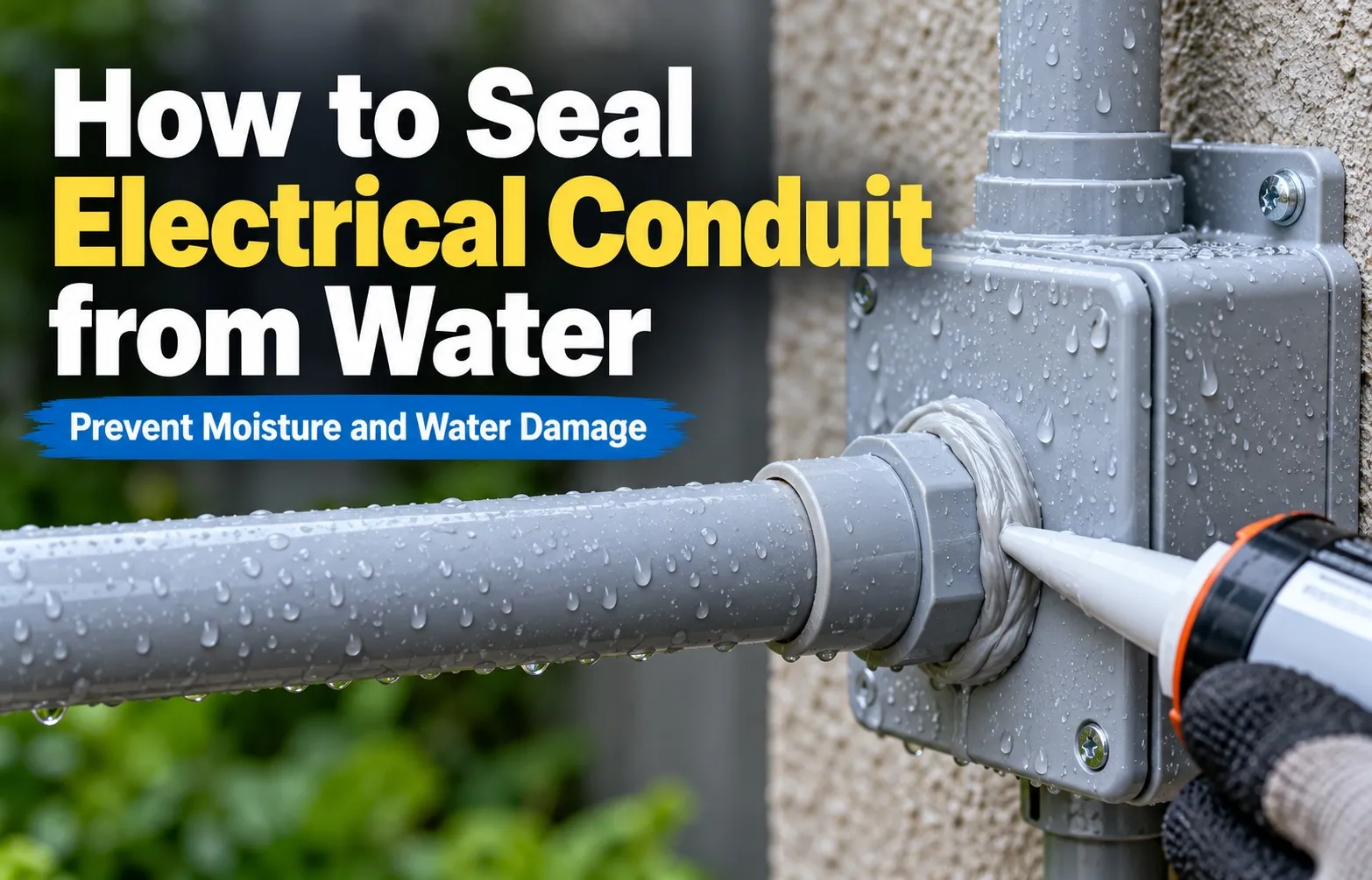
The exterior gap between a conduit pipe and surrounding masonry, stucco, or siding is a primary path for rainwater to enter building walls. Sealing this annular space requires a neutral-cure elastomeric caulk that accommodates building movement and thermal expansion without cracking.
- Neutral-Cure Exterior Masonry Caulk: Use alkoxy-cure neutral-cure silicone or polyurethane masonry sealants around exterior wall penetrations. Avoid standard acetic-cure silicones, which release acidic vapors that degrade surrounding concrete, brick mortar, and metal pipe surfaces.
- Backer Rod Insertion: For annular gaps deeper or wider than 1/2 inch, insert a closed-cell foam backer rod into the wall cavity first. This creates a solid backing, ensuring the sealant adheres properly to both the conduit outer wall and the building surface.
- Tooling a Smooth Shedding Joint: Tool the applied caulk into a smooth, downward-sloped bead away from the conduit top to ensure driving rain flows off the joint rather than pooling against the wall.
Using Gasketed Watertight Hubs and O-Rings at Enclosure Entries
Standard locknuts do not form a watertight joint when terminating conduit runs into top or side knockouts of outdoor electrical boxes or NEMA 3R/4 enclosures. Utilizing gasketed watertight conduit hubs with integrated rubber O-rings prevents water from leaking into live electrical equipment.
- Integrated Rubber O-Rings: Watertight conduit hubs feature an integrated neoprene or nitrile rubber O-ring seated inside a machined groove. When tightened against the exterior enclosure wall, the rubber compresses to form a positive, weather-tight face seal.
- Rain-Tight Locknut Engagement: Secure the hub from inside the enclosure cabinet using the specialized insulated locknut provided, ensuring firm compression on the exterior O-ring without over-tightening and pinching the rubber seal.
- Orientation Precautions: Whenever possible, enter outdoor enclosures through the bottom. If top or side entry is unavoidable, using an approved watertight hub rather than a standard locknut is mandatory to meet electrical safety codes.
Electrical Code & Cable Selection (Addressing PAA & PAA Intent Gaps)
Navigating the National Electrical Code (NEC) ensures your installation remains inspection-ready, safe, and legally compliant. Choosing the correct wire type and sealing method prevents insulation breakdown and catastrophic faults caused by moisture accumulation in raceways.
NEC Code Requirements for Sealing Underground & Raceway Transitions (NEC 300.5(G) & NEC 225.27)
The National Electrical Code sets strict mandates regarding how raceways transitioning between outdoor, underground, and indoor environments must be sealed against moisture, condensation, and gas infiltration.
- NEC Section 300.5(G): Requires underground conduits entering a building or structure to be sealed at an accessible point to prevent moisture and gases from entering the conditioned interior space.
- NEC Section 225.27: Governs raceway seals for outdoor overhead and underground feeder runs, mandating approved compounds that remain secure under temperature fluctuations and hydrostatic pressure.
- Official Code Reference: Consult the National Electrical Code (NEC) guidelines for complete regulatory compliance requirements and localized amendments.
Can You Run Romex (NM-B) Cable Underground or Outside in Conduit?
Running indoor Romex (NM-B) cable inside an underground or outdoor conduit is a frequent mistake that violates electrical codes and leads to premature cable failure due to moisture exposure.
- Moisture Absorption Vulnerability: NM-B cable features inner paper filler and an outer sheath that is strictly rated for dry locations. Condensation inside a conduit saturates the paper, rotting the jacket and exposing copper conductors.
- Code Violations (NEC 300.5 & 334.10): Romex is prohibited in wet locations. Placing it in an outdoor or underground raceway violates code because underground conduits are legally classified as wet locations.
- Long-Term Fire Hazards: Trapped water inside the pipe causes copper conductors to oxidize and short-circuit over time, creating a severe electrical fire risk behind walls and inside panels.
What Is the Best Wire to Run Underground Inside a Sealed Conduit?
Selecting individual conductors rated specifically for wet locations ensures long-term reliability and compliance when pulling wires through underground raceways.
- THHN/THWN-2 Conductors: Single or stranded copper wires featuring a dual THHN/THWN-2 rating are engineered for both dry and wet locations up to 90°C, making them the gold standard for conduit runs.
- UF-B Cable Options: Underground Feeder (UF-B) cable is sunlight-resistant and rated for direct burial. If pulled inside a conduit, the raceway must still be sealed at both ends to prevent moisture buildup.
- Conduit Fill Compliance: Always calculate conduit fill percentages according to NEC Chapter 9 tables to ensure wire pulling does not damage insulation or leave insufficient space for proper sealant application.
Frequently Asked Questions
Common questions regarding electrical conduit sealing, code compliance, and proper material selection ensure safe, reliable, and inspection-ready installations across residential and commercial applications.
Does electrical conduit need to be sealed by code?
Yes, the National Electrical Code (NEC) explicitly mandates sealing underground raceways and conduits where they transition from subterranean or exterior environments into buildings or conditioned spaces to prevent the migration of moisture, gases, and water vapor into electrical enclosures.
- Regulatory Enforcement: Code compliance under NEC Section 300.5(G) protects indoor breaker panels from damp environments and subterranean water pressure.
- Gas & Vapor Control: Sealing prevents dangerous subterranean gases from traveling through raceway pipes into living spaces.
What happens if water gets inside an electrical conduit?
Water accumulation inside an electrical conduit accelerates wire degradation, corrodes copper conductors and metal terminals, compromises insulation integrity, and dramatically increases the risk of catastrophic short-circuits or dangerous arc flash explosions when contacting energized components.
- Insulation Breakdown: Trapped moisture rots wire jackets and breaks down dielectric properties over time.
- Terminal Corrosion: Standing water causes metal oxidation on bus bars and circuit breaker lugs, leading to high-resistance connections and overheating.
Can I use standard silicone caulk to seal electrical conduit?
No, standard acetic-cure RTV silicone caulk should never be used inside or directly around electrical conduits because it releases corrosive acetic acid fumes during curing that aggressively attack copper and galvanized steel, causing severe rust and component failure.
- Neutral-Cure Alternatives: Always select alkoxy-cure neutral silicone when sealing exterior wall gaps to prevent acid corrosion.
- Approved Internal Compounds: Use duct seal putty or 2-part closed-cell polyurethane foam inside pipes rather than household aerosol foams or caulks.
Is it illegal to put Romex inside outdoor conduit?
Yes, running indoor Romex (NM-B) cable inside outdoor or underground conduit violates National Electrical Code regulations because exterior and subterranean raceways are legally classified as wet locations, where Romex is prohibited due to paper jacket rot.
- NM-B Restrictions: Romex inner paper filler absorbs condensation rapidly, destroying the cable assembly and creating fire hazards.
- Proper Wire Selection: Use individual THHN/THWN-2 rated conductors designed specifically for wet raceway environments.

Oscar Vance | Master Plumber & Drainage Expert
Meet Oscar Vance, a licensed master plumber sharing practical solutions on residential repairs, preventive maintenance, and thoughtful home upkeep.