Schedule 40 vs Schedule 80 Electrical Conduit
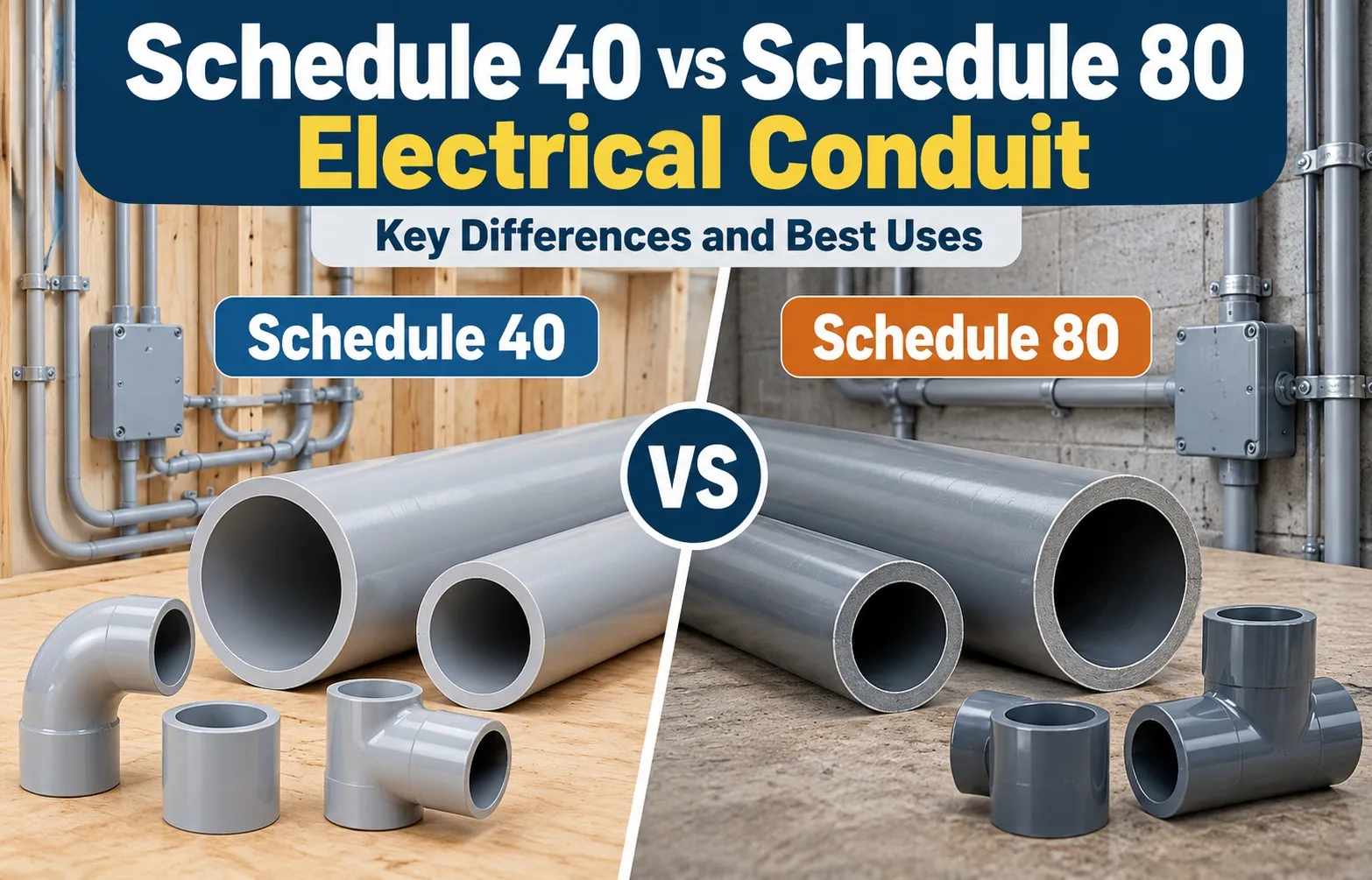 Schedule 40 and Schedule 80 PVC electrical conduits share identical outside diameters (OD) and accept the same standard fittings, but they differ significantly in wall thickness, internal diameter (ID), structural strength, and total weight. Selecting between them depends on the installation environment, local building codes, and required physical protection.
Schedule 40 vs. Schedule 80 at a Glance
While both conduits are constructed from rigid polyvinyl chloride (PVC) and designed for electrical race applications, their structural profiles dictate where they can be legally and safely installed under National Electrical Code (NEC) guidelines.
- Shared Outside Diameter (OD): A 1-inch Schedule 40 pipe and a 1-inch Schedule 80 pipe measure exactly 1.315 inches on the outside, allowing both types to utilize identical standard PVC couplings, connectors, and solvent cements.
- Divergent Wall Thickness: Schedule 80 features significantly thicker walls to resist crushing, impact, and mechanical stress, whereas Schedule 40 features thinner walls optimized for cost efficiency and standard electrical runs.
- Internal Diameter & Capacity: Because Schedule 80 expands inward to build wall thickness, its inner diameter (ID) is noticeably smaller, directly reducing the available cross-sectional area for conductor wire fill.
- Physical Damage Protection: Schedule 80 is specifically rated for locations exposed to physical damage, such as exterior stub-ups near vehicular traffic or lawn care equipment, whereas Schedule 40 is restricted to concealed, direct-burial, or low-risk areas.
Core Takeaway: Which One Do You Need?
Choose Schedule 40 PVC conduit for standard underground trenching, direct burial, slab pours, and interior concealed walls where physical impact is unlikely. Its thinner walls provide a larger interior area, making wire pulls faster and more efficient while keeping material expenses low.
Choose Schedule 80 PVC conduit whenever the installation is exposed to physical damage, such as electrical lines transitioning from underground to above ground along exterior walls, industrial facilities, or driveways. Compliance with NEC Article 352 often mandates Schedule 80 for exposed vertical stub-ups to prevent crushing or puncture hazards.
Physical Specifications & Compatibility
Schedule 40 and Schedule 80 electrical conduits are engineered with identical outside dimensions to ensure full compatibility with standard hardware, but their wall profiles and tensile strength dictate how they interact under physical and thermal stress.
Wall Thickness, OD, and ID Dynamics
Schedule 40 and Schedule 80 pipes share the exact same Outside Diameter (OD) for any given trade size, meaning a 1-inch pipe of either schedule measures precisely 1.315 inches externally. However, Schedule 80 features a thicker wall that encroaches inward, resulting in a noticeably smaller Inner Diameter (ID) and higher tensile strength.
Outside Diameter (OD) Consistency: Because the external dimensions are identical, both schedule types slide into the exact same knockouts, hangers, and standard electrical boxes.
Wall Profile Differences: Schedule 80 sacrifices internal clearance to add structural mass, which increases its crush resistance and durability against heavy physical impacts.
Internal Limitations: The reduced ID of Schedule 80 directly impacts conduit fill calculations, requiring careful review when pulling multiple conductors through long runs.
Can You Mix Schedule 40 and 80 Fittings and Pipes?
Yes, you can seamlessly mix Schedule 40 and Schedule 80 pipes with standard PVC fittings, couplings, and male or female adapters because the matching Outside Diameter ensures a secure, uniform fit inside any standard electrical connector. Installers frequently utilize this compatibility by running cost-effective Schedule 40 underground and transitioning to Schedule 80 above ground where physical damage risks increase.
Universal Fittings: Standard PVC couplings, female adapters, terminal adapters, and elbows accept both Schedule 40 and Schedule 80 pipe bodies without modification.
Transition Efficiency: Contractors can switch schedule types mid-run using standard couplings when local building codes or site conditions shift from protected burial to exposed walls.
Solvent Cement and Joint Integrity Across Schedules
Standard PVC solvent cement creates a chemical weld that bonds Schedule 40 and Schedule 80 pipes and fittings with equal effectiveness, provided surfaces are thoroughly cleaned, primed, and cured according to manufacturer specifications. However, installers must account for thermal expansion and contraction differentials when mixing schedules in exposed outdoor environments.
Chemical Welding: The solvent cement melts the outer layer of the pipe and inner layer of the fitting, fusing them into a single homogenous piece regardless of pipe schedule.
Thermal Stress Management: Exposed outdoor runs subject to extreme temperature swings experience linear expansion; rigid joints between mixed schedules require properly installed expansion joints to prevent cracking or joint pull-apart.
Primer Requirements: Always use an approved purple primer before applying solvent cement to ensure maximum bond strength and compliance with electrical code standards.
Practical Applications & NEC Code Requirements
Selecting the correct PVC schedule is not merely a matter of structural preference; it is a legal requirement governed by strict safety codes. The National Electrical Code dictates where light-duty conduit suffices and where heavy-duty protection is legally mandatory to prevent fires and electrocution hazards.
When Schedule 40 is Permitted (Residential & Underground)
Schedule 40 Rigid Polyvinyl Chloride Conduit (PVC) is approved for direct burial underground, encased in concrete, and installed in concealed indoor areas such as inside stud walls or above drop ceilings. Because these environments shield the conduit from direct impacts, its standard wall thickness fully complies with electrical safety codes.
- Underground Burial: Standard residential utility runs, subpanel feeders, and garden lighting conduit placed in trenches satisfy code requirements using Schedule 40 PVC.
- Concrete Encasement: When poured into concrete slabs or buried below concrete foundations, Schedule 40 provides sufficient strength against the pressure of curing concrete.
- Concealed Indoor Walls: Behind drywall or inside floor joists, Schedule 40 protects conductors while offering maximum interior space for easy wire pulling.
When Schedule 80 is Legally Required (Physical Damage Zones)
Schedule 80 PVC conduit is legally required wherever an electrical run is exposed to physical damage, such as exterior building walls, driveways, parking lots, and industrial equipment zones. The most common residential application is the 8-foot rule: where underground conduit transitions out of the earth and ascends an exterior wall, it must be Schedule 80 up to a minimum height of 8 feet above finished grade.
- Grade-Level Stub-Ups: Exterior transitions are exposed to lawnmowers, weed trimmers, falling debris, and vehicular impact, making Schedule 80 mandatory to prevent cracking.
- Driveway & Parking Crossings: Conduits installed beneath high-traffic vehicular zones or exposed along commercial loading docks require the elevated crush rating of Schedule 80.
- Industrial Workplaces: Anywhere forklift traffic, heavy tools, or moving machinery operate near exposed wiring runs, inspectors require heavy-wall Schedule 80 conduit.
NEC Article 352 & Section 300.5 Demystified
The rules governing rigid nonmetallic conduit are clearly defined across two core sections of the National Electrical Code. National Electrical Code (NEC) Article 352 guidelines classify rigid PVC conduit and specifically mandate Schedule 80 wherever the raceway is subject to physical damage, while explicitly prohibiting Schedule 40 in those high-risk locations.
Complementing this rule, NEC Section 300.5 dictates underground burial depth and protection requirements. While Schedule 40 satisfies standard underground burial depth guidelines (typically 18 inches for residential branch circuits), the moment that underground conduit emerges from the trench to stub up an exterior wall, Section 300.5 requires a transition to Schedule 80 or metallic conduit from the bottom of the trench up to 8 feet above finished grade level.
The Hidden Traps: Wire Fill & Romex Rules
Electrical installations often fail inspection not because of improper burial depth, but due to overlooked code requirements concerning conduit interior dimensions and cable ratings. Understanding wire fill limits and wet-location cable restrictions prevents costly rework and safety violations.
The Inner Diameter Trap: Wire Fill Percentage Calculations
Schedule 80 features a thicker wall that encroaches inward, shrinking the internal cross-sectional area compared to Schedule 40 of the same nominal size. This reduced interior space directly restricts your wire fill limit under National Electrical Code Chapter 9 tables, meaning a multi-wire bundle that fits comfortably in Schedule 40 may violate fill percentage caps in Schedule 80.
- Cross-Sectional Reduction: The smaller ID of Schedule 80 leaves less room for heat dissipation, triggering potential conduit derating rules when bundling multiple current-carrying conductors.
- Trade Size Scaling: Installers frequently must increase the conduit trade size by one step when switching to Schedule 80 to accommodate the same number of THHN/THWN-2 conductors legally.
- NEC Chapter 9 Compliance: Fill calculations must factor in the exact internal diameter of the chosen schedule rather than nominal trade size to avoid failed inspections.
Can You Run Romex (NM-B Cable) Inside PVC Conduit?
Running non-metallic sheathed cable—commonly known as Romex or NM-B cable—inside underground or wet-location PVC conduit violates the National Electrical Code. While homeowners frequently ask whether Romex can be sleeved in outdoor conduit, NM-B cable is strictly rated for dry locations only, whereas the interior of any underground or exterior conduit is legally classified as a wet location.
- Moisture Exposure: Underground conduits inevitably accumulate condensation and moisture, which degrades the paper and plastic jacket of Romex cable over time.
- Proper Conductor Selection: Installers must pull individual single-conductor wires rated for wet conditions—such as THWN-2—through outdoor and underground PVC raceways.
- Code Violation Risks: Using NM-B inside wet-location conduit creates severe short-circuit and fire risks, resulting in automatic inspection failures.
Sleeving vs. Continuous Underground Conduit Runs
Short sections of PVC conduit used purely for mechanical protection where cables emerge from walls or floors are classified as sleeves rather than complete raceway systems. However, even when using PVC strictly for short protective sleeves exposed to weather or dampness, the internal conductors must still meet appropriate damp or wet location ratings.
- Protective Sleeving Rules: Sleeving exterior wall penetrations helps shield cables from physical impacts, but does not exempt the installation from wet-location wiring standards.
- Transition Protection: When transitioning indoor NM-B cable into an outdoor protective sleeve, electricians must terminate the cable in an approved junction box and transition to individual THWN-2 conductors.
- Damp and Wet Location Mandates: Any conduit exposed to weather elements or earth contact requires conductors specifically listed for wet environments to maintain long-term safety and code compliance.
Cost Breakdown & Real-World Decision Guide
Determining whether to use Schedule 40 or Schedule 80 often comes down to balancing material budget constraints against physical risk and electrical code compliance. Electrical communities like Reddit’s r/AskElectricians frequently debate whether Schedule 80 is necessary or overkill for residential projects.
Price Comparison: Schedule 40 vs. Schedule 80
On average, Schedule 80 PVC conduit costs 20% to 50% more per foot than Schedule 40 of the same trade size due to the additional raw materials required for its thicker walls. While this price variance adds up quickly on long underground runs, selecting the right material for specific sections of a run keeps the overall material budget manageable.
- Cost per Foot Variance: For standard 1-inch conduit, Schedule 40 provides significant savings over long distances, making it the preferred choice for extensive trenching.
- Fitting Cost Parity: Standard PVC couplings and adapters fit both schedule types, meaning fitting expenses remain essentially identical regardless of pipe schedule.
- Project-Scale Impact: Using Schedule 80 exclusively on a 150-foot trench increases costs unnecessarily, whereas using it only on exposed stub-ups adds minimal expense to the total project.
Is Schedule 80 Overkill for DIY Residential Projects?
The consensus among licensed contractors and DIY electrical enthusiasts on forums like Reddit is clear: using Schedule 80 for the entirety of an underground run is usually unnecessary overkill, but using Schedule 40 for above-ground exposed stub-ups is a code violation. The smart approach is a hybrid installation that maximizes both safety and cost efficiency.
- Underground Cost Savings: Use Schedule 40 beneath soil, turf, or sand where earth cushions the pipe from impacts, saving 20% to 50% on piping costs.
- Targeted Protection: Transition to Schedule 80 right as the run emerges from the trench using standard female or male terminal adapters to protect against lawn care equipment, weed trimmers, and lawn aeration.
- Code Compliance: Inspectors focus on exposed zones; transitioning to Schedule 80 for grade-level stub-ups satisfies local requirements without inflating your entire material budget.
Contractor Decision Matrix: Where to Spend vs. Where to Save
Evaluating your installation against potential physical hazards helps you determine exactly where to allocate your budget and where lighter-duty materials are sufficient.
Frequently Asked Questions
Clear, direct answers to common questions regarding schedule differences, compatibility, and installation rules help resolve project uncertainty and satisfy search engine snippet intent.
Can you connect Schedule 40 to Schedule 80 conduit?
Yes, you can connect Schedule 40 to Schedule 80 conduit. Because both types share the exact same outside diameter, standard PVC couplings, adapters, and solvent cement work seamlessly across both schedules, allowing you to easily transition from underground runs to above-ground protected stub-ups.
Does Schedule 40 and Schedule 80 have the same outside diameter?
Yes, Schedule 40 and Schedule 80 pipes share the exact same outside diameter for any given trade size. The primary structural difference is that Schedule 80 features a thicker wall that extends inward, resulting in a smaller inside diameter and higher crush strength.
Which PVC is stronger, Schedule 40 or Schedule 80?
Schedule 80 is significantly stronger and offers higher crush resistance and impact durability than Schedule 40. Its thicker wall profile makes it ideal for areas exposed to heavy traffic, physical abuse, or code inspector mandates regarding physical damage protection.
Can I use Schedule 80 PVC for electrical conduit?
Yes, you can use Schedule 80 PVC for electrical conduit. It is fully approved under electrical standards and is frequently required by code inspectors wherever raceways are exposed to physical damage, such as exterior wall transitions and grade-level equipment zones.
How deep do I need to bury Schedule 40 PVC conduit?
Under National Electrical Code requirements, Schedule 40 PVC conduit must typically be buried at least 18 inches deep for standard residential branch circuits under yards or lawns, though specific situations like driveway crossings require greater burial depths.

Oscar Vance | Master Plumber & Drainage Expert
Meet Oscar Vance, a licensed master plumber sharing practical solutions on residential repairs, preventive maintenance, and thoughtful home upkeep.