Offering HVAC Financing: Strategic Overview & Sales Psychology
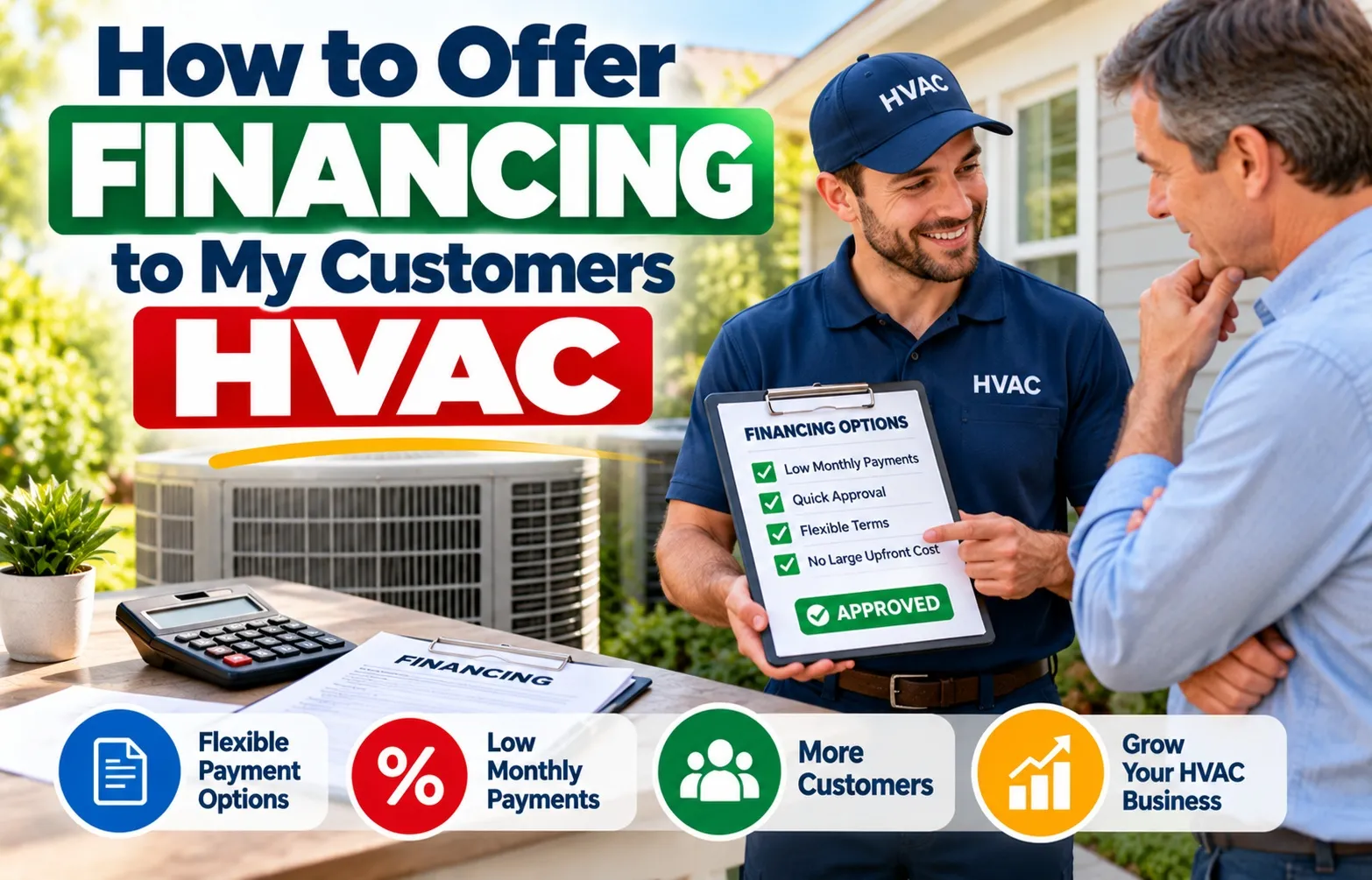 Offering HVAC financing allows contractors to convert high-ticket system replacements into accessible monthly payment plans. Instead of demanding $5,000 to $15,000 upfront, contractors partner with consumer lenders to fund the installation within 24 to 48 hours, while homeowners pay manageable installments over 3 to 10 years.
By shifting the sales presentation from a massive lump-sum cost to predictable monthly options, contractors eliminate price friction, increase average ticket sizes, and boost conversion rates during home sales calls.
How HVAC Financing Works for Contractors
Implementing a customer financing program involves a simple four-step operational workflow that integrates directly into your daily quoting process:
- Provider Onboarding: Partner with a dedicated home-improvement consumer lender (such as Synchrony, Wisetack, or Goodleap) or a multi-lender platform to establish your dealer account.
- Software Integration: Connect the lender’s application portal to your field service management software (like ServiceTitan or Housecall Pro) so technicians can generate application links on mobile devices.
- Upfront Proposal Quotes: Present every repair and replacement proposal with low monthly payment options alongside the total cash price right at the kitchen table.
- Rapid Vendor Funding: Once the customer approves the proposal and completes a soft credit pull on their phone, the lender approves the credit line and disburses the full job amount directly to your business upon project completion.
This structure removes the non-payment risk from your business while ensuring your working capital remains healthy without managing in-house debt collections.
The $5,000 Rule: Turning Replacement Sticker Shock into a $95/Month Solution
The HVAC industry relies heavily on the $5,000 rule as a decision-making benchmark for homeowners: when you multiply the age of the heating or cooling system (in years) by the estimated repair cost (in dollars), any result exceeding $5,000 indicates the unit has reached its replacement threshold and should be replaced rather than repaired.
When faced with a sudden system failure, homeowners experience severe customer sticker shock upon learning that a full replacement costs between $8,000 and $12,000. Presenting financing directly addresses this psychological barrier:
- Reframe the Buying Decision: Presenting a quote as “$95 per month” instead of “$10,000 upfront” shifts the customer’s mental evaluation from a major capital outlay to a standard monthly utility expense.
- Protect Homeowner Savings: Customers maintain their cash reserves for emergency funds rather than liquidating savings or maxing out high-interest personal credit cards.
- Upsell High-Efficiency Units: When the price difference between a standard 14 SEER system and a premium 20 SEER heat pump is only $18 more per month, customers regularly upgrade to higher-efficiency models with better profit margins for the contractor.
Evaluating HVAC Financing Models: Third-Party vs. Manufacturer vs. In-House
Choosing the correct credit structure protects your working capital, maximizes customer approval rates, and shields your business from financial liabilities. HVAC contractors typically select from third-party consumer lenders, manufacturer-backed programs, or direct in-house payment structures.
Third-Party Lenders & Multi-Lender Platforms (Low Risk, Fast Funding)
Third-party consumer lenders and multi-lender platforms provide the safest and most efficient financing route for contractors by completely absorbing default risk and underwriting liabilities. These platforms fund your business directly within 24 to 48 hours while managing all consumer credit collections.
- Risk-Free Transactions: The lender assumes 100% of the credit risk and non-payment risk, ensuring your business receives full payment regardless of customer default issues.
- Multi-Lender Network Advantage: Multi-lender software routes customer applications across multiple financial institutions simultaneously, significantly increasing approval rates for homeowners with varying credit tiers.
- Streamlined Underwriting: Automated digital underwriting approves qualified buyers in seconds via mobile devices right at the kitchen table.
Manufacturer-Sponsored Financing Programs (Carrier, Trane, Goodman, Daikin)
Manufacturer-sponsored financing programs offer exclusive low-interest promotional rates and dealer rebates tied directly to specific equipment brands you install. Major HVAC manufacturers partner with national financial institutions to provide specialized loan packages for authorized dealers.
- Brand-Specific Promotions: Brands like Carrier, Trane, Goodman, and Daikin frequently subsidize low-APR or deferred-interest promotions to help dealers close equipment upgrade sales.
- Co-Op Marketing Support: Manufacturers often provide marketing funds and digital assets to help contractors advertise low monthly payment plans locally.
- Dealer Status Requirements: Accessing these programs typically requires maintaining specific annual equipment purchase volumes or becoming an authorized registered dealer.
In-House Payment Plans: Why Most Small HVAC Contractors Should Avoid Them
In-house financing requires a contractor to extend their own credit directly to clients, creating severe cash flow bottlenecks and high administrative burdens. Most small and mid-sized HVAC businesses should completely avoid this model due to its compounding financial exposure.
- Severe Cash Flow Strain: Carrying customer installment payments freezes your working capital, making it difficult to purchase inventory, pay technicians, or cover daily operational overhead.
- High Non-Payment Risk: Your business assumes full exposure to credit risk, late payments, defaults, and expensive legal collection processes.
- Regulatory Compliance Burdens: Issuing direct credit subjects your business to complex federal and state lending regulations, truth-in-lending laws, and strict consumer data privacy requirements.
Top HVAC Financing Partners & Lender Comparison Matrix
Selecting the right financing partner directly impacts your conversion rates, customer satisfaction, and overall administrative overhead. Contractors must evaluate the structural differences between traditional contractor lending institutions, technology-first point-of-sale platforms, and general consumer Buy Now, Pay Later (BNPL) apps.
Dedicated Contractor Lenders: Synchrony, Wisetack, Goodleap & FTL Finance
Dedicated home-improvement lenders design their loan offerings specifically around trade business workflows, high loan limits, and flexible promotional terms. Choosing the right lender depends on your primary job types and target customer base:
- Synchrony Business: Industry leader offering both revolving credit cards and fixed-rate installment loans. Excellent for brand familiarity, high credit ceilings, and multi-use financing for future maintenance agreements.
- Wisetack Financing: Built for modern mobile workflows with instant mobile pre-approvals. Seamlessly embeds into major field service management software to allow technicians to present financing choices with zero friction.
- Goodleap & Sunlight Financial: Specialized in high-efficiency equipment upgrades, heat pump transitions, and clean-energy home improvements. Ideal for contractors selling premium 18+ SEER systems or bundled solar-HVAC installations.
- FTL Finance: Focuses specifically on consumer credit accessibility, providing dedicated support and flexible underwriting for homeowners who fall outside traditional prime credit boxes.
For more details on structuring your program, consult Ferguson’s contractor financing guidelines.
Modern BNPL Apps (Affirm, Klarna) vs. Specialized Home Improvement Credit
While consumer point-of-sale applications like Affirm financing have gained popularity in retail ecommerce, they present distinct operational limitations when applied to residential HVAC replacements.
Lower Credit
The Financial Math: Navigating Dealer Fees Without Killing Profit Margins
Lender dealer fees ranging from 2% to over 10% can quickly cannibalize an HVAC contractor’s net profit margin if not factored into job pricing. Mastering the financial mechanics of merchant fees ensures you maintain healthy profit margins while successfully offering competitive customer financing options.
Understanding Merchant & Dealer Fees (0% APR Promos vs. Standard Installments)
Dealer fees represent the upfront merchant discount rate that lenders charge contractors to subsidize attractive consumer loan terms. When a homeowner receives 0% APR promotional financing or deferred interest, the lender recovers their cost of capital by deducting a fee directly from the contractor’s payout.
- 0% APR Promotional Financing: Carries the highest dealer fees (often 6% to 12%+) because the lender receives zero interest payments from the consumer over the 12 to 24-month promotional window.
- Standard Installment Loans: Feature lower or zero dealer fees (ranging from 1% to 4%) because the consumer pays a low fixed annual percentage rate (APR) over a 3 to 10-year repayment term.
- Deferred Interest Traps: Requires careful consumer disclosures so clients understand that failing to pay off the balance before the promotional period expires triggers retroactive interest charges.
Two Legal Pricing Strategies: Margin Absorption vs. Cash Discount Pricing Structure
Contractors must implement intentional pricing models to protect their bottom line without violating lending agreements or state consumer protection regulations. Absorbing fees blindly destroys profitability, while improper fee surcharging can violate Truth-in-Lending compliance laws.
- Baseline Pricing Adjustment (Margin Absorption): Many contractors bake a standardized 4% to 5% blended financing fee into their baseline equipment estimates, balancing cash-paying and financed clients under a single transparent retail price.
- Cash vs. Financed Dual Pricing Structure: Offering a legitimate cash discount (e.g., 5% off for payment via cash or check) while maintaining standard retail pricing for financed jobs complies with regulations and protects your operating margins.
- Compliance and Consumer Disclosures: Always verify that your pricing adjustments align with federal Truth-in-Lending Act (TILA) guidelines and state-specific merchant agreement rules regarding surcharges.
Step-by-Step Profit Margin Formula for Financed Jobs
Calculating the true job cost requires incorporating labor, equipment, overhead, and the exact dealer fee percentage of your chosen loan product into your pricing sheet:
- Determine Base Job Cost: Add up your direct labor, equipment wholesale cost, permits, and allocated company overhead to establish your baseline break-even project cost.
- Identify the Lender Dealer Fee: Look up the exact dealer fee percentage associated with the specific loan tier your customer selects (e.g., 7.9% for a 12-month same-as-cash promo).
- Calculate Adjusted Selling Price: Divide your target job cost by (1 – Desired Net Profit Margin – Dealer Fee Percentage) to ensure your net margin remains untouched after the lender deducts their fee.
- Review and Present Quote: Verify that the final customer proposal accurately reflects the monthly payment terms and meets all legal disclosure requirements before presenting it at the kitchen table.
On-Site Integration & Sales Tech Enablement for Field Technicians
Seamlessly integrating financing into your daily field operations turns technicians into trusted advisors who can close high-ticket system replacements right at the kitchen table. Equipping your team with modern field tools eliminates administrative friction and accelerates customer purchase decisions.
Integrating Financing Links into Field Service Software (ServiceTitan, Housecall Pro)
Modern field service management platforms simplify the financing workflow by embedding lender portals directly into mobile dispatch and estimating tools. Technicians can generate quotes and applications instantly without leaving the app.
- Mobile Estimate Embedding: Software like ServiceTitan and Housecall Pro allows techs to attach financing payment calculators directly to the digital proposal presented on a tablet.
- Instant SMS Application Links: Techs can text a secure application link straight to the homeowner’s smartphone, allowing them to fill out the form privately in seconds.
- Automated Status Updates: Office managers and technicians receive real-time notifications when a customer’s credit application is approved, streamlining job scheduling.
Sales Scripting for Techs: Presenting Payment Options at the Kitchen Table
Technicians often struggle with pricing because they present a lump-sum total before introducing financing options. Training your team to lead with monthly payment quotes changes customer psychology completely.
- Lead with Monthly Payments: Instead of saying, “The new system is $10,000,” technicians should frame the proposal around affordability: “We can get this installed with comfortable payments starting at $95 a month.”
- Utilize Soft Pull Pre-Qualification: Instruct techs to explain soft pull pre-qualification benefits: “We can check your options right now in 60 seconds without affecting your credit score.”
- Standardize the Presentation: Present financing as a standard payment method for every repair over $1,000 or full replacement, rather than a last-resort option for reluctant buyers.
Handling Customer Objections and Credit Declines Softly
Even with high approval rates, field technicians occasionally encounter credit declines or customer hesitation regarding monthly commitments. Having a structured protocol prevents lost sales.
- Secondary Second-Look Lenders: If a primary lender declines an application, multi-lender platforms automatically route the request to second-look lenders specializing in near-prime credit tiers.
- Alternative Payment Methods: Transition smoothly to alternative options such as split payments, credit card project lines, or standard deposit schedules if traditional financing is not approved.
- Maintaining Customer Dignity: Train technicians to handle credit declines privately and professionally on the homeowner’s mobile device to avoid awkward conversations at the kitchen table.
Frequently Asked Questions About HVAC Financing
Navigating the operational, financial, and credit aspects of customer financing raises critical questions for contractors aiming to close more high-ticket installations. Review these detailed answers to top industry inquiries.
What is the $5,000 rule in HVAC?
The $5,000 rule is a standard industry formula used to decide whether an aging heating or cooling unit should be repaired or replaced. By multiplying the age of the HVAC system in years by the estimated repair cost in dollars, contractors determine if the total exceeds a $5,000 threshold.
- Calculation Formula: System Age (Years) multiplied by Repair Cost (Dollars) equals the evaluation metric.
- Replacement Threshold: Any result over $5,000 indicates that continuing to repair the unit is financially inefficient, making a full replacement the better investment.
- Financing Synergy: Offering monthly payment options makes this replacement decision immediately accessible to homeowners facing sticker shock.
Can an LLC or small contractor use Affirm for HVAC financing?
Registered LLCs and small HVAC contractors can apply for merchant accounts with consumer point-of-sale platforms like Affirm, provided their business satisfies volume and underwriting requirements. However, retail BNPL apps operate differently than dedicated trade lenders.
- Business Verification: Contractors must submit business tax identification, bank records, and merchant history during the application review.
- Platform Limitations: While small businesses can use these platforms, consumer-facing apps are rarely optimized for large home-improvement project scopes.
- Alternative Solutions: Most HVAC professionals prefer specialized contractor platforms like Wisetack or Synchrony for robust field integration.
What credit score is needed for Synchrony HVAC financing?
Synchrony typically looks for a FICO credit score of 640 or higher to qualify customers for standard promotional 0% APR or low-interest plans. However, multi-lender networks provide alternative pathways.
- Prime Borrower Tier: Homeowners with credit scores above 700 easily qualify for premier promotional financing tiers with zero dealer fee adjustments.
- Near-Prime Access: Buyers with scores in the 600 to 639 range may still qualify for standard installment plans or require secondary lender approval.
- Multi-Lender Advantage: Using platforms that shop multiple financial institutions simultaneously captures approvals for applicants across wider credit spectrums.
- How do contractors cover financing dealer fees legally?
- Contractors cover lender dealer fees legally by incorporating a small percentage into their baseline estimating structure or by implementing a transparent cash discount policy that complies with federal guidelines.
- Baseline Price Adjustment: Factoring a standardized 4% to 5% blended fee into all standard retail quotes ensures operating margins remain protected across all payment types.
- Cash Discount Structure: Offering a legitimate discount for payments made via cash or check while maintaining standard pricing for financed jobs complies with consumer protection laws.
- Truth-in-Lending Compliance: Always ensure pricing adjustments align with federal Truth-in-Lending Act (TILA) regulations and state merchant agreements.
- What is the downside of using consumer BNPL apps like Affirm for high-ticket HVAC?
Consumer Buy Now, Pay Later (BNPL) apps present distinct disadvantages when applied to expensive residential HVAC system replacements compared to dedicated home-improvement lending programs.
Strict Loan Caps: BNPL apps frequently cap credit limits below $5,000 to $10,000, which falls short of typical full-system replacements costing $12,000 or more.
Shorter Repayment Windows: Retail installment models favor short repayment schedules that drive up monthly payments beyond what homeowners budgeting for replacements prefer.
Merchant Processing Costs: High transaction overhead and rigid fee structures can compress contractor margins without offering industry-specific promotional flexibility.

Oscar Vance | Master Plumber & Drainage Expert
Meet Oscar Vance, a licensed master plumber sharing practical solutions on residential repairs, preventive maintenance, and thoughtful home upkeep.