Can You Pull Your Own Plumbing Permit?
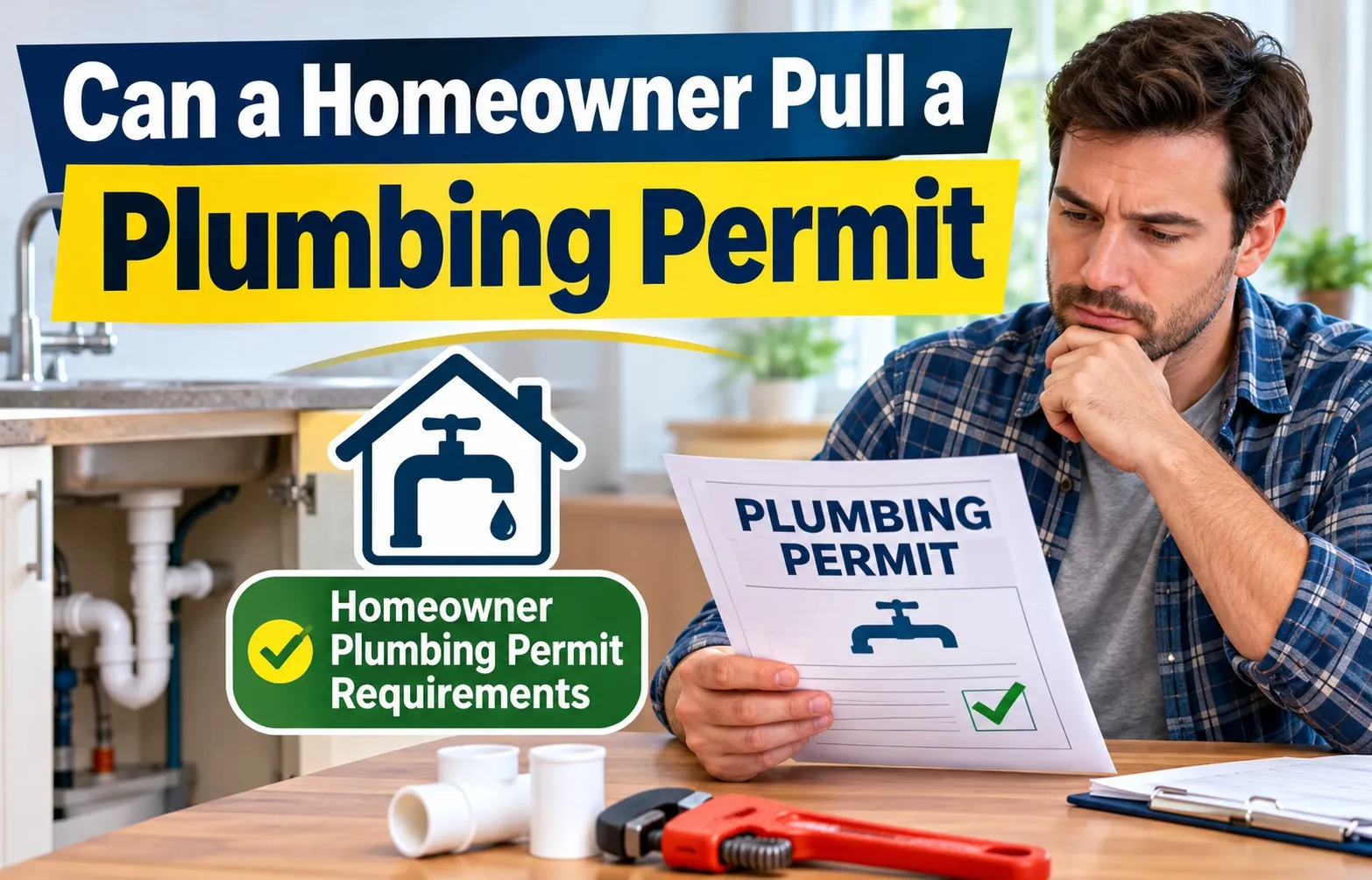 In most municipalities, a homeowner can legally pull a plumbing permit without holding a master plumbing license, provided they own and occupy the property as their primary single-family residence. Local building departments grant this authorization through a legal provision commonly known as the homeowner exemption. However, pulling the permit places full legal liability, code compliance, and inspection obligations directly on the property owner.
Can You Pull Your Own Plumbing Permit?
You can pull a plumbing permit for your own home if your local Authority Having Jurisdiction (AHJ) recognizes a homeowner exemption. Municipal building codes across the United States allow property owners to act as their own contractor for routine and major plumbing modifications, provided the home is not used for commercial or rental purposes.
While the exemption grants legal permission to perform DIY plumbing work, it does not bypass municipal safety standards or municipal oversight:
- Permit issuance requires plan approval: The municipal building department must review and approve your plumbing layout or schematic before issuing the permit.
- Legal compliance remains mandatory: All installed piping, drainage, and fixtures must strictly adhere to the regional building code, such as the International Plumbing Code (IPC) or Uniform Plumbing Code (UPC).
- Mandatory official inspections: You must schedule and pass all required rough-in and final plumbing inspections conducted by a certified municipal code enforcement officer.
What is the Homestead Exemption Rule?
The homestead exemption rule is a statutory provision enforced by local building departments that allows owner-occupants to perform trade work on their personal dwelling without a professional license. Cities and counties establish this policy to give property owners autonomy over their personal living space while protecting public safety and utility infrastructure.
This legal exemption strictly separates residential owner-operators from commercial real estate developers, contractors, and landlords:
- Occupancy verification: The building department requires proof that the applicant legally owns the property and uses it as their primary residence.
- Commercial exclusion: The exemption explicitly denies permit issuance to investors, property managers, or individuals flipping residential properties for profit.
- Personal execution mandate: Pulling a permit under the homestead exemption legally binds the homeowner to perform the physical labor themselves rather than hiring unverified third parties.
4 Strict Conditions You Must Meet to Qualify
Before an Authority Having Jurisdiction (AHJ) approves a homeowner plumbing permit application, you must satisfy four foundational legal and operational requirements. Failing to meet any single condition results in an immediate permit rejection and requires the hiring of a licensed master plumber.
- Primary Single-Family Residence Ownership: The structure must be a detached single-family home or homestead where you currently reside or intend to occupy immediately upon completion of work. Multi-family buildings, apartment complexes, commercial units, and rental properties are entirely excluded.
- Execution of a Signed Homeowner Affidavit: Applicants must sign a legally binding document at the local building department affirming they will personally execute the plumbing work without hiring unlicensed subcontractors.
- Demonstrated Code and Technical Competency: Many local jurisdictions require homeowners to pass a written basic code understanding test or submit an accurate isometric plumbing diagram before issuing the permit.
- Adherence to Mandatory Inspection Timelines: The homeowner must leave all newly installed supply lines, drain-waste-vent (DWV) piping, and connections fully exposed until a municipal inspector performs a formal rough-in approval.
Allowed DIY Tasks vs. Licensed Plumber Required
Most local building departments permit homeowners to handle minor fixture replacements, fixture additions, and select maintenance tasks themselves, provided they pull the proper permit. However, high-risk modifications involving municipal utility connections, fuel gas distribution, and major backflow prevention devices strictly require a state-licensed master plumber.
Plumbing Projects Homeowners Can Permit and Do Themselves
Homeowners acting under an authorized homestead exemption can legally execute a wide variety of standard residential plumbing installations. Under the guidelines of both the International Plumbing Code (IPC) and the Uniform Plumbing Code (UPC), DIYers are permitted to perform work that maintains or slightly expands existing household plumbing networks.
The following projects are typically approved for homeowner-pulled permits:
- Fixture Replacements: Swapping out toilets, bathroom sinks, bathtubs, and kitchen faucets using existing supply lines and drainage stub-outs.
- Branch Line Modifications: Running new PEX or copper supply lines for appliance hookups like dishwashers and refrigerators within standard interior walls.
- Drain-Waste-Vent (DWV) System Repairs: Replacing damaged PVC or ABS drain pipes under sinks or minor branch venting lines, provided slope and venting standards are maintained.
- Water Heater Replacements: Replacing an existing electric water heater in-kind, subject to local electrical safety rules and thermal expansion tank requirements.
High-Risk Work That Demands a Licensed Master Plumber
Certain plumbing projects carry severe structural, environmental, and public safety hazards that prohibit homeowner DIY permits. Municipal building codes mandate that specialized tradespeople with active state licensing and bonding execute these high-stakes installations to protect community water supplies and municipal infrastructure.
You cannot pull a homeowner permit for the following systems:
- Gas Line Installation: Running, extending, or modifying black iron or corrugated stainless steel tubing (CSST) natural gas or propane lines requires certified pressure testing and professional licensing.
- Main Sewer Line Hookup: Tapping into municipal sewer mains, installing commercial-grade septic tanks, or repairing public right-of-way sewer connections.
- Backflow Preventer Certification: Installing, testing, or servicing reduced pressure zone (RPZ) backflow assemblies or irrigation cross-connection controls.
- Major Structural Alterations: Cutting through load-bearing framing members to route large-diameter drain stacks or main vent headers.
Comparison Matrix: Homeowner DIY vs. Master Plumber Scope
The General Contractor Trap: Why You Should NEVER Pull a Permit for a Tradesperson
A contractor or plumber who asks you to pull a permit in your own name is handing you total legal and financial liability for their work. When a tradesperson refuses or avoids pulling their own permit, it usually indicates they lack a valid license, carry insufficient insurance, or are attempting to dodge municipal oversight.
Why a Contractor Asks You to Pull the Permit (And Why It’s a Red Flag)
Unlicensed contractors and handymen often tell homeowners that pulling the permit themselves saves time and money. In reality, this request is a major warning sign that protects the worker while exposing the property owner to significant risk.
Contractors typically ask homeowners to pull permits for three main reasons:
- Lack of Active Licensing: The contractor does not possess a valid master plumber license or has had their credential suspended by state licensing boards.
- No Workers’ Compensation or Liability Insurance: Municipalities require licensed contractors to prove active insurance coverage and hold a surety bond before issuing trade permits.
- Avoiding Accountability: If the work fails inspection or damages your home’s infrastructure, the contractor bears no official record or liability with the building department.
Legal & Financial Risks of Name Pulling
Pulling a permit under your name legally declares that you are performing the work personally. Allowing a third party to work under a homeowner permit creates severe legal and financial vulnerabilities.
The primary risks of name pulling include:
- Full Liability for Code Violations: The local building authority holds you personally responsible for fixing any non-compliant plumbing work out of pocket.
- Insurance Denial: Property insurance carriers may reject claims for water damage or flooding if the work was performed by an unlicensed worker operating under a homeowner permit.
- Accident Liability: If an uninsured handyman gets injured on your property while working under your permit, you can be held personally liable for their medical expenses and lost wages.
- Permit Fraud Allegations: Submitting false statements on a municipal permit application constitutes permit fraud, which carries fines and potential misdemeanor charges in many jurisdictions.
How to Verify Your Contractor’s Master Plumbing License
Before signing a contract or allowing any plumber to begin work on your home, verify their license status directly with your state’s occupational licensing database. Never rely solely on a business card, advertisement, or verbal assurance.
To ensure your contractor is fully credentialed, follow these verification steps:
- Request License Details: Ask the contractor for their state master plumber license number, certificate of insurance, and business registration name.
- Check State Verification Portals: Visit your state licensing database, such as the Michigan LARA License Lookup portal, to confirm their license status is active, in good standing, and free of disciplinary actions.
- Verify Insurance and Bond Coverage: Contact the insurance carrier listed on their certificate to confirm their general liability and workers’ compensation policies remain active.
- Require Contractor Permit Submission: Ensure the final contract states that the contractor is solely responsible for pulling all required plumbing permits in their own company name.
How a Homeowner Pulls a Plumbing Permit
Securing a plumbing permit as a homeowner requires a structured, administrative approach that starts long before you touch a wrench. Following the precise procedures mandated by your local building department ensures your project clears plan review smoothly and passes inspections without costly delays.
Step 1: Gathering Required Documentation & Isometric Schematics
Before visiting your municipal building department or accessing their online portal, you must assemble the specific documentation required for residential trade permits. Most jurisdictions demand a clear layout of your intended plumbing modifications to verify compliance with local codes.
Key items to prepare during this initial stage include:
- Isometric Plumbing Diagram: A scaled schematic drawing showing supply lines, drain-waste-vent (DWV) piping, fixture locations, and pipe sizing drawn on 30-degree isometric grid paper.
- Property Deed or Tax Assessment: Official proof confirming you own the structure and maintain homestead status as a primary resident.
- Signed Homeowner Affidavit: A legal form acknowledging that you will personally perform the installation and assume full code liability.
Step 2: Submitting the Application & Paying Municipal Fees
Once your documents and schematics are complete, you can submit your application to the local Authority Having Jurisdiction (AHJ). The building department will review your paperwork to ensure safety standards and sizing rules are met.
During submission, keep the following administrative steps in mind:
- Plan Review Process: A municipal plan examiner reviews your isometric drawings, which can take anywhere from a few hours to several business days depending on the municipality.
- Permit Application Fee: You must pay the required administrative and valuation-based fees, which typically range from fifty to a few hundred dollars.
- Card Issuance: Upon approval, you receive an official placard or permit document that must be displayed prominently at the job site.
Step 3: Passing the Rough-in Inspection (Before Wall Closing)
The rough-in inspection is the most critical milestone in any permitted plumbing project. This evaluation occurs after all supply pipes, DWV stacks, and vents are installed inside the walls or subfloors, but before drywall, insulation, or finishes seal them from view.
To ensure your rough-in inspection passes on the first visit:
- Pressure Testing: Water or air pressure tests must be applied to supply lines and drain systems to prove there are no leaks or pressure drops.
- Code Compliance Checks: The code enforcement officer verifies proper pipe sizing, correct slope on horizontal drain lines, and adequate structural protection where pipes pass through framing.
- Open Access Requirement: All joints, fittings, and connections must remain entirely uncovered and visible for visual examination by the inspector.
Step 4: Final Inspection and Permit Closure
The final inspection takes place after all fixtures—such as sinks, toilets, showers, and water heaters—are fully connected, operational, and sealed against leaks. This step closes out the permit lifecycle.
Finalizing your permit involves the following actions:
- Scheduling the Visit: Contact your local building department to request a final walkthrough once all fixture trim and appliance hookups are finished.
- Inspector Verification: The inspector checks that backflow preventers, traps, supply shut-off valves, and temperature-pressure relief valves function properly.
- Certificate of Completion: Once approved, the department signs off on the permit, officially closing the record and protecting your home’s resale value.
State-Specific Rules & Regional Variations
Plumbing regulations and homeowner permit allowances are governed at state, county, and municipal levels, meaning rules vary significantly depending on where your property is located. While many jurisdictions grant homeowner exemptions under strict conditions, others enforce stricter licensing mandates or require detailed legal affidavits before issuing trade permits.
Michigan Plumbing Rules (LARA Code Regulations)
In Michigan, residential plumbing permits are regulated by the Bureau of Construction Codes (BCC) under the Department of Licensing and Regulatory Affairs (LARA). Michigan code explicitly permits single-family homeowners to apply for and pull plumbing permits, provided they own and occupy the property as their primary residence.
Specific requirements under Michigan LARA regulations include:
- LARA Permit Application Submission: Homeowners must complete an official LARA plumbing permit application detailing the scope of work, fixture counts, and structural details.
- Strict DIY Execution: Work must be physically performed by the homeowner. Contracting an unlicensed person under a Michigan homeowner permit violates state construction codes.
- Local Bureau Jurisdiction: Municipalities with their own local enforcing agencies manage permits locally under state oversight, requiring homeowners to confirm whether local or state LARA inspectors conduct the job site reviews.
Kentucky Plumbing Code & Homeowner Affidavit Requirements
Kentucky enforces centralized plumbing regulations through the Kentucky Department of Housing, Buildings and Construction (DHBC) Division of Plumbing. The state permits primary owner-occupants of single-family dwellings to perform plumbing installations, but requires formal legal documentation prior to permit issuance.
Key aspects of the Kentucky Plumbing Code for DIY applicants involve:
- Homeowner Affidavit Submission: The DHBC mandates that homeowners sign a notarized affidavit verifying sole ownership and affirming that they will personally install all piping and fixtures.
- Division Approval & Plan Review: Before work begins, detailed isometric schematics must be reviewed by the local state plumbing inspector representing the DHBC.
- Exclusion of Complex Gas and Utility Systems: While basic supply and drainage additions are permissible under the affidavit, connections to public mains and specialized gas systems require a state-licensed master plumber.
Checking Local Amendments in Your Municipality
Even when state codes allow homeowner exemptions, individual cities and counties retain the authority to pass stricter local building codes or eliminate homeowner trade permits entirely within their jurisdiction.
To verify the specific regulations in your area, follow these steps before purchasing materials:
- Consult the Authority Having Jurisdiction (AHJ): Contact your local city or county building department to confirm whether homeowner permits are permitted for your project scope.
- Review Local Ordinance Amendments: Ask whether municipal codes impose additional restrictions beyond the national or state baseline (such as requiring licensed plumbers for water heater replacements or gas piping).
- Confirm Inspector Availability and Fee Schedules: Verify local permit fees, required inspection phases, and submission portals to avoid delays during project execution.
The True Costs: Permit Fees vs. Unpermitted Plumbing Penalties
Pulling an official plumbing permit incurs a modest upfront administrative cost, typically adding a negligible percentage to your overall renovation budget. Conversely, performing unpermitted plumbing work exposes homeowners to severe financial penalties, immediate construction shutdowns, and long-term liabilities that far exceed initial permit application fees.
Average Cost of Pulling a Homeowner Plumbing Permit
Plumbing permit fees are established at the county or municipal level and vary based on project scope, total valuation, and fixture count. Most building departments publish standardized fee schedules to maintain transparency for residential property owners.
Typical residential plumbing permit costs break down as follows:
- Minor Projects & Fixture Swaps: Simple fixture additions or minor pipe relocations generally cost between $50 and $150.
- Water Heater Replacements: Dedicated permit fees for installing or replacing a standard water heater average $50 to $125.
- Full Remodels & Additions: Comprehensive bathroom additions or whole-house repiping projects range from $200 to $500, which includes plan review and multiple inspection phases.
- Re-inspection Fees: If an initial rough-in or final inspection fails, local municipalities typically charge a re-inspection fee between $50 and $100 per additional site visit.
What Happens If You Do Plumbing Work Without a Permit?
Municipal code enforcement officers continuously monitor neighborhoods, online real estate listings, and utility disruptions. Discovering unpermitted plumbing work triggers immediate legal and financial enforcement mechanisms against the property owner.
Common enforcement actions and unpermitted work risks include:
- Stop Work Orders: The local building department posts an official legal notice on the property requiring all construction to cease immediately until compliance is established.
- Double or Triple Penalty Fees: Municipalities penalize unpermitted work by charging double or triple the standard permit fee when issuing a retroactive permit.
- Forced Demolition or Exposure: Inspectors can compel homeowners to tear down finished drywall, tile, or subflooring at their own expense so concealed piping can be visually examined.
Impact on Home Insurance Claims and Real Estate Resale Disclosures
The long-term risks of skipping a plumbing permit extend well beyond city hall enforcement, directly jeopardizing your home’s equity and insurance protections.
Unpermitted plumbing negatively impacts property protection and real estate transactions in two major ways:
- Insurance Claim Denial: If an unpermitted pipe connection fails and causes major water damage, flooding, or mold, property insurance carriers can legally deny your claim on the grounds of unapproved, non-code-compliant modifications.
- Seller’s Property Disclosure Complications: Standard real estate contracts mandate that sellers complete a legal disclosure statement detailing known unpermitted work. Failing to disclose non-permitted plumbing can trigger buyer lawsuits or cause mortgage lenders to decline buyer financing during escrow.
Frequently Asked Questions
Homeowners exploring DIY plumbing modifications often face specific legal and logistical questions regarding permit eligibility, structural boundaries, and inspection failures. Below are direct answers to common questions about pulling homeowner plumbing permits.
Can I legally do my own plumbing without a license?
Yes, you can legally perform your own plumbing without a license if your local municipality offers a homeowner exemption and you meet all statutory eligibility criteria. To qualify, you must legally own the property, occupy it as your primary single-family residence, and pull an official plumbing permit from your local building department. You must personally perform all the labor, submit drawings for plan review, and pass mandatory rough-in and final plumbing inspections conducted by code enforcement officers.
Can a homeowner install their own water heater?
In most jurisdictions, a homeowner can legally perform a DIY water heater installation under an authorized homeowner permit, provided the replacement is an electric unit. Installing an electric water heater requires installing a thermal expansion tank, proper temperature and pressure (T&P) relief valve discharge piping, and adhering to strict code compliance standards. However, if the project involves a gas water heater installation requiring new fuel gas piping, flue venting modifications, or electrical panel upgrades, many building departments mandate hiring a licensed master plumber or gas fitter.
Can you pull a plumbing permit for a rental property or house flip?
No, you cannot pull a homeowner plumbing permit for a commercial/investment property, multi-family rental unit, or house flip. The homeowner exemption applies strictly to primary owner-occupied residences. For non-owner-occupied properties, real estate developers, property managers, and investors are legally required to hire a licensed master plumbing contractor to pull all necessary permits and execute trade work to protect public health and safety.
How long is a homeowner plumbing permit valid?
A homeowner plumbing permit is typically valid for 180 days (6 months) from the date of issuance. To prevent permit expiration, active work must begin within that initial 6-month window, and each passing milestone inspection automatically extends the permit’s validity for another 180 days. If project work stalls for more than 180 consecutive days without an official inspection scheduled, the permit expires, requiring the homeowner to request a formal extension or pay administrative renewal fees to resume construction.
What should you do if your DIY work fails inspection?
If your plumbing work fails a rough-in or final inspection, do not panic. The code enforcement officer will issue a detailed correction notice listing the specific non-compliant items, such as improper pipe slope, incorrect fitting usage, or leaks discovered during pressure testing. To resolve the issue, make all necessary structural or piping corrections identified on the list, leave the work exposed, and schedule a re-inspection with your building department. Keep in mind that municipalities typically charge a nominal re-inspection fee before the inspector returns for sign-off.

Oscar Vance | Master Plumber & Drainage Expert
Meet Oscar Vance, a licensed master plumber sharing practical solutions on residential repairs, preventive maintenance, and thoughtful home upkeep.