How Long Does Cast Iron Plumbing Last?
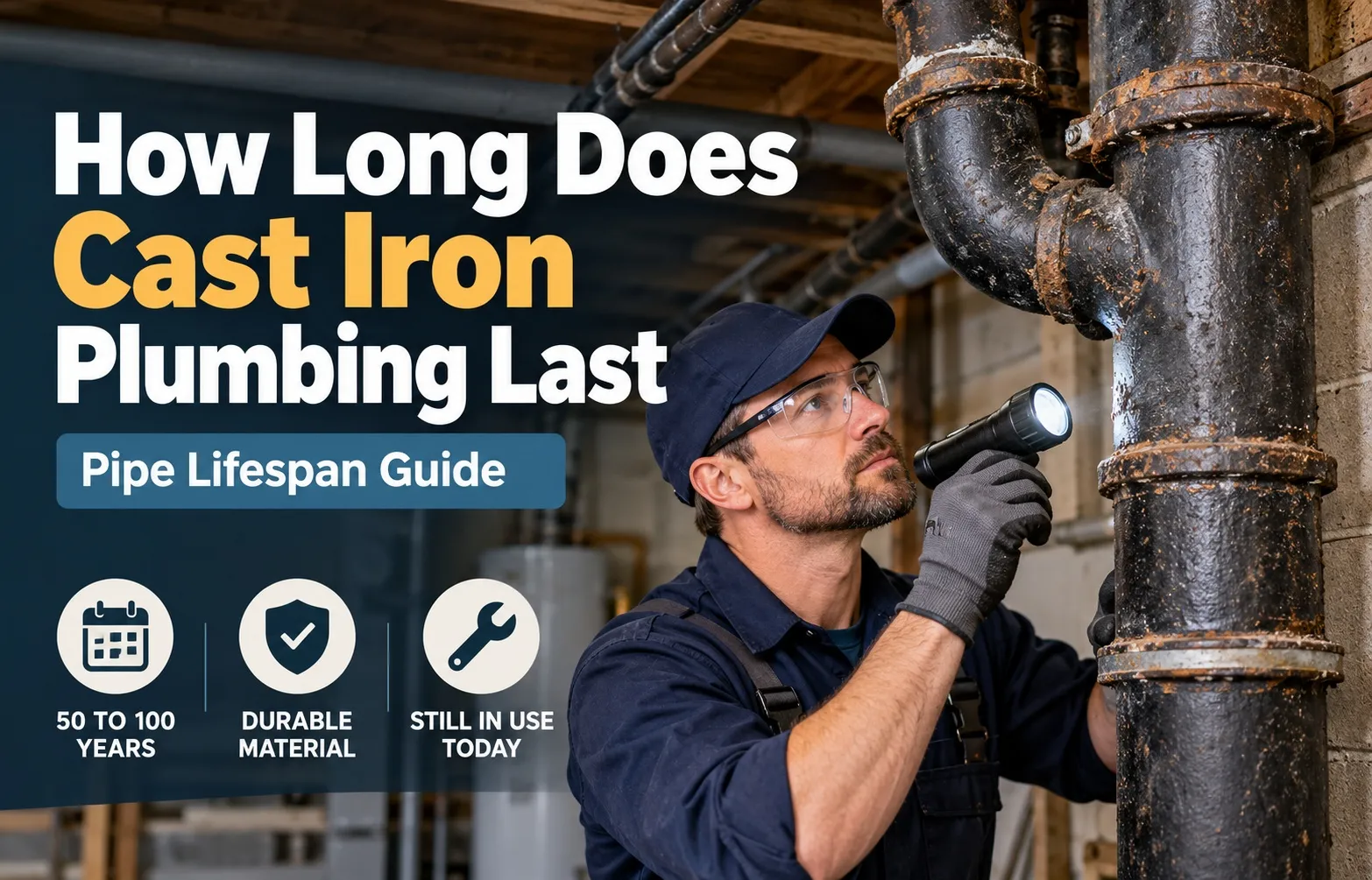 Cast iron plumbing typically lasts between 50 and 80 years in standard residential applications, though optimal indoor conditions can extend its lifespan up to 100 years. However, real-world horizontal underground main drains frequently experience structural failure or severe corrosion within 30 to 50 years due to constant standing wastewater and acidic soil conditions.
Understanding how long your system will remain functional depends heavily on whether you are inspecting dry vertical stacks or buried horizontal lines, as orientation drastically alters decay rates.
Vertical Stacks vs. Horizontal Invert Lines: Why Location Matters
Vertical stack pipes continuously outlast horizontal drain lines because gravity prevents liquid wastewater from resting against the inner iron walls for extended periods. These dry lines primarily process falling water and venting gases, reducing the rate of oxidation and chemical decay.
In contrast, horizontal underground lines experience significantly faster degradation due to several key environmental factors:
- Standing Water Contact: Wastewater sits along the bottom of the pipe (the invert), causing steady bottom-up erosion known as channel rot.
- Soil pH & Moisture Exposure: External rust accelerates when buried in acidic, highly saturated, or expansive clay soils.
- Corrosive Household Waste: Concentrated drain cleaners, harsh detergents, and acidic food waste pool in horizontal sections, gradually stripping away protective internal coatings.
Because of these operational differences, a vertical cast iron stack in a multi-story home can easily reach 80 to 100 years of functional life, whereas the horizontal line connecting that same house to the city sewer often fails decades earlier.
How Cast Iron Pipes Fail: The 3 Types of Hidden Corrosion
Cast iron pipes rarely fail overnight or from uniform thinning across the entire pipe wall. Instead, structural degradation occurs through distinct localized chemical and biological processes that break down the metal from the inside out, often masking severe damage until total pipe collapse occurs.
Understanding the specific mechanics of iron degradation clarifies why standard visual inspections can be deceptive and why certain sections of a drainage system fail decades before others.
1. Invert Corrosion & Channel Rot (Bottom-Line Erosion)
Invert corrosion—commonly referred to as channel rot—occurs exclusively along the bottom inside surface (the invert) of horizontal sewer lines where wastewater continuously flows and pools.
This localized decay accelerates through a combination of chemical and mechanical factors:
- Constant Water Immersion: Settled water prevents a protective oxide layer from stabilizing, causing persistent surface rusting.
- Abrasive Scouring: Suspended solids, grit, and debris in household wastewater physically scrape away soft rust layers, exposing fresh iron to ongoing chemical attack.
- Channeling Effect: Over time, the bottom of the pipe wears completely away, transforming the circular pipe into an open-bottom trough (channel rot) that allows raw sewage to erode the surrounding soil beneath the foundation.
Because invert corrosion affects only the bottom third of the pipe, camera inspections that only scan the top or sides of the line often miss early-stage channel formation.
2. Crown Corrosion from Biogenic Sulfuric Acid
While channel rot damages the bottom of horizontal pipes, crown corrosion attacks the very top interior surface (the crown) of dry or partially filled drain lines through biological gas reactions.
This destructive process follows a multi-step biological and chemical pathway:
- Hydrogen Sulfide Generation: Anaerobic bacteria thriving in slow-moving wastewater release hydrogen sulfide gas ($H_2S$) into the air space above the water line.
- Bacterial Oxidation: Aerobic bacteria (such as Thiobacillus) living on the damp pipe crown absorb the gas and convert it directly into biogenic sulfuric acid.
- Acidic Dissolution: The highly concentrated sulfuric acid steadily eats away at the upper cast iron wall, causing heavy tuberculation rust flakes to fall into the flowing stream below and trigger frequent drain blockages.
Crown corrosion is particularly dangerous because it thins the pipe wall from the top, increasing the risk of structural collapse under heavy soil or slab loads above.
3. Graphitic Corrosion: The “Invisible” Structural Failure
Graphitic corrosion (or graphitic leaching) is the most deceptive form of cast iron pipe failure because it alters the internal matrix of the metal without changing the pipe’s exterior shape or appearance.
During this electrochemical process, the metallic iron matrix leaches out of the pipe wall due to exposure to soft water, stray electrical currents, or acidic soil conditions, leaving behind only an interconnected network of brittle graphite flakes:
- Deceptive Visual Appearance: On a standard sewer camera inspection, a pipe suffering from graphitic corrosion appears completely intact, smooth, and full-dimensioned.
- Loss of Structural Integrity: Despite looking solid, the remaining graphite shell lacks all tensile strength and can crumble like dry dirt under minimal mechanical stress, load shifts, or high-pressure hydro-jetting.
- Sudden Collapse: Pipes degraded by graphitic leaching often experience sudden, catastrophic wall failure during simple plumbing maintenance or ground settling events.
Identifying graphitic leaching requires physical probing or mechanical descaling during inspection, as visual observation alone cannot distinguish a sound iron pipe from a hollowed-out graphite shell.
5 Critical Signs Your Cast Iron Pipes Are Reaching End-of-Life
Recognizing the early warning signs of cast iron degradation is essential for preventing catastrophic sewer main backups, interior water damage, and expensive foundation repairs. Because corrosion occurs invisibly from the inside out, homeowners often mistake structural pipe failure for simple, recurring clogs.
Paying close attention to recurring plumbing anomalies, strange odors, and structural shifts can help you catch deteriorating cast iron before complete system failure occurs.
1. Recurrent Drain Blockages & Tuberculation Buildup
When cast iron pipes age, the interior walls experience a process called tuberculation, where iron-oxide crusts and jagged mineral deposits accumulate and narrow the internal diameter of the pipe. This rough buildup easily catches grease, hair, and toilet paper, leading to persistent clogs that routine snaking only temporarily resolves.
- Narrowed Flow Capacity: Heavy internal scaling reduces drainage efficiency across multiple household fixtures.
- Frequent Backup Events: Slow drains eventually transition into complete sewer main backups during peak water usage.
Critical EEAT Warning: Hydro-Jetting Risks
Never permit a plumber to perform high-pressure hydro-jetting on aged cast iron without a prior camera inspection. High-PSI water jets can easily blow out thin, tuberculated, or graphitized pipe walls, causing massive slab leaks or catastrophic collapses.
2. Sewer Gas Odors (Hydrogen Sulfide) & Drain Flies
Persistent, unpleasant odors resembling rotten eggs or sulfur typically indicate that hydrogen sulfide gas is leaking through micro-cracks, deteriorated seals, or rotted pipe walls in your plumbing system. This gas accumulation often coincides with uninvited insect activity inside your living spaces.
- Sewer Gas Leakage: Unsealed gaps allow noxious gases to escape into crawl spaces, basements, and living areas.
- Drain Fly Infestations: Organic sludge lining corroded pipes provides an ideal breeding ground for moth flies and drain gnats that cannot be eliminated by standard surface cleaning.
If chemical drain cleaners or standard odor-neutralizers fail to resolve foul smells, a compromised cast iron vent or drain line is often the root cause.
3. Water Discoloration Rust Flakes and Pinhole Leaks
As internal corrosion accelerates, rust flakes and discolored water begin breaking free from aging vertical stacks and branch lines during heavy water flow. Homeowners frequently notice visible signs of metal decay around exposed basement pipes and structural walls.
- Rusty Water and Flakes: Sinks, tubs, or washing machine discharge lines intermittently push out brownish water or small iron debris.
- Surface Pinhole Leaks: Small bubbling paint, rusted pipe collars, and damp exterior pipe surfaces indicate that oxidation has completely penetrated the metal wall.
Ignoring these localized pinholes allows moisture to rot surrounding drywall, wooden framing, and subfloor structures.
4. Foundation Cracks Wall Moisture or Lawn Sinkholes
When underground horizontal cast iron lines develop channel rot or structural cracks, wastewater leaks directly into the surrounding soil rather than reaching the city sewer or septic tank. This subterranean leakage destabilizes the ground beneath and around your home, creating distinct structural red flags.
- Foundation Settling & Cracks: Washout from leaking sewer lines causes soil to compact unevenly, triggering drywall cracks and sticky doors.
- Lawn Indentations & Soggy Spots: Unexplained wet patches or depression sinkholes appearing in your yard directly above the sewer line path.
Subsurface soil erosion requires immediate professional camera scoping to assess whether pipe lining or excavation is necessary.
5. Unexplained Pest or Rodent Infestations
Breaks, cracks, and channel rot in underground cast iron create open pathways from municipal sewer mains directly into the subfloor and walls of a residence. Sewer rats, mice, and invasive insects exploit these structural gaps to enter living spaces, making persistent pest problems a potential indicator of severe plumbing failure.
Repair Reline or Replace? Comparing Modern Solutions
When dealing with deteriorating cast iron plumbing, homeowners face a critical choice: spot repairs, trenchless relining, or complete excavation and pipe replacement. Evaluating the extent of pipe degradation, structural integrity, and long-term costs helps prevent misapplying expensive repair methods to unsalvageable systems.
Choosing the right intervention strategy ensures your drainage system remains functional for decades while avoiding unnecessary property damage and expenses.
Mechanical Descaling & Spot Clamping (Minor Rust)
For early-stage corrosion where pipe walls remain structurally intact, mechanical descaling combined with localized spot repairs offers a cost-effective way to restore internal flow without replacing entire pipe runs.
- Mechanical Descaling: A plumber uses specialized rotating chains or carbide blades attached to a flexible shaft to scrape away heavy tuberculation rust buildup, restoring the pipe’s original interior diameter.
- Spot Clamping: If minor pinhole leaks or localized exterior cracks exist on accessible vertical stacks, heavy-duty stainless steel repair sleeves or rubber couplings seal the damaged section.
Mechanical descaling is purely surface maintenance; it removes internal rust scale but cannot structural reinforce or restore metal that has already been lost to age and chemical exposure.
CIPP Trenchless Epoxy Lining (When It Works vs. When It Fails)
Cured-In-Place Pipe (CIPP) lining involves inserting a resin-saturated felt tube into the existing host pipe, inflating it with air or steam, and curing the epoxy resin to create a seamless, jointless “pipe-within-a-pipe” that can last 50 years or more without trenching floors or lawns.
While CIPP trenchless pipe lining provides an efficient, non-invasive repair method, it is not a universal cure-all for every aging sewer line.
Open-Trench Excavation & Full Schedule 40 PVC/ABS Replacement
When cast iron lines suffer from total structural collapse, severe channel rot, or back-pitched bellies, open-trench excavation remains the gold standard for long-term reliability. Plumbers cut out the failing metal and install smooth-walled Schedule 40 PVC or ABS plastic piping.
- Complete System Renewal: Replacing old cast iron with modern plastic eliminates future corrosion, tuberculation, and tree root penetration permanently.
- Slab Trenching: Underground lines beneath home foundations require jackhammering through the concrete slab, which adds restoration costs for flooring and foundation concrete backfilling.
While traditional replacement involves higher property disruption, it guarantees correct pipe slope and provides a brand-new drainage system with an expected lifespan exceeding 100 years.
Cost Breakdown Matrix: Trenchless vs. Traditional Excavation
Financial considerations often drive the decision between trenchless epoxy lining and open-trench replacement. Below is a comparative cost and operational overview for standard residential applications.
Consulting with an experienced plumbing specialist to perform a thorough sewer camera scope prior to selecting a solution ensures you invest in the most durable option for your property.
Home Insurance & Purchasing Advice for Older Cast Iron Systems
Navigating financial liabilities and property transactions involving aging cast iron plumbing requires a clear understanding of insurance limitations and pre-purchase due diligence. Because cast iron pipes installed before 1975 are nearing or past their intended service life, both insurance providers and home buyers must assess risk proactively to avoid unexpected out-of-pocket expenses.
Understanding policy exclusions and establishing rigorous inspection protocols protects your financial investment whether you are maintaining an existing property or purchasing a vintage home.
Does Homeowners Insurance Cover Cast Iron Pipe Replacement?
A standard homeowners insurance policy generally does not cover the cost of replacing or repairing cast iron pipes that have failed due to age, wear-and-tear, or gradual rust corrosion. Insurance carriers view internal pipe oxidation as routine home maintenance rather than a sudden, accidental loss.
However, specific coverage scenarios dictate how claims are handled:
- Covered Damage (Sudden & Accidental): If a compromised pipe suddenly bursts or collapses, insurance typically pays for consequential water damage repairs to walls, flooring, and cabinetry, as well as tear-out costs required to access the broken pipe.
- Uncovered Costs (Age & Decay): The actual cost to replace the corroded cast iron pipe itself is almost always excluded under standard wear-and-tear policy clauses.
- Water Backup Rider Addendum: Standard policies exclude sewer backups unless you purchase an explicit Water Backup and Sump Pump Overflow endorsement, which provides coverage for property cleanup and restoration following a main drain blockage.
To ensure compliance with federal standards when financing older properties, review official HUD Housing & Plumbing System Guidelines regarding legacy drainage infrastructure and loan approval requirements.
Should You Buy a House Built Before 1975 With Original Cast Iron?
Purchasing a home built before 1975 that retains its original cast iron drainage system carries inherent financial risk, as complete replacement costs can range from $5,000 to over $15,000 depending on slab layout and pipe depth. However, inheriting old plumbing does not need to be a dealbreaker if approached strategically during contract negotiations.
Home buyers should take specific precautionary steps before closing:
- Request a Dedicated Sewer Scope Inspection: Never rely solely on a general home inspector’s visual check. General inspectors only evaluate visible fixtures and running water, which fails to reveal subsurface invert corrosion or pipe bellies.
- Include Real Estate Contingencies: Write a specific sewer inspection contingency into your purchase agreement that allows you to negotiate repair credits, price reductions, or full pipe replacement prior to closing if severe degradation is discovered.
- Get Replacement Estimates Early: Obtain written repair quotes from a licensed plumbing contractor to leverage as concrete evidence during price negotiations with the seller.
The Descale-First Camera Inspection Protocol
A standard sewer camera scope through an uncleaned, heavily tuberculated cast iron pipe can produce misleading results. Thick layers of rust flakes, grease, and sludge frequently mask the actual condition of the pipe wall beneath, making an accurate assessment impossible.
Home buyers and owners should insist on a rigid “Descale-First” camera inspection protocol:
- Step 1: Mechanical Descaling: A plumber runs a flexible shaft with light rotating chains through the main line to knock away soft rust scale and accumulated debris without damaging the pipe.
- Step 2: High-Definition Scope: Following descaling, a high-definition video camera scans the entire length of the main line from the cleanout to the municipal sewer junction.
- Step 3: Structural Wall Evaluation: The cleared pipe wall allows the inspector to clearly identify channel rot, graphitic leaching, severe cracking, or off-set joints that would otherwise remain hidden under rust buildup.
Adopting this thorough inspection method provides an accurate baseline of your plumbing system’s remaining lifespan, empowering you to negotiate effectively or plan future pipe upgrades with confidence.
Frequently Asked Questions
Addressing specific technical queries helps clarify long-term plumbing maintenance and legacy infrastructure behavior. Below are concise, data-backed answers to common questions regarding aging cast iron drainage systems.
What year did builders stop using cast iron sewer pipes?
Most residential builders phased out cast iron sewer pipes between 1975 and 1980 as local building codes across North America adopted modern plastic alternatives like PVC and ABS. While the Cast Iron Pipe Institute (CIPI) maintained standards for commercial applications, residential construction shifted almost entirely to plastic by 1975 due to lower material costs and immunity to internal rusting.
Why do chemical drain cleaners ruin cast iron pipes?
Liquid chemical drain openers containing high concentrations of sulfuric acid or sodium hydroxide (lye) trigger an intense exothermic reaction when contacting standing wastewater and organic clogs inside the pipe. This rapid heat release generates temperatures high enough to boil trapped water, creating thermal shock that cracks brittle, aging iron walls while acidic residues sit in low spots and accelerate internal invert corrosion.
How much does it cost to replace cast iron plumbing under a slab?
Replacing cast iron plumbing beneath a concrete slab typically costs between $150 and $350 per linear foot, bringing total project estimates to $5,000–$15,000+ depending on layout complexity and accessibility. Overall expenses reflect both the plumbing work (cutting out old metal and installing Schedule 40 PVC) and necessary structural remediation, such as jackhammering concrete, backfilling trench soil, and restoring interior flooring.
What type of plumbing pipe lasts the longest?
Cast bronze and heavy-gauge copper piping (Type L or Type K) last the longest for supply lines, offering a service life of 70 to 100+ years in neutral water environments. For drain, waste, and vent (DWV) systems, modern Schedule 40 PVC and ABS plastic piping provide an estimated functional lifespan exceeding 100 years because they do not corrode, tuberculate, or react to acidic wastewater chemicals.

Oscar Vance | Master Plumber & Drainage Expert
Meet Oscar Vance, a licensed master plumber sharing practical solutions on residential repairs, preventive maintenance, and thoughtful home upkeep.