What Does It Take to Run a Successful Plumbing Business?
 Running a profitable plumbing business requires shifting your focus from turning wrenches to mastering systems, predictable lead generation, and strict financial controls. A licensed plumber transitioning into an entrepreneur must balance technical mastery with operational management to build a resilient, high-margin service company.
- Licensing & Compliance: Securing proper state and local contracting licenses, bonding, and general liability insurance to protect your operations.
- Strategic Pricing: Implementing flat-rate pricing models that account for overhead, parts, travel time, and target profit margins rather than simple hourly billing.
- Consistent Lead Flow: Maintaining a multi-channel acquisition strategy, anchored by a fully optimized Google Business Profile and local service ads.
- Operational Systems: Utilizing modern field service software to automate dispatching, invoicing, customer communications, and inventory tracking.
- Team Development: Recruiting, training, and retaining skilled technicians while shifting the owner’s daily role from technician to high-level manager.
Who This Guide Is For
This comprehensive roadmap is tailored for ambitious professionals at three distinct stages of growth within the trade industry. Whether you are launching your first truck or restructuring an established enterprise, these frameworks provide clarity on scaling operations sustainably.
- The New Plumber: Independent mechanics transitioning out of W-2 employment who want to launch their own licensed plumbing business with strong financial foundations.
- The Non-Plumber Business Owner: Investors and entrepreneurs entering the lucrative home services sector who need to understand trade-specific operations, safety codes, and tech management.
- The Growth-Oriented Owner: Established plumbing shop operators currently stuck around the single-truck or multi-truck plateau who need systems to scale past seven figures.
What Separates Profitable Shops from Struggling Ones
The difference between a struggling plumbing shop barely surviving on low margins and a thriving enterprise often comes down to mindset and metric tracking. Too many owners act merely as high-paid technicians in their own companies instead of building a scalable business model.
As industry experts and high-performing contractors frequently observe, successful operators track every dollar of job-costing and prioritize recurring revenue. Shops that thrive focus heavily on maintenance agreements and efficient dispatching, while struggling shops rely entirely on reactive emergency calls and guesswork pricing.
Are You Starting Out or Scaling? Pick Your Roadmap
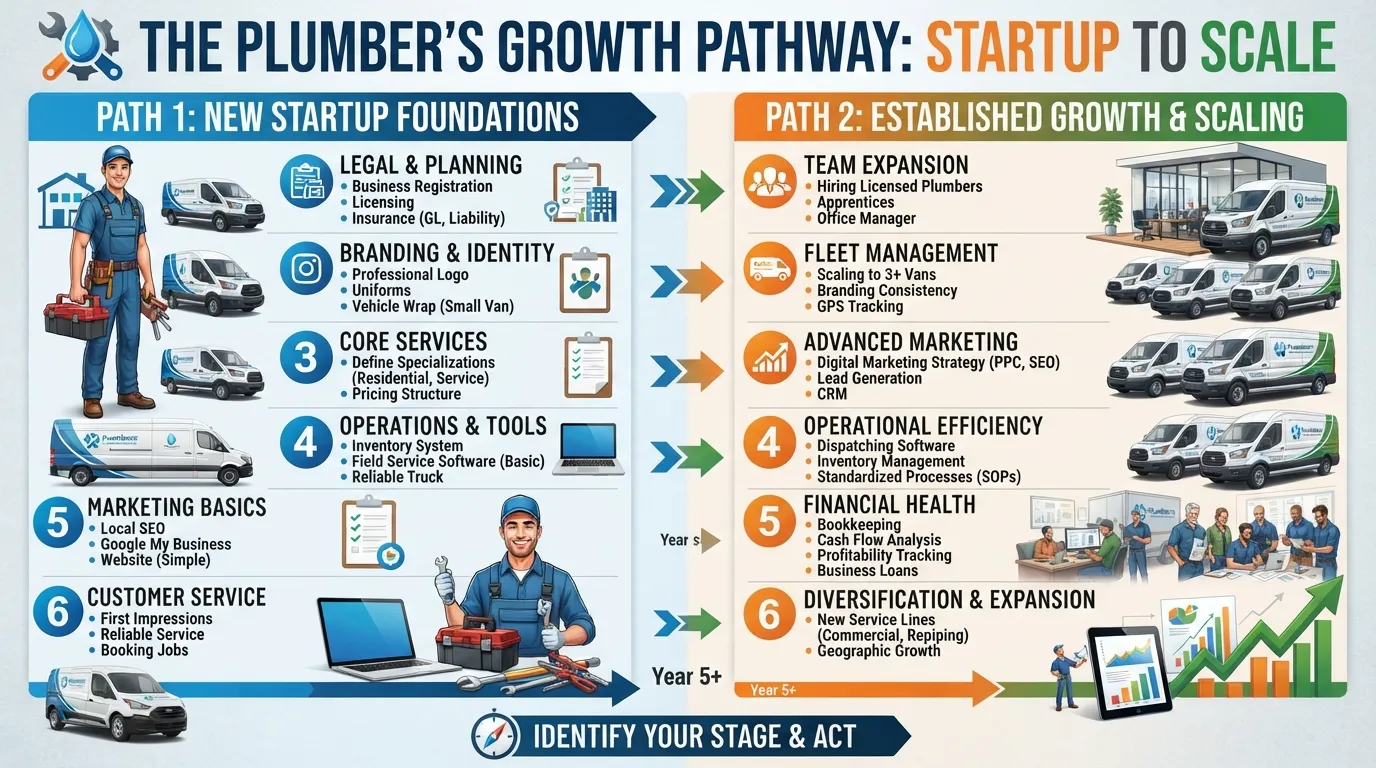 Launching a plumbing venture with a clean slate requires strict adherence to licensing requirements, initial equipment investments, and building your brand from the ground up. New founders must navigate the transition from hands-on trade work to establishing legal and operational foundations.
- Secure your journeyman or master plumber credentials to satisfy state board regulations.
- Build your initial startup checklist, vehicle outfitting, and tool inventory as outlined in Section 3 through Section 5.
- Establish initial cash flow management and basic marketing channels to land your first residential clients.
If You Already Have a Plumbing Business
Established shop owners facing stagnant revenue or chaotic daily operations need to transition toward advanced fleet management, team delegation, and automated marketing systems. Scaling an existing company requires shifting from owner-operator survival to enterprise-level growth.
- Optimize your tech stack, dispatching workflows, and recruitment pipelines detailed in Section 6 through Section 8.
- Implement robust flat-rate pricing matrices and maintenance membership programs to maximize customer lifetime value.
- Step out of the truck permanently to focus exclusively on strategic leadership and financial oversight.
Can You Start a Plumbing Business Without Being a Plumber?
You do not necessarily need to hold a plumbing license yourself to launch and own a profitable plumbing business. However, state regulations strictly require you to employ or partner with a licensed master plumber who acts as the official qualifying agent for the company.
- The Qualifying Agent Model: Hire a licensed master plumber to pull permits, oversee technical code compliance, and supervise field quality.
- Your Operational Focus: Concentrate purely on business administration, marketing, finance, customer service management, and scaling the brand.
- Legal Verification: Ensure your local state licensing board permits corporate structures where a non-licensee owns the entity alongside a licensed qualifier.
Can You Start with Very Little Money?
Starting a traditional plumbing business with zero capital is exceedingly difficult due to the high costs of service vehicles, professional tools, insurance, and licensing fees. However, you can minimize upfront expenses by launching as a lean owner-operator using existing personal tools, running out of a home office, and leveraging low-cost digital marketing.
- Lean Startup Strategy: Utilize a reliable personal vehicle with a simple ladder rack instead of financing a brand-new branded cargo van immediately.
- Phased Tool Procurement: Buy only the essential diagnostic and hand tools required for basic residential service calls rather than heavy commercial excavation equipment.
- Cash Flow Protection: Reinvest initial profits directly into inventory and licensing while keeping overhead strictly minimized during your first six months.
Set Up Your Plumbing Business Legally
Securing the proper contractor licensing is the absolute legal foundation of any legitimate plumbing operation. State requirements vary wildly across the United States, typically requiring an individual to hold a Journeyman license for years before testing for a Master Plumber certification.
- State vs. Local Jurisdiction: Some states issue a statewide contractor license, while others require municipal or county-level competency cards and local permits.
- The Florida Example: In Florida, contractors must pass the state certification exam, prove four years of experience (or a related college degree), and show financial stability before performing work statewide.
- Qualifying Agent Compliance: If you are an entrepreneur without a license, your business must legally employ a certified master plumber of record to pull municipal permits.
Bonds and Liability Insurance
Protecting your company from catastrophic financial loss requires comprehensive bonding and insurance coverage before your first service truck rolls out. Clients, commercial properties, and municipalities will demand proof of coverage before allowing you on site.
- General Liability Insurance: Covers property damage and bodily injury accidents; most commercial contracts and residential clients require a minimum of $1,000,000 in coverage.
- Surety Bonds: License and permit bonds guarantee to the state or municipality that your business will comply with local building codes and regulations.
- Workers’ Compensation: Mandatory in most states the moment you hire your first employee, covering medical expenses and lost wages for on-the-job injuries.
Choosing a Business Structure
Selecting the right legal entity safeguards your personal assets from business liabilities and impacts your overall tax obligations. Transitioning from a sole proprietorship to a formal corporate structure is a critical early milestone.
How to Choose a Memorable Plumbing Company Name
Your business name should instantly communicate trust, locality, and trade clarity to prospective customers searching online. Avoid confusing abstract words or overly restrictive personal surnames that complicate future business sales or regional expansion.
- 3 Good Examples: Apex City Plumbing, Metro Rooter & Drain, Benchmark Plumbing Solutions.
- 3 Bad Examples: J&K Holdings LLC (unclear trade), Smith’s Magic Wand Services (confusing/abstract), Xtreme Pipez (unprofessional spelling).
- Clarity Over Cleverness: Ensure consumers immediately understand you are a professional plumbing service within three seconds of seeing your vehicle or ad.
Van, Branding and Essential Tools
Equipping your service vehicle and securing heavy-duty trade tools represent your largest initial capital expenditure. Professional outfitting ensures your technicians can execute jobs efficiently on the first visit.
- Vehicle & Branding: High-roof work van wrapped with clear contact numbers, service categories, and license numbers for mobile trust.
- Drain Cleaning Machinery: Heavy-duty sectional and drum drain machines capable of clearing main sewer lines up to 100 feet.
- Diagnostic & Joining Tools: Waterproof sewer inspection cameras and professional PEX expansion or crimping tool kits.
Startup Legal Checklist
Keep this actionable checklist handy to ensure every regulatory and administrative box is checked before launching your operations to the public.
- Verify state contractor licensing requirements and secure a qualified master plumber.
- Form your LLC or legal business entity through your state’s division of corporations.
- Obtain your federal Employer Identification Number (EIN) from the IRS.
- Purchase general liability insurance policies and state-mandated surety bonds.
- Open a dedicated business checking account to completely separate personal and commercial funds.
- Register your local business licenses and secure municipal tax certificates.
How Much Does It Cost to Start a Plumbing Business?
Capital requirements vary based on equipment choices, vehicle acquisition strategies, and local licensing fees. Most solo plumbing operations require a total startup investment between $15,000 and $50,000 to cover legalities, inventory, and transport.
Is $10,000 to $50,000 Enough?
The wide financial spectrum depends primarily on whether you leverage existing assets or purchase everything brand new. Underfunding is a leading cause of early trade business failure, particularly when unexpected vehicle repairs or slow invoice cycles occur.
- The Lean Scenario: If you already own a reliable truck, possess core hand tools, and operate out of a home office, you can safely launch for under $15,000.
- The Turnkey Scenario: Financing a wrapped cargo van, purchasing heavy ProPress tools, and investing heavily in upfront digital ads pushes initial capital needs past $40,000.
- Cash Flow Buffer: Always maintain an additional 2 to 3 months of operating expenses in reserve to pay for fuel, software subscriptions, and emergency parts before client payments clear.
How to Start a Plumbing Business with No Money
Launching with virtually zero liquid capital requires creative bootstrapping, leveraging equipment financing, and maximizing sweat equity. You must trade initial cash outlays for strategic partnerships and phased growth.
- Subcontracting First: Take on subcontract work for larger local plumbing companies or general contractors on a 1099 basis to build fast capital without marketing expenses.
- Equipment Financing: Utilize vendor financing or equipment leases to acquire heavy drain cleaning machines and power tools with zero down payment.
- Bare-Minimum First Month: Operate out of your personal vehicle using basic hand tools, relying entirely on word-of-mouth and free local directory listings until your first jobs generate profit.
Costs Most Beginners Forget
New business owners frequently budget only for major equipment while ignoring the micro-expenses that accumulate during day-to-day field operations. Failing to account for these line items quickly strains your monthly cash flow.
- Permit Fees: Municipalities charge distinct fees for water heater replacements, repipes, and gas line extensions that must be factored into job bids.
- Callback and Warranty Risk: Setting aside a financial buffer to absorb the material and labor costs of fixing a warranty leak or failed valve installation.
- Software and Subscriptions: Ongoing monthly fees for field service dispatch software, CRM platforms, digital payment processing, and accounting tools.
- Tax Reserves: Forgetting to set aside 25% to 30% of every service ticket for federal, state, and self-employment taxes.
Price Your Jobs to Actually Make a Profit
Choosing the correct pricing model dictates your company’s profitability and how customers perceive your value in the market. While hourly rates penalize speed and experience, flat-rate pricing builds trust and incentivizes efficient technician performance.
How to Calculate Your Real Hourly Rate
Underpricing is the single fastest way to put a plumbing business out of business within its first year. To determine what you must charge per billable hour, you must calculate total business overhead and divide it by billable field hours.
- Step 1 – Total Annual Overhead: Add up fixed costs including vehicle payments, insurance, software, marketing, and tools (e.g., $60,000/year).
- Step 2 – Target Owner Salary & Technician Wages: Factor in fair compensation for your labor and administrative time (e.g., $70,000/year).
- Step 3 – Billable Hours Calculation: Multiply 30 billable hours per week by 48 working weeks to get 1,440 annual billable hours.
- Step 4 – Break-Even Rate: Divide total financial needs ($130,000) by billable hours (1,440) to establish a baseline break-even hourly rate of roughly $90/hour before adding your net profit margin.
Track Your Numbers for 90 Days
Data collection during your first quarter establishes historical benchmarks that eliminate guesswork from job quoting. Without precise tracking of time and expenses, profitability remains completely accidental.
- Job Duration Tracking: Log the exact arrival and completion time for every service call to check estimating accuracy.
- Material Cost Auditing: Compare supplier wholesale invoices against estimated parts costs on every completed invoice.
- Overhead Variance: Monitor monthly fluctuations in fuel, supply costs, and software fees against your initial budget projections.
The Weekly Metrics That Matter
Reviewing key financial indicators every single week allows you to catch operational leaks before they compromise monthly payroll. Monitoring these metrics aligns your daily field activity with broader company growth goals.
- Gross Profit Margin: Benchmark range should target 60% to 75% across residential service and repair tickets.
- Average Ticket Size: Target an average of $350 to $500+ per residential service visit through effective diagnostics and add-on recommendations.
- Cost Per Lead (CPL): Track total marketing spend divided by inbound customer calls to optimize your digital ad spend.
Sample Monthly P&L for a Small Plumbing Shop
This illustrative example outlines a healthy revenue and expense distribution for a single-truck residential plumbing operation generating $35,000 in monthly gross revenue.
Cash Flow Taxes and Bookkeeping Basics
Maintaining positive cash flow requires strict invoicing discipline and proactive tax planning throughout the year. Mixing personal and business funds or ignoring tax set-asides will trigger immediate financial distress.
- Immediate Invoicing: Collect payment immediately upon job completion via mobile credit card processing rather than waiting to invoice net-30.
- Tax Reserve Discipline: Automatically transfer 25% to 30% of every collected payment into a separate, untouched tax account.
- Dedicated Bookkeeping: Reconcile bank statements weekly using specialized trade accounting software to maintain accurate financial records.
Get Customers Consistently
In the home services industry, speed is currency; homeowners with an overflowing toilet or burst pipe will immediately call your competitor if you fail to answer. Missing inbound phone calls directly destroys your marketing ROI and hands high-intent emergency jobs straight to rival shops.
- The 5-Minute Window: Leads contacted within five minutes of submitting an online form or calling are significantly more likely to book.
- Live Answering Services: Utilize dedicated virtual receptionist services to handle after-hours and overflow calls so you never miss a revenue opportunity.
- Instant Text-Back Tools: Implement automated SMS response systems that text missed callers immediately to capture details while they wait.
Set Up and Optimize Your Google Business Profile
Your Google Business Profile (GBP) is the single most powerful digital asset for driving local, high-intent plumbing leads without paying for every click. An optimized map listing positions your business directly in the coveted local 3-pack for high-volume local searches.
- Primary Category Selection: Set “Plumber” as your primary category, and add relevant secondary options like “Plumbing Supply Store” or “Drain Cleaning Service.”
- Service Area Precision: Define exact geographic radiuses and neighborhoods you serve to capture hyper-local search queries.
- Photos and Posts: Upload high-resolution images of completed jobs, branded vans, and uniformed technicians weekly to boost engagement.
Local SEO Basics for Plumbers
Dominating local organic search results requires building a structurally sound website tailored specifically to your service regions and core trade offerings. Search engines rely on consistent data and localized content to match your brand with nearby homeowners.
- Dedicated Service Pages: Create individual, keyword-optimized landing pages for core offerings like water heater repair, sewer line replacement, and leak detection.
- NAP Consistency: Ensure your Business Name, Address, and Phone number match identically across your website, GBP, directories, and social profiles.
- City-Specific Landing Pages: Build targeted pages for each suburb or municipality within your service radius to capture regional search traffic.
Build a Referral Pipeline
Relying solely on digital advertising leaves your lead flow vulnerable to algorithm shifts and rising ad costs; building strategic B2B referral partners creates a steady stream of recurring work. Establishing symbiotic relationships with allied home service professionals yields high-trust clients.
- Property Managers: Partner with local apartment complexes and commercial property management firms needing reliable, priority maintenance.
- Real Estate Agents: Connect with residential real estate brokers who frequently need rapid plumbing inspections and minor repairs before home sales close.
- Insurance Adjusters: Cultivate relationships with local adjusters handling water damage claims who require immediate emergency mitigation and repiping.
Reviews and Reputation
Social proof heavily dictates consumer trust in the trade sector, making a consistent pipeline of five-star reviews essential for conversion. Homeowners heavily vet online ratings before inviting a contractor into their private residence.
- Automated Review Requests: Send automated SMS and email review links immediately upon completing a successful service call and collecting payment.
- Staff Incentives: Reward field technicians financially when their specific name is mentioned positively in public Google reviews.
- Professional Response Management: Respond publicly and professionally to every review—both positive and negative—to demonstrate commitment to customer satisfaction.
Handling Emergency and After-Hours Calls
Emergency plumbing calls command premium pricing and build fiercely loyal customer relationships when handled with urgency and professionalism. Structuring your dispatch rotation to capture late-night and weekend emergencies maximizes annual revenue.
- Premium After-Hours Rates: Establish clear, higher emergency dispatch fees and hourly rates for nights, weekends, and holiday calls.
- On-Call Rotation: Rotate emergency call duties fairly among technicians or utilize an answering service to screen non-urgent morning inquiries.
- Clear Communication: Provide homeowners with accurate arrival time windows and upfront pricing before dispatching a truck into the night.
Build Systems Before You Hire
Transitioning from a solo technician turning wrenches to a true business owner requires a complete shift in your daily responsibilities and mindset. Instead of diagnosing pipe leaks in crawlspaces, your daily focus must pivot entirely toward marketing oversight, financial management, and dispatch coordination.
- The Owner-Operator Trap: Spending 50+ hours a week in the field leaves zero time for strategic growth, financial review, or scalable team development.
- The Managerial Transition: Daily routines shift to reviewing yesterday’s key metrics, managing customer service inquiries, and optimizing fleet schedules.
- Strategic Delegation: Establishing standard operating procedures allows you to step away from daily firefighting and focus on business expansion.
Field Service Software: What You Actually Need
Choosing the right field service management (FSM) software is vital for streamlining dispatching, inventory tracking, and client invoicing. Selecting a platform that aligns with your specific shop size prevents software bloat and unnecessary monthly overhead.
Dispatching, Scheduling, and Invoicing Workflow
An efficient operational workflow ensures that customer inquiries are booked, dispatched, and invoiced without dropping leads through the cracks. Digitizing your entire pipeline eliminates lost paperwork and accelerates cash collection.
- Instant Call Booking: CSRs enter client details and issue urgency levels directly into the CRM dispatch board in real-time.
- GPS-Optimized Routing: Match incoming service requests with the nearest available technician to minimize fuel waste and response times.
- Immediate Mobile Checkout: Technicians present digital flat-rate pricebooks on tablets and collect payment before leaving the job site.
Standard Operating Procedures
Documenting your company workflows through standard operating procedures (SOPs) guarantees consistent service delivery across every single technician. Clear guidelines remove guesswork and maintain brand reputation as you scale.
- Job Execution Checklists: Step-by-step protocols for pre-inspection, drop cloth placement, repair execution, and post-job clean-up.
- Customer Communication Scripts: Standardized phrasing for greeting homeowners, explaining diagnostic findings, and presenting repair options.
- Inventory Restocking Protocol: Daily van inventory audits to ensure high-turnover fittings and valves are replenished nightly.
Warranty Callbacks and Liability
Protecting your company from unprofitable callbacks and legal liability requires clear warranty policies and stringent quality control. Unmanaged warranty claims can quickly erode your gross margins and damage local trust.
- Clear Workmanship Guarantees: Define explicit warranty terms (e.g., 1-year labor warranty) while passing manufacturer warranties on parts directly to the client.
- Callback Root-Cause Tracking: Audit every warranty return to determine if the issue stemmed from parts failure, installation error, or misdiagnosis.
- Risk Mitigation: Ensure liability waivers are signed by homeowners prior to attempting high-risk repairs on degraded or corroded legacy piping systems.
Hire Grow and Build Recurring Revenue
Transitioning from a solo operator to a multi-person team requires recognizing clear financial and operational inflection points. Hiring prematurely can devastate your cash flow, while waiting too long leaves high-value emergency leads unserved.
- Capacity Thresholds: Make your first hire when your weekly schedule is consistently booked 80% to 90% out for the next two weeks.
- Revenue Stability: Ensure your monthly gross revenue consistently covers all overhead, inventory, and projected payroll for at least three consecutive months.
- Administrative Overwhelm: Hire administrative support when you are spending more than 15 hours a week answering phones, invoicing, and pulling permits instead of working on the business.
Who to Hire First: Apprentice Plumber or Office Admin?
Choosing your initial team member depends heavily on whether your primary bottleneck is field capacity or administrative disorganization. Each hire carries unique training requirements and financial impacts.
Training and Retaining Technicians
Skilled trade labor is scarce, making structured onboarding and competitive compensation essential for keeping top technicians from jumping to competitors. Building a positive shop culture reduces turnover and protects customer relationships.
- Continuous Technical Upskilling: Provide regular training on new plumbing technologies, tankless water heaters, and advanced diagnostic tools.
- Performance-Based Pay Structures: Implement commission or hourly-plus-bonus models that reward efficient, high-quality workmanship.
- Clear Career Paths: Outline transparent advancement milestones from apprentice to lead technician and service manager.
Preventative Maintenance Agreements
Establishing a recurring membership program transforms unpredictable seasonal lulls into steady, recurring monthly revenue while locking out competitors. Maintenance agreements build high customer lifetime value and drive repeat referral business.
- Sample Membership Offer: Price annual plans around $150 to $250 per year to include an annual water heater flush, whole-home plumbing inspection, and priority dispatch.
- Exclusive Member Perks: Offer members waived diagnostic fees, 10% discounts on all plumbing repairs, and exclusive after-hours emergency access.
- Recurring Cash Flow: Automate monthly or annual credit card billing to build a predictable revenue floor that covers basic overhead.
Residential Service vs. Commercial New Construction
Choosing your primary market sector dictates your cash flow cycles, labor requirements, and overall business model risk profile. Each segment requires entirely different operational strategies.
How Much Can a Plumbing Business Owner Make?
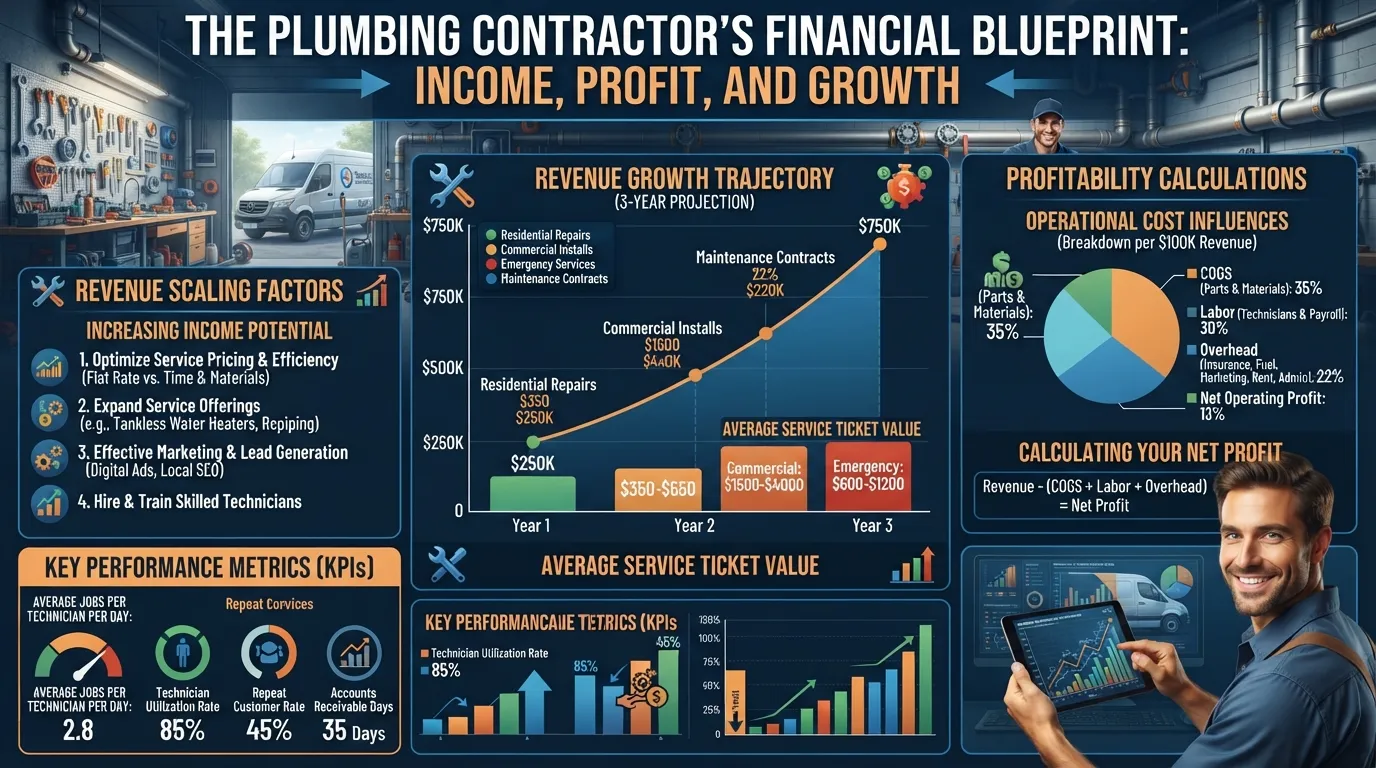 Owning a plumbing business is exceptionally profitable, routinely outperforming standard retail and service sectors due to high emergency demand and steep technical barriers to entry. However, profitability is not guaranteed simply by opening your doors; it requires strict adherence to flat-rate pricing, tight labor utilization, and low overhead management.
- High Profit Margins: Well-run residential service and repair plumbing shops typically achieve net profit margins between 15% and 25% after all expenses and owner compensation.
- Recession-Resistant Demand: Burst pipes, failing water heaters, and overflowing sewer lines require immediate remediation regardless of broader economic fluctuations.
- Prerequisite Discipline: Shops fail when owners underprice their services, mix personal funds, or fail to account for hidden vehicle and insurance overhead.
Plumbing Business Owner Salary: What to Expect in Year 1, 3, and 5
While employed mechanics and technicians earn a median wage tracked by government agencies like the U.S. Bureau of Labor Statistics, business owner earnings scale dramatically higher once systems and multi-truck operations are established.
- Year 1 (The Survival Phase): Expect a modest owner draw between $45,000 and $70,000 as early revenues are heavily reinvested back into tools, marketing, and emergency vehicle reserves.
- Year 3 (The Stabilization Phase): With a steady local brand presence and your first technician deployed, owner take-home compensation typically climbs to $90,000–$140,000.
- Year 5 (The Scale Phase): Established multi-truck operators managing a structured team frequently clear $180,000 to $250,000+ in combined salary and net business distributions.
Can Plumbers Make $200,000 a Year?
Breaking the $200,000 annual earnings threshold is entirely realistic for both master technicians working in high-cost metro markets and dedicated plumbing business owners. Achieving this level of income requires moving away from hourly wage work and building a leveraged service model.
- As an Owner: Scaling a two-to-three truck residential service operation past $600,000 in gross annual revenue safely yields a $200,000+ net owner income.
- As a Field Technician: Elite commission-based service plumbers in affluent metropolitan regions can surpass $150,000 to $200,000 by mastering high-ticket sales, diagnostics, and after-hours emergency shifts.
- Efficiency and Upselling: Reaching this benchmark demands consistent execution of add-on repairs, whole-home safety inspections, and membership renewals on every call.
What Makes the Most Money in Plumbing?
Not all plumbing services generate equal profit margins; emergency repairs, high-ticket replacements, and specialized residential diagnostics vastly outperform standard new construction rough-ins.
- Water Heater Replacements: High-margin swap-outs of tankless and traditional tank water heaters generate fast, lucrative revenue.
- Drain Cleaning & Hydro Jetting: Clearing main sewer line blockages commands high hourly billing rates with minimal material costs.
- Whole-House Repipes: Replacing galvanized or polybutylene pipes with modern PEX piping brings in multi-thousand-dollar multi-day project fees.
- Maintenance Memberships: Building a base of recurring annual subscribers provides predictable cash flow during seasonal slow periods.
Plumbing vs. HVAC: Which Pays Better?
Both plumbing and HVAC represent elite trades within the home services sector, offering comparable income ceilings and high consumer demand. The primary differences lie in seasonality, equipment costs, and ticket structures.
- HVAC Advantages: Systems feature massive replacement ticket sizes during peak summer and winter extreme weather spikes, though demand can drop sharply during mild spring and autumn shoulder months.
- Plumbing Advantages: Plumbing demand remains steady and consistent year-round because water and waste emergencies happen every single day regardless of the weather forecast.
- Earning Parity: Master operators and business owners in both trades achieve nearly identical earning potentials when implementing modern flat-rate pricing and digital marketing strategies.
10 Mistakes That Sink New Plumbing Businesses
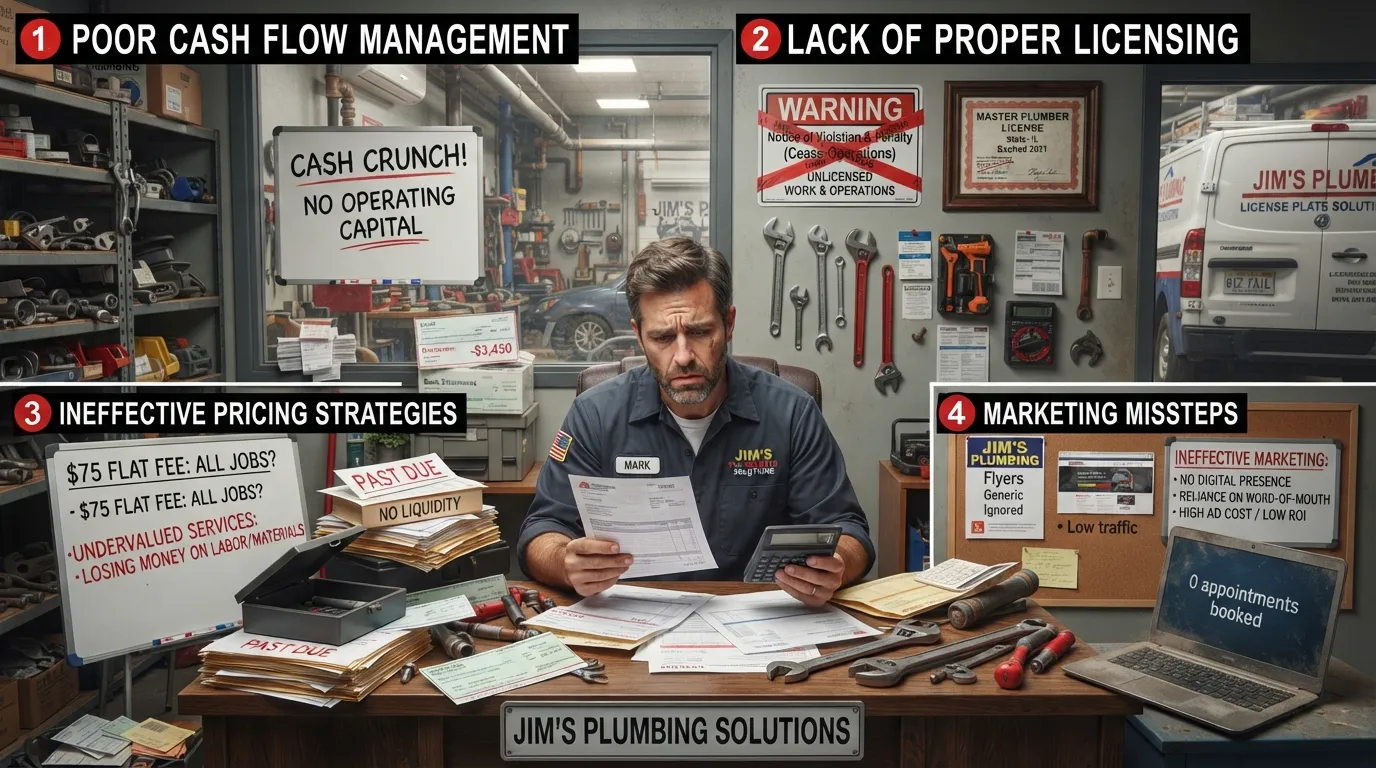 Pricing your services based solely on what competitors charge—or guessing your rates without factoring in hidden operating costs—is the fastest route to insolvency. New owners frequently forget to account for vehicle depreciation, commercial insurance premiums, fuel, tool replacement, and warranty callbacks when quoting customers.
- The Guesswork Trap: Charging arbitrary hourly rates rather than calculating your true break-even operating costs per billable hour.
- Forgetting Overhead: Failing to distribute fixed monthly software, marketing, and administrative expenses across your service ticket pricing matrix.
- Margin Erosion: Absorbing material price increases without updating your flat-rate pricebooks, destroying your net profit margins.
Missing Calls and Slow Follow-Up
In the home services sector, the customer who calls first will usually book with the first company that answers their phone live. Letting inbound calls roll over to voicemail or responding to web leads hours later hands high-intent emergency jobs directly to your competitors.
- Voicemail Leakage: Homeowners with overflowing toilets or burst pipes will rarely leave a message; they will simply dial the next number on Google.
- Delayed Digital Response: Waiting hours to reply to online contact form submissions destroys lead conversion rates and wastes marketing dollars.
- Lack of Answering Support: Operating without an after-hours answering service or automated text-back system cuts off your most lucrative night and weekend emergency calls.
Hiring Before Systems Exist
Bringing employees onto your payroll before you have documented standard operating procedures, steady lead flow, and clear pricing creates instant financial chaos. Hiring out of desperation when you are overwhelmed usually leads to poor cultural fits and severe cash flow crunches.
- Disorganized Onboarding: Handing new technicians the keys to a truck without structured job checklists, pricing guides, or CRM training.
- Payroll Pressure: Forcing your business to generate enough high-ticket work to cover fixed technician salaries before your acquisition channels are stable.
- Training Bottlenecks: Spending all your operational hours supervising a new hire instead of managing the broader business growth.
Mixing Personal and Business Money
Co-mingling personal and business funds makes tax preparation a nightmare and completely compromises your legal liability protection. Operating out of a single personal checking account strips away the asset separation that your LLC was formed to provide.
- Corporate Veil Piercing: Mixing funds can legally invalidate your LLC structure, leaving your personal home and savings exposed in a lawsuit.
- Tax Season Panic: Inability to accurately reconcile business expenses and revenue spikes when filing annual federal and state returns.
- Cash Flow Blindness: Failing to maintain a dedicated business operating account makes it impossible to track true monthly profitability.
Skipping Insurance or Licensing Shortcuts
Attempting to save money by delaying general liability insurance, surety bonds, or state contractor licensing exposes your business to catastrophic legal and financial risk. Municipalities and discerning homeowners will quickly lock unlicensed operators out of lucrative jobs.
- Uninsured Liability: A single major water leak caused by a faulty fitting can trigger hundreds of thousands of dollars in property damage with zero insurance coverage.
- Stop-Work Orders: Municipal inspectors can instantly shut down your jobs and slap your company with heavy fines for pulling permits without proper credentials.
- Reputational Damage: Being unable to provide proof of insurance or licensing destroys consumer trust immediately during initial estimates.
Chasing Every Job Instead of Profitable Jobs
Taking on low-margin, high-headache projects—like basic clogged drains for $75 or distant cross-town service calls—burns valuable time and fuel that should be spent on profitable repairs. Chasing volume over margin exhausts your technicians and clogs your daily schedule.
- Low-Ticket Distractions: Spending hours on minor service calls that lose money once travel time and fuel costs are factored in.
- Geographic Bloat: Driving an hour across town for a minor repair instead of tightening your service radius to high-density neighborhoods.
- Ignoring High-Margin Work: Failing to pitch water heater upgrades, whole-house repipes, or maintenance agreements during standard service visits.
What Reddit Plumbers Say They Wish They Knew
Experienced trade professionals active in online contractor communities frequently emphasize that technical mastery alone does not translate to business survival. Seasoned operators often share hard-earned lessons regarding customer communication, business boundaries, and financial discipline.
- Value of Saying No: Experienced owners stress the importance of walking away from abusive or unrealistic customers who drain company morale and time.
- Invest in Good Software Early: Veterans consistently advise automating dispatch, invoicing, and customer texts from day one rather than migrating manual systems later.
- Charge Your Worth: A recurring theme among trade veterans is regret over undercharging early in their careers out of fear of losing bids.
Your 30-60-90 Day and 12-Month Action Plan
 Your opening month is dedicated entirely to laying an airtight legal, administrative, and technical foundation. Rushing past this phase creates massive compliance vulnerabilities that can derail your business before your first service call.
- Secure your state contractor licensing and establish your official legal business entity (LLC).
- Purchase mandatory general liability insurance policies, commercial vehicle coverage, and surety bonds.
- Outfit your service vehicle with essential hand tools, diagnostic equipment, and initial pipe fittings.
- Build your baseline flat-rate pricebook to ensure every repair accounts for true operating overhead.
Days 31 to 60: Marketing Setup and First Customers
With your legal framework established, month two focuses intensely on digital visibility and capturing your initial inbound customer leads. Speed and responsiveness during this phase dictate how fast your reputation spreads locally.
- Optimize your Google Business Profile with precise service categories, local photos, and service areas.
- Launch a clean, fast-loading mobile website featuring dedicated landing pages for core plumbing services.
- Establish partnerships with local real estate agents and property managers to generate early referral work.
- Implement an instant call-answering or text-back system to ensure zero missed customer leads.
Days 61 to 90: Track Numbers Fix Pricing Get Reviews
Your third month centers on financial auditing, operational refinement, and cementing your local social proof. Reviewing historical job costs eliminates early pricing mistakes and stabilizes your cash flow.
- Audit 90 days of job durations, material invoices, and fuel expenses against your initial budget.
- Refine your flat-rate pricebook based on actual historical labor times and overhead variances.
- Automate post-job review requests to build a consistent stream of five-star Google ratings.
- Establish a separate tax reserve account, transferring 25% to 30% of every completed service ticket.
Months 4 to 12: Systems First Hire Maintenance Agreements
The remainder of your first year shifts your focus from solo survival to scalable growth, recurring revenue, and team delegation. Implementing robust field service software allows you to step back from daily firefighting.
- Deploy field service management software to streamline dispatching, GPS routing, and mobile invoicing.
- Introduce recurring preventative maintenance agreements to build predictable monthly cash flow.
- Hire your first apprentice, journeyman, or office administrator once booking capacity consistently hits 80%.
- Document core standard operating procedures (SOPs) for job execution and customer communication.
Frequently Asked Questions About Running a Plumbing Business
Is owning a plumbing business profitable?
Owning a plumbing business is highly profitable, typically generating net profit margins between 15% and 25%. Because plumbing emergencies like burst pipes and failed water heaters cannot be delayed, demand remains resilient year-round. Profitability depends heavily on implementing flat-rate pricing, controlling overhead expenses, and maximizing technician efficiency.
Can I start a plumbing business without being a plumber?
Yes, you can own a plumbing business without holding a license yourself, provided your state allows corporate ownership structures. However, you must legally employ or partner with a certified master plumber of record to pull municipal permits, supervise technical compliance, and oversee field operations.
How much does it cost to start a plumbing business?
Starting a traditional plumbing business typically requires an initial capital investment between $15,000 and $50,000. This startup budget covers essential equipment like a used service vehicle, general liability insurance, surety bonds, contractor licensing fees, hand tools, drain cleaning machinery, and an initial working capital cash reserve.
What license do I need to start a plumbing business?
You need a valid state or municipal plumbing contractor license, general liability insurance policies, and a state-mandated surety bond. Requirements vary significantly by region; for instance, some states require proving four years of journeyman experience before passing the master plumber certification exam required to operate independently.
How do I start a plumbing business with no money?
Starting with zero liquid capital requires bootstrapping by taking on 1099 subcontracting work for established local contractors to build fast cash. You can utilize equipment financing for heavy tools, operate out of your personal vehicle initially, and rely entirely on word-of-mouth marketing until profits accumulate.
Can I open a plumbing business after 5 years of experience?
Yes, five years of hands-on experience is often the exact threshold required to test for your journeyman or master plumber certification in many jurisdictions. Combining this technical background with foundational business management skills prepares you to transition successfully into company ownership.
What is the profit margin for a plumbing business?
Well-run residential service and repair plumbing businesses routinely achieve gross profit margins between 60% and 75%, resulting in healthy net profit margins of 15% to 25%. Maintaining these margins requires strict tracking of labor costs, part markups, and overhead expenses.
Do plumbing business owners still work in the field?
Early-stage owner-operators frequently work full-time in the field while managing administration after hours. However, sustainable business growth requires transitioning away from tools to focus entirely on dispatching, marketing, financial oversight, and team leadership once revenue supports hiring technicians.
Which pays more: residential service or commercial plumbing?
Residential service and repair generally yields higher profit margins and immediate payment collection, whereas commercial plumbing involves larger contract values with slower net-30 payment terms. Both sectors offer exceptional earning potential depending on your operational focus and team structure.
What software do plumbing companies use?
Plumbing companies utilize Field Service Management (FSM) software such as Housecall Pro, ServiceTitan, and Simpro to handle scheduling, dispatching, inventory tracking, and mobile invoicing. Additionally, platforms like Podium or Weave are widely used to manage customer communications and automate review requests.
Final Thoughts: Build the Business Not Just the Job
Building a thriving plumbing enterprise requires shifting your mindset from a technician turning wrenches to an executive managing scalable systems. Mastering these core principles ensures long-term market survival and personal financial freedom.
- Legal & Financial Foundation: Always secure your proper contractor licensing, surety bonds, liability insurance, and a dedicated business entity before taking on clients.
- Profitable Pricing: Implement flat-rate pricing models and calculate your true break-even operating costs to protect your 60% to 75% gross profit margins.
- Speed & Lead Flow: Never miss an inbound phone call; utilize immediate response workflows and optimize your Google Business Profile to capture high-intent local emergency leads.
- Systems Before Staff: Document clear standard operating procedures and deploy field service software before onboarding your first employee or technician.
- Recurring Revenue: Introduce preventative maintenance agreements to transform unpredictable seasonal lulls into a steady, predictable monthly cash flow floor.

Oscar Vance | Master Plumber & Drainage Expert
Meet Oscar Vance, a licensed master plumber sharing practical solutions on residential repairs, preventive maintenance, and thoughtful home upkeep.