26 Gauge vs 29 Gauge Metal Roofing
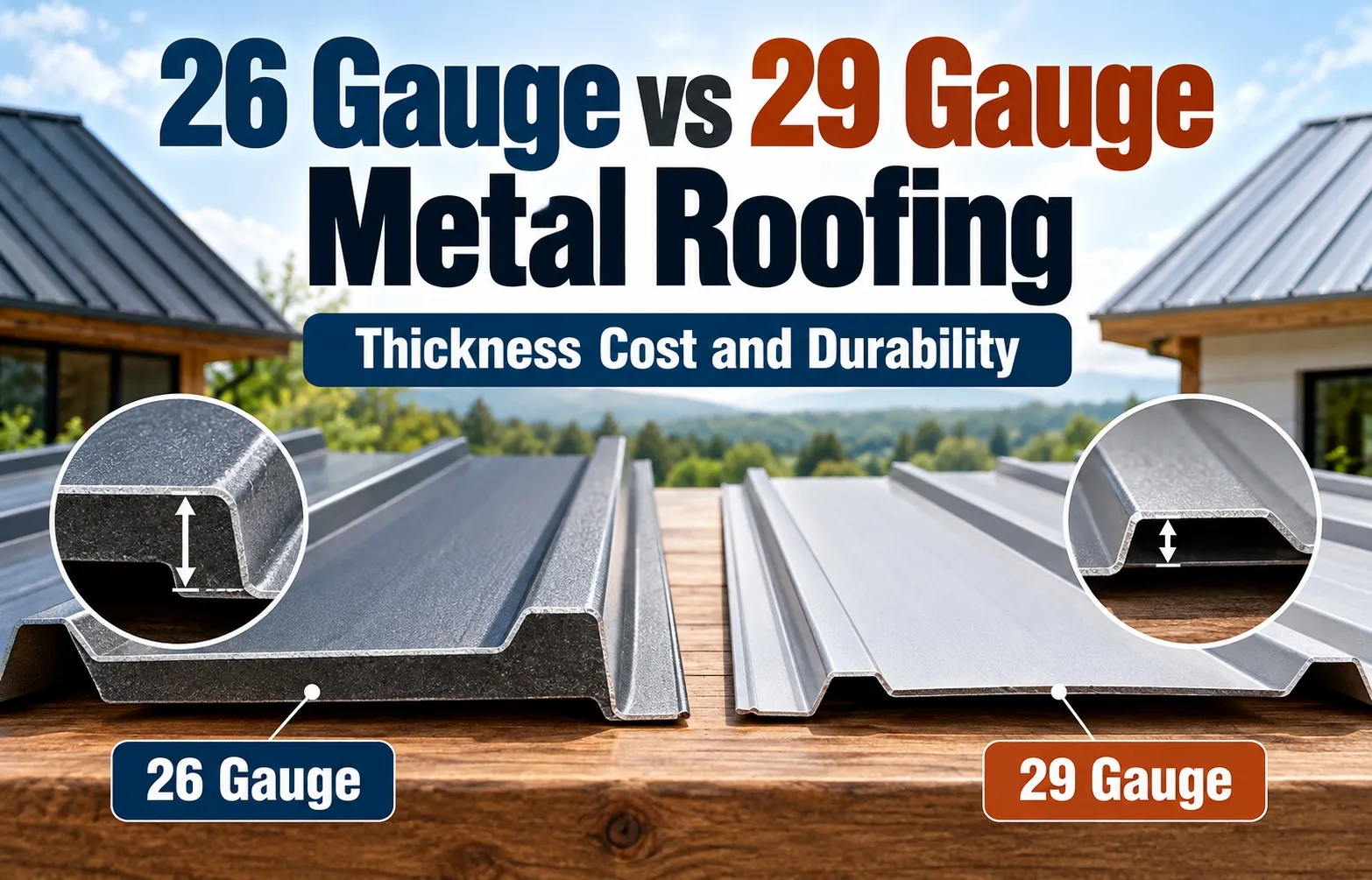 Choosing between 26 gauge vs 29 gauge metal roofing comes down to structural strength, decimal thickness, and project budget. A 26 gauge steel panel measures roughly 0.0187 inches (0.475 mm) in thickness, making it about 25% thicker and significantly more rigid than a 29 gauge panel, which measures approximately 0.0142 inches (0.361 mm). While 29 gauge metal roofing offers an economical solution for agricultural structures, 26 gauge steel provides superior panel rigidity, higher wind uplift resistance, and better protection against hail impact for residential homes and barndominiums.
Investing in 26 gauge metal roofing costs roughly 15% to 30% more in raw material expenses compared to 29 gauge panels. However, the increased decimal thickness delivers substantial long-term benefits, including enhanced screw thread retention, minimal oil canning, and an extended service life exceeding 40 to 50 years under severe weather conditions.
At a Glance: 26 Gauge vs. 29 Gauge Metal Roofing Quick Matrix
The following side-by-side comparison outlines the critical physical, financial, and structural differences between these two standard steel panel options:
The Reverse Gauge Scale Explained (Why Lower Numbers Mean Thicker Steel)
Understanding the standard steel gauge scale can be confusing because the numbering system operates inversely to actual physical dimension. In metal manufacturing, a lower gauge number always designates a thicker sheet of metal, whereas a higher gauge number represents a thinner sheet.
This measurement standard originates from historic wire-drawing processes, where the gauge number represented the total number of drawing passes required to thin out the metal:
- More Manufacturing Passes: A 29 gauge steel sheet undergoes more reduction steps, resulting in a thinner, lighter final panel (~0.0142 inches).
- Fewer Manufacturing Passes: A 26 gauge steel sheet undergoes fewer reduction steps, leaving a thicker, stronger metal substrate (~0.0187 inches).
- Structural Thickness Gap: The difference of 0.0045 inches between these two options may sound tiny, but it yields a 25% increase in structural mass and stiffness for 26 gauge panels.
When selecting panels for structural installations, prioritizing greater decimal thickness enhances total panel rigidity, secures fastener grip, and protects the roof against long-term environmental degradation.
Deep Dive into 26-Gauge Metal Roofing
26-gauge metal roofing serves as the industry standard for residential, commercial, and heavy-duty structural applications. Engineered with high structural strength, this panel thickness provides exceptional weather protection, making it the preferred choice for homeowners and professional building contractors seeking long-term performance.
What is 26-Gauge Steel Roofing? (Specs & Measurements)
26-gauge steel roofing features a nominal decimal thickness range between 0.0187 inches and 0.0217 inches (including protective substrate coatings). Manufactured from high-tensile structural steel, these residential steel panels deliver optimal stiffness without adding excessive dead weight to the roof framing.
Key technical specifications of 26-gauge steel panels include:
- Decimal Thickness: Ranging from 0.0187” to 0.0217” depending on paint layers and zinc/Galvalume coating depth.
- Protective Metallic Coatings: Standardized with Galvalume (aluminum-zinc alloy) or G90 galvanization for extreme corrosion resistance.
- Yield & Tensile Strength: Typically rated at 50,000 PSI (Grade 50 steel) or 80,000 PSI (Grade 80 steel) to prevent structural deformation under heavy physical loads.
- Panel Weight: Weighs approximately 0.90 to 1.00 pounds per square foot, providing substantial heft to resist uplift forces.
Wind Uplift Hail Resistance and Longevity
The core advantage of 26-gauge metal roofing lies in its superior mechanical resilience under severe weather conditions. The extra mass directly improves fastener pull-out strength, ensuring that structural screws maintain maximum thread engagement within the steel substrate during intense storms.
Key performance advantages include:
- Wind Uplift Resistance: Thicker steel increases screw retention, preventing hurricane-force wind loads from tearing panels away from purlins or plywood decking.
- Class 4 Hail Rating: Most 26-gauge steel panels achieve a Class 4 impact rating (UL 2218 testing), withstanding steel ball impacts that would puncture or severely dent lighter gauge panels.
- Exceptional Service Life: Combined with premium PVDF (Kynar 500) paint finishes, 26-gauge installations routinely last 40 to 60 years with minimal maintenance.
Residential Homes Barndominiums and High-Wind Zones
Building contractors widely mandate 26-gauge steel as the absolute minimum standard for living spaces and occupied structures. Its rigid profile maintains structural integrity across wide spans while reducing thermal expansion noise and panel distortion.
Recommended use cases include:
- Residential Homes & Barndominiums: Delivers essential strength, premium aesthetics, and long-term durability required for primary residences and barndominium roofing projects.
- High-Wind and Coastal Zones: Engineered to satisfy strict local building codes in regions prone to severe weather, high wind shear, or tropical storms.
- Heavy Snow and Hail Belts: Supports dense snow loads and ice accumulation without buckling or sagging between framing supports.
Are There Any Drawbacks to 26-Gauge Roofing?
While 26-gauge steel delivers superior overall performance, property owners should consider a few operational trade-offs before purchasing.
- Higher Initial Investment: Raw material expenses run approximately 15% to 30% higher than lighter 29-gauge options.
- Handling & Cutting Requirements: Thicker steel panels require heavy-duty metal shears or nibblers during field cutting and installation.
Deep Dive into 29-Gauge Metal Roofing
29-gauge metal roofing provides an economical, lightweight solution for utility and agricultural structures where extreme structural reinforcement is not required. Measuring between 0.0140 inches and 0.0172 inches in decimal thickness, these budget roofing options deliver reliable weather-shedding performance at a significantly lower initial cost.
What is 29-Gauge Steel Roofing? (Specs & Cost Factors)
29-gauge steel roofing features a nominal decimal thickness range from 0.0140 inches to 0.0172 inches. As a primary cost-saving alternative to heavier panels, it reduces raw material and transportation expenses by offering a lighter structural profile while maintaining standard corrosion-resistant Galvalume coatings.
Core specifications and factors governing 29-gauge steel include:
- Decimal Thickness Range: Typically measures between 0.0140” and 0.0172” prior to paint applications.
- Cost Optimization: Offers the most affordable entry point for large-scale steel building projects.
- Coating Protection: Treated with standard zinc or acrylic-coated Galvalume to prevent baseline environmental corrosion.
Advantages: Budget-Friendly and Lightweight
The primary advantage of 29-gauge steel is its exceptional cost-efficiency and lightweight nature. This economy makes it the preferred material choice for large-scale agricultural projects and DIY structures where minimizing upfront expenses is a primary construction objective.
Key practical advantages include:
- Lower Purchasing Expenses: Significantly reduces total material costs per square foot compared to heavier residential gauges.
- Lightweight Handling: Easier manual transport and positioning during field installation due to reduced panel mass.
- Minimal Framing Demands: Places very little dead load on standard pole barn framing or secondary timber purlins.
Key Vulnerabilities: Oil Canning Dents and Weather Stress
Due to its increased panel flexibility, 29-gauge steel is notably more vulnerable to oil canning, surface denting, and thermal stress. The thinner substrate lacks the structural rigidity needed to mask framing imperfections or resist heavy impact from severe hail storms.
Important performance vulnerabilities to evaluate include:
- Oil Canning Susceptibility: Highly prone to visual waviness, stress wrinkling, and uneven reflections across flat panel surfaces.
- Impact Damage: Easily dented or punctured by moderate hail, falling tree branches, or heavy foot traffic.
- Weather Stress: Reduced screw pull-out strength makes it less suitable for regions experiencing high wind uplift or severe storm activity.
Where Should You Use 29-Gauge Steel? (Agricultural & Utility Buildings)
29-gauge metal roofing is ideally suited for unheated agricultural buildings, livestock shelters, open hay barns, and basic storage sheds. These structures benefit from cost-effective weather protection where interior climate control and heavy daily occupancy are absent.
Recommended building applications include:
- Agricultural Facilities: Excellent for pole barns, machine sheds, and livestock shelters requiring basic weather protection.
- Open Storage Structures: Ideal for open-sided hay barns and equipment covers where ventilation outweighs insulation.
- Utility & DIY Sheds: Perfect for backyard sheds, detached carports, and hobby workshops built on strict budgets.
The Oil Canning Factor & Sub-Framing Imperfections
Oil canning—the visible wavy distortion across flat areas of metal panels—is one of the most frequent aesthetic complaints in metal roofing. While oil canning is an inherent characteristic of light-gauge sheet metal and does not indicate structural failure, choosing the right panel gauge and understanding sub-framing interaction significantly reduces its occurrence.
What Causes Oil Canning in Metal Panels?
Oil canning occurs when localized stresses accumulate within the flat sections of metal panels, forcing the metal to bow outward or inward under tension. This stress wrinkling creates an uneven, distorted reflection that becomes especially pronounced under direct sunlight.
Primary drivers of oil canning in metal roofing include:
- Sub-Framing Imperfections: Uneven wood purlins, bowed rafters, or protruding fastener heads force installed panels into an unlevel plane.
- Over-Tightened Fasteners: Driving screws too tightly restricts normal panel movement, creating localized tension ripples around the fastener heads.
- Differential Thermal Expansion: Temperature fluctuations cause metal panels to expand along their length, creating surface buckling if movement is constrained.
How 26-Gauge Steel Bridges Sub-Framing Imperfections
The primary defense against oil canning is structural panel rigidity. Thicker 26-gauge steel possesses greater flexural strength, allowing it to span minor framing variations without conforming to underlying unevenness.
How 26-gauge steel mitigates visual distortion:
- Spanning Purlin Misalignments: The added decimal thickness enables 26-gauge panels to bridge slight high or low spots across wood purlins or solid plywood decking without telegraphing ripples to the surface.
- Resisting Fastener Stress: Thicker substrate material distributes torque stress evenly around screw holes, preventing deep dimpling and localized distortion.
- Maintaining Flatness Across Spans: Enhanced structural rigidity keeps wide, flat panel profiles visually flat over varied support spacing.
Why 29-Gauge Warps Faster Under Direct Sun
Thermal expansion affects all metal roofing, but thinner 29-gauge steel reacts far more severely to direct solar heating. As dark roof surfaces heat up during summer days, the metal expands rapidly along its length.
The impact of thermal stress on 29-gauge vs 26-gauge panels:
- Higher Substrate Flexibility: Because 29-gauge steel lacks heavy cross-sectional mass, internal thermal stress immediately manifests as visible surface waves across flat panel areas.
- Sub-Framing Telegraphing: Unlevel framing or warped timber purlins easily bend thin 29-gauge panels, creating permanent wave patterns across the roof line.
- Rigidity Under Heat: 26-gauge panels maintain structural stability during extreme temperature swings, significantly curbing visible wave creation and visual distortion under intense sun.
Walkability Maintenance & Fastener Safety
Roof walkability is a primary concern for property owners performing routine cleaning, gutter maintenance, or solar panel installation. Panel thickness directly determines whether a roof can support human foot traffic without sustaining permanent surface dents, structural creases, or fastener pull-out damage.
Can You Walk on a 26-Gauge Metal Roof? (Safety & Weight Guidelines)
Yes, you can safely walk on a 26-gauge metal roof because its heavier decimal thickness and rigid structural profile effectively support normal human weight when stepping directly over underlying support points, making it dependable for regular roof maintenance and contractor access.
Key considerations for walking on 26-gauge panels include:
- Structural Resilience: Thicker steel distributes body weight efficiently across support spans, minimizing the risk of buckling or surface dimpling.
- Maintenance Suitability: Safely accommodates occasional foot traffic required for gutter cleaning, roof inspections, and minor repairs.
- Fastener Integrity: Greater rigidity prevents foot pressure from loosening screws or distorting pre-drilled fastener holes.
Can You Walk on a 29-Gauge Metal Roof Without Denting It?
Walking on a 29-gauge metal roof requires extreme caution because its thin substrate easily dents, creases, or oil-cans under direct heel pressure, especially when panels are installed over open wood purlins rather than solid plywood decking.
Important factors regarding 29-gauge walkability include:
- High Vulnerability to Dents: The lighter gauge metal lacks the cross-sectional mass needed to resist concentrated body weight between support spans.
- Risk of Surface Buckling: Uncareful stepping can permanently distort flat panel areas and compromise weather-tight seals around fasteners.
- Mitigation Techniques: Requires specialized weight distribution boards or professional roof pads if frequent rooftop access is unavoidable.
Contractor Foot Placement Rules: Where and How to Step
Professional roofing contractors follow strict foot placement rules to protect steel panels from damage, always stepping directly over purlin support lines and flat panel sections while wearing soft, clean, rubber-soled boots to ensure maximum traction.
Essential contractor safety guidelines include:
- Step on Purlin Lines: Always position your feet directly over the screw lines where panels anchor securely into the underlying purlins or decking.
- Flat Rib Placement: Walk on the flat valleys or lower ribs of the panel rather than balancing precariously on high standing ribs that can easily fold under pressure.
- Rubber-Soled Footwear: Wear soft-soled shoes to prevent slipping on sloped metal surfaces and to avoid scratching the protective Kynar or Galvalume paint finish.
True Cost Analysis & Long-Term ROI
Evaluating the financial impact of metal roofing requires looking beyond initial material prices. While thinner panels offer immediate upfront savings, a comprehensive analysis of total cost of ownership, replacement intervals, labor expenses, and potential home insurance premium discounts reveals that heavier gauge steel often delivers superior long-term financial returns.
Upfront Material & Installation Price Breakdown
Choosing 26-gauge steel over 29-gauge steel increases the raw material expense by approximately 15% to 30%. However, because installation techniques, underlayment requirements, and crew labor costs remain virtually identical for both panel thicknesses, the overall impact on the total job estimate is far less dramatic.
Key financial factors in initial roofing quotes include:
- Raw Material Cost per Square Foot: 29-gauge panels represent the baseline economical pricing, whereas 26-gauge panels add a modest premium to the raw sheet steel cost.
- Labor Costs Balance: Installation crews charge similar rates for handling both gauges, as fastener placement, trim installation, and panel alignment require equal labor time.
- Total Installed Cost Impact: The 15% to 30% increase applies strictly to the panel materials, resulting in only a 5% to 12% total project cost increase for the complete roof system.
The Insurance Angle: Class 4 Hail Discounts for 26-Gauge Panels
A major financial advantage of 26-gauge metal roofing lies in its ability to earn significant policy premium reductions. Most 26-gauge panels qualify for a Class 4 impact resistance rating under UL 2218 testing standards, whereas thinner 29-gauge panels are far more prone to hail denting and frequently fail to meet top impact criteria.
How insurance incentives offset initial material costs:
- Home Insurance Premium Discount: Insurance carriers frequently offer discounts ranging from 10% to 28% annually on home policy premiums for roofs featuring certified Class 4 impact resistance.
- Accelerated Payback Period: Annual premium savings of $300 to $600 routinely recoup the initial 15% to 30% material price premium for 26-gauge steel within 5 to 7 years.
- Deductible Protection: Thicker panels withstand severe hail storms without puncturing, saving homeowners from paying costly out-of-pocket insurance deductibles after major weather events.
Total Cost of Ownership (TCO): 15-Year Replacement vs. 40-Year Investment
Analyzing total cost of ownership over a 40-year window demonstrates the true value proposition of higher-strength steel. A budget 29-gauge installation in high-stress weather zones may require repainting, panel replacement, or fastener overhauls within 15 to 20 years due to thermal movement, panel denting, or storm degradation.
Long-term ROI considerations for homeowners include:
- Extended Panel Longevity: 26-gauge steel systems routinely achieve a service life exceeding 40 to 60 years with basic maintenance.
- Avoided Replacement Costs: Installing 26-gauge steel eliminates the need for premature teardowns and costly mid-life replacements.
- Enhanced Property Resale Value: Premium residential steel panels offer documented architectural appeal, durable weather protection, and high structural rating credentials that boost home appraisal value.
Decision Framework: Which Gauge Should You Choose?
Selecting the right metal roofing gauge depends on balancing long-term performance requirements against initial project budget constraints. Evaluating your specific building type, local climate risks, structural framing layout, and municipal building codes will help you make a confident, cost-effective decision.
Choose 26-Gauge Metal Roofing IF
26-gauge steel is the recommended standard for primary residences, commercial properties, and high-value structures where long-term durability and aesthetic appeal are essential.
Select 26-gauge metal panels if your project meets any of the following criteria:
- Occupied Residential Structures: You are roofing a primary home, barndominium, or attached residential garage where structural longevity and sound dampening matter.
- Severe Climate Conditions: Your property is located in high-wind coastal zones, heavy snow belts, or hail-prone regions requiring Class 4 impact resistance.
- Strict Building Codes: Local municipal building codes or HOA guidelines mandate minimum panel thickness or certified wind uplift ratings for residential roof selection.
- Minimizing Oil Canning: You want a sleek, flat architectural appearance with minimal risk of surface wave distortion across wide panel spans.
- Rooftop Access Needs: You anticipate foot traffic for ongoing maintenance, solar panel installation, or routine chimney and gutter cleaning.
Choose 29-Gauge Metal Roofing IF
29-gauge steel provides a practical, budget-friendly roofing solution for utility and agricultural applications where basic weather protection is the primary goal.
Select 29-gauge metal panels if your project meets any of the following criteria:
- Agricultural & Utility Buildings: You are constructing open-sided hay barns, agricultural sheds, livestock shelters, or detached carports.
- Tight Initial Budget: Minimizing upfront raw material expenses is your top priority for an unheated or non-residential structure.
- Mild Climate Zones: The building location experiences low risk of severe hail, heavy snow accumulation, or hurricane-force wind shear.
- Light Duty Applications: Rooftop access will be minimal or non-existent, eliminating concerns about panel denting from foot traffic.
People Also Ask & Frequently Asked Questions
Finding straightforward answers to specific technical questions is crucial when evaluating metal panel thickness. Below are direct, expert-backed answers to the most common questions homeowners and builders ask about 26 gauge and 29 gauge metal roofing systems.
What is the best gauge for a residential metal roof?
The best gauge for a residential metal roof is 26 gauge steel. Its 0.0187-inch decimal thickness offers optimal panel rigidity, superior wind uplift resistance, and a Class 4 impact rating to withstand severe weather, hail, and foot traffic on homes and barndominiums.
How long will a 26-gauge metal roof last compared to a 29-gauge roof?
A 26-gauge metal roof typically lasts 40 to 60 years due to its thicker steel substrate and high fastener retention. In contrast, a 29-gauge roof averages a 20 to 30-year service life because thinner metal is more vulnerable to storm damage, panel fatigue, and seal degradation.
Do you need solid plywood decking under 26-gauge and 29-gauge metal roofing?
Thinner 29-gauge metal roofing requires solid plywood decking or OSB underlayment to prevent severe sag and oil canning across spans. Conversely, rigid 26-gauge panels can safely span open purlin support lines spaced up to 24 inches apart without requiring continuous solid wood decking beneath.
What is the biggest problem with 29-gauge metal roofing?
The biggest problem with 29-gauge metal roofing is its high vulnerability to oil canning, surface denting, and wind tear-off. Because the metal is thin (0.0142 inches), thermal expansion easily warps flat panel areas, while severe hail and foot traffic cause permanent cosmetic and structural damage.
Does panel gauge affect metal roofing paint warranties?
Yes, panel gauge directly impacts paint warranties. Thicker 26-gauge steel undergoes less flexing, allowing premium PVDF finishes like Kynar 500 to adhere better and offer 40-year fade and chalk warranties. Thinner 29-gauge steel flexes frequently under thermal stress, often resulting in shorter 20 to 30-year limited paint coverage.

Oscar Vance | Master Plumber & Drainage Expert
Meet Oscar Vance, a licensed master plumber sharing practical solutions on residential repairs, preventive maintenance, and thoughtful home upkeep.