What Causes Pinhole Leaks in Copper Plumbing?
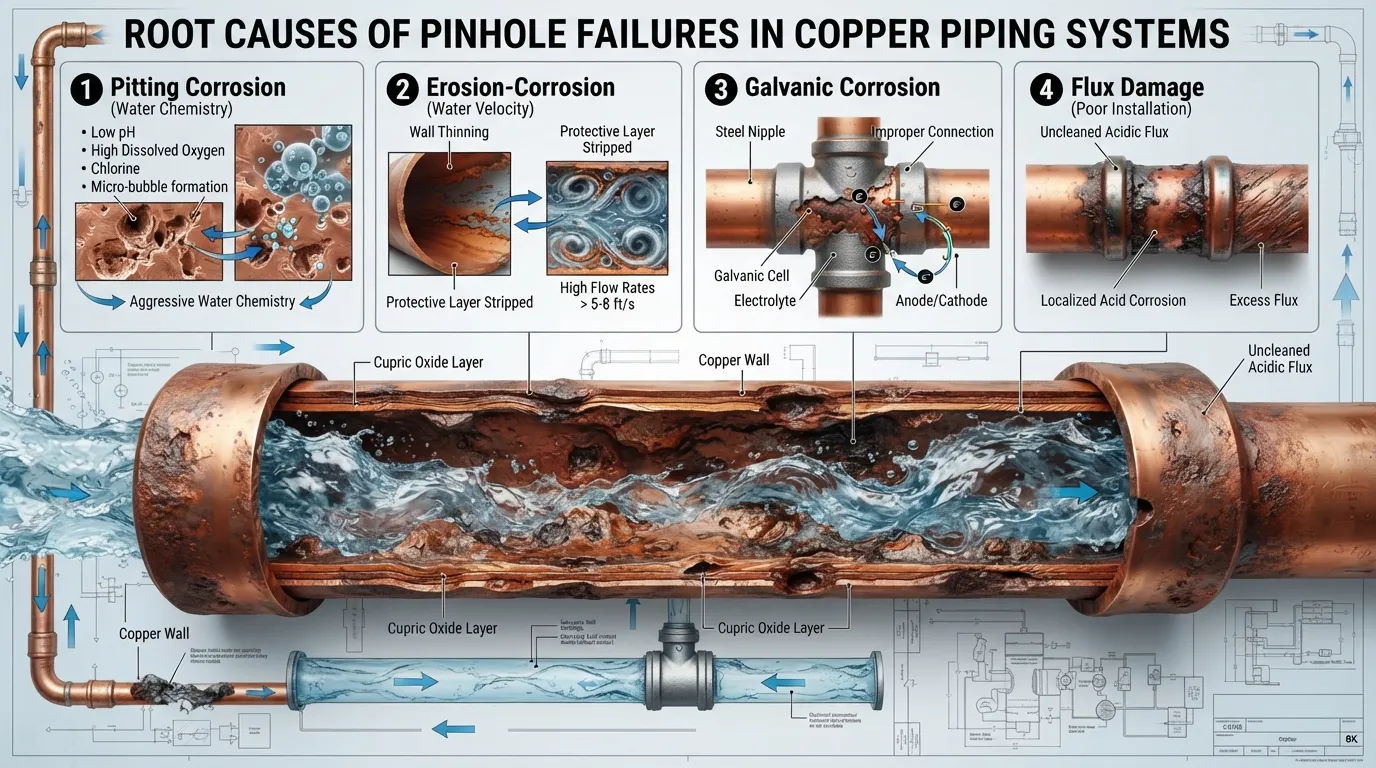
Pinhole leaks in copper pipes typically stem from localized pitting corrosion that breaches the metal’s protective oxide layer. This degradation is rarely driven by a single factor; instead, it results from a combination of aggressive water chemistry, trapped excess flux, high flow velocity, and microbial activity.
Understanding these underlying mechanisms allows property owners to address root issues rather than just treating recurring symptoms. Several factors have been extensively documented by plumbing engineers, while others remain subject to ongoing technical debate.
Target Audience and Expert Review
This breakdown is engineered to provide absolute clarity for several key groups:
- Homeowners: Seeking to identify why pipes fail unexpectedly and how to prevent costly structural water damage.
- Property Buyers: Evaluating the health and remaining lifespan of aging copper plumbing systems before purchase.
- Landlords & Managers: Protecting multi-unit residential investments from recurring plumbing failures.
- DIY Enthusiasts: Learning the core science behind pipe degradation to implement correct repair methods.
Content rigorously reviewed by certified master plumbers and water treatment specialists to ensure maximum technical accuracy and actionable insight.
What Is a Pinhole Leak and How Does Pitting Form Inside Copper Pipe?

Understanding the underlying mechanical process of copper pipe degradation is essential for diagnosing recurring plumbing failures. Before examining specific triggers, property owners must grasp how localized electrochemical reactions breach sturdy metal walls.
How Pitting Corrosion Eats Through Copper From the Inside Out
Copper naturally forms a protective oxide layer or scale that shields the metal from standard water contact. When aggressive water chemistry or chemical residues compromise this scale, a tiny localized anode spot is established, initiating deep, destructive pitting.
- Scale Breakdown: Protective layers crack under chemical stress, exposing bare copper underneath.
- Anode Formation: An electrochemical cell forms where metal ions dissolve rapidly at the microscopic anode site.
- Pit Deepening: Tuberculation and corrosion products build up over the pit, creating a localized environment that accelerates the perforation process.
Cold-Water Versus Hot-Water Pitting
Copper pipe corrosion manifests differently depending on whether lines carry cold or heated supply water. Type 1 pitting typically affects cold water systems driven by high dissolved carbon dioxide, while hot water lines often experience thermal-accelerated erosion-corrosion.
- Cold-Water Pitting (Type 1): Associated with well water or high-CO2 supplies, forming deep, random pits covered by green basic copper carbonate tubercles.
- Hot-Water Pitting (Type 2): Frequently observed in recirculating hot water loops where elevated temperatures and high flow rates break down protective films.
Green Stains Do Not Always Mean a Pinhole Leak
As noted by municipal water authorities like Butler County Water and Sewer, blue-green patches or staining on copper pipes indicate general surface corrosion. However, these visible discoloration zones do not automatically confirm an active pinhole leak or structural failure.
The Best-Documented Causes of Pinhole Leaks in Copper Pipes
Pinpointing the exact origin of pipe failure requires looking beyond simple generalizations. Multiple distinct environmental, chemical, and installation factors contribute to localized copper degradation, each supported by varying degrees of scientific field evidence.
Aggressive Water Chemistry pH Alkalinity Chlorine Sulfate
Imbalanced municipal water profiles often compromise the stability of protective copper scale. Low pH levels, insufficient buffering alkalinity, and high levels of dissolved oxygen or sulfates create an environment where corrosion cells can thrive.
- How to Identify: Widespread thinning of pipe walls across multiple fixtures, often accompanied by metallic tastes or bluish-green water discoloration.
- Evidence Strength: High. However, nuance is critical; studies by organizations like the Carnegie Mellon Center for Water Quality in the Built Environment (CCMWA) reveal that even with moderately alkaline or soft water supplies, water chemistry alone is frequently secondary to physical installation defects.
- Chloramine Nuance: While some studies associate secondary disinfectants like chloramine with accelerated degradation, overall field evidence remains mixed and heavily dependent on specific municipal treatment practices.
Excess Soldering Flux and Poor Installation
During installation, excessive application of acidic water-soluble or petroleum-based soldering flux often leaves chemical residue trapped inside the pipe. When heat and initial water flows push this paste along the interior wall, it eats away at the copper from day one.
- How to Identify: Pits and pinholes located strictly within one to two inches of soldered pipe joints or fittings, often matching runs installed during specific renovation periods.
- Evidence Strength: Very High. Historical plumbing failure analyses, including insights from the Housing Directorate Research (HDR 2012), highlight flux residue as a primary driver of premature pitting.
- Actionable Insight: Ask your installer whether they used water-soluble flux, thoroughly flushed and reamed the lines post-installation, and avoided over-applying the product.
High Water Velocity Pressure and Sediment Erosion-Corrosion
When water flows too quickly through copper plumbing or carries abrasive sand and sediment, it mechanically strips away the protective oxide film rather than allowing it to repair itself. High velocity combined with sharp directional changes causes severe turbulence.
- How to Identify: Grooved, horseshoe-shaped wear patterns or thinning concentrated on the outside radius of elbows, tees, and abrupt bends.
- Evidence Strength: High. Standard plumbing codes dictate maximum water velocity limits (typically kept below 5 to 8 feet per second for copper) to prevent this mechanical wear.
- Distinction: Static water pressure measures force against pipe walls when taps are closed, whereas velocity measures the actual speed of moving water when fixtures are open; erosion-corrosion is driven almost entirely by excessive velocity and turbulence, not normal static pressure ranges (typically 40 to 80 PSI).
Microbial Corrosion Low Chlorine and Stagnant Water
Biological factors can also destabilize copper integrity. Research from institutions like Virginia Tech (2018) indicates that homes with low municipal chlorine residuals, minimal daily water usage, or extended periods of stagnation foster environments conducive to microbial activity.
- How to Identify: Pitting clusters in dead-end plumbing branches, guest bathrooms, or infrequently used basement supply lines showing dark, localized corrosion byproducts.
- Evidence Strength: Moderate to Mixed. While sulfate-reducing bacteria (SRB) and internal biofilms are heavily implicated in lab environments, specific municipal investigations (such as CCMWA bacteria cultures) occasionally yield negative tests for active microbes, proving that microbial action is a localized risk rather than a universal cause.
Debated and Less-Certain Causes What Isn’t Proven
Plumbing literature is often filled with sweeping claims about what triggers pinhole leaks in copper piping. While some factors are scientifically airtight, many commonly cited explanations rely on speculation, anecdotal evidence, or misunderstood mechanics rather than rigorous field proof.
Electrical Grounding and Stray Current
Many homeowners are told that household electrical systems grounded to copper water lines accelerate corrosion via stray currents. Expert forums like the Mike Holt Electrical Forum frequently debate whether alternating current (AC) or direct current (DC) causes actual metal loss, while municipal studies (such as those by Butler County) classify electrical interference merely as a possible contributing factor.
- The Reality: Empirical data proving that standard electrical grounding causes widespread pinhole leaks remains sparse and inconclusive.
- Confidence Level: Low to Moderate.
Dissimilar Metals and Galvanic Corrosion
Direct contact between copper and other metals—such as galvanized steel or iron—initiates a galvanic reaction where the less noble metal corrodes rapidly. However, plumbers often misapply this theory to minor fittings or modern installations.
- The Reality: True galvanic corrosion is heavily mitigated by modern dielectric unions or non-conductive connectors, meaning it is rarely the hidden cause of isolated mid-pipe pinholes unless direct metal-to-metal contact occurs without isolation.
- Confidence Level: Moderate.
Pipe Quality Thin-Wall Tubing and Age
A common assumption is that modern copper pipes are manufactured thinner than older generations, leading to premature failure. Comprehensive evaluations by organizations like the Carnegie Mellon Center for Water Quality in the Built Environment (CCMWA) found no direct correlation proving that thin-wall copper tubing inherently fails more often than thick-wall variants.
- The Reality: Wall thickness (such as Type M versus Type L) dictates baseline pressure ratings, but localized chemistry and installation flaws dictate failure, not age or manufacturing quality alone.
- Confidence Level: Low.
Water Heater and Hot-Water Effects
Online plumbing forums frequently suggest that high water heater temperatures or thermal expansion tanks directly cause downstream pinhole leaks. While heat accelerates chemical reactions, direct field proof linking water heater settings to widespread mid-line pitting is largely anecdotal.
- The Reality: Elevated temperatures worsen existing chemical or erosion vulnerabilities, but heat alone rarely initiates a fresh leak in otherwise pristine copper.
- Confidence Level: Low.
Why One Pipe Leaks and Its Neighbor Doesn’t
Property owners are often baffled when a single section of copper pipe develops a leak while identical runs inches away remain pristine. Butler County Water and Sewer notes that copper corrosion exhibits no consistent, predictable pattern across a single home network.
- The Reality: Microscopic manufacturing imperfections, localized turbulence at specific fittings, or a tiny blob of trapped flux can cause one specific section to fail while surrounding pipe experiences zero degradation.
- Confidence Level: Moderate.
Summary of Corrosion Claim Confidence Levels
What Real Investigations Found Case Files
Municipal water authrities and academic researchers have spent decades investigating why copper pipes fail prematurely. Examining the findings of major institutional studies reveals a complex reality where local environmental factors, water treatment adjustments, and installation variables interact in unpredictable ways.
Cobb County Georgia HDR Study 2012 and Virginia Tech Study 2018
Extensive forensic analysis commissioned by the Cobb County-Marietta Water Authority’s pinhole leak study page shed light on the primary drivers of pipe pitting. The 2012 HDR Engineering study evaluated regional water chemistry alongside physical plumbing attributes, discovering that excessive acidic soldering flux was a predominant catalyst for localized joint failures.
- Subsequent Findings: Later evaluations, including academic reviews by Virginia Tech researchers, highlighted how shifts in secondary water disinfectants and low daily water usage can interact with interior pipe scales.
- Regulatory Impact: These investigations prompted water utilities to re-evaluate their corrosion control strategies under the Lead and Copper Rule to balance pH and buffering capacity.
Butler County Ohio Scientists Still Can’t Fully Explain Pitting
Municipal water specialists in Butler County, Ohio, have openly acknowledged that despite rigorous water testing and engineering analyses, internal copper pitting remains an elusive phenomenon. Their public utility guidance stresses that localized pinholes often defy a single, neat explanation.
- Unpredictable Manifestations: Utility officials note that two homes receiving identical municipal water from the same treatment plant can experience vastly different plumbing lifespans.
- Complex Variables: Because corrosion depends heavily on microscopic flaws in individual pipe segments and localized installation practices, municipal water chemistry alone does not tell the whole story.
Brown Deer and Santa Fe When Microbes Were the Culprit
In distinct regional cases investigated in areas like Brown Deer and Santa Fe, specialized laboratory testing confirmed that biological factors played a major role in pipe degradation. Stagnant water zones and dead-end plumbing branches allowed microbial communities to thrive.
- Bacterial Action: Sulfate-reducing bacteria and internal biofilms were found to disrupt the protective cuprous oxide layer, driving deep pit formation.
- Chlorine Residuals: These cases frequently correlated with low or depleted chlorine residuals, emphasizing the importance of active disinfectant levels throughout residential supply networks.
3 Lessons for Your Own Home
Real-world investigations provide clear, practical takeaways for property owners looking to safeguard their plumbing systems:
- Installation Matters More Than Age: Flaws like trapped flux and aggressive reaming practices often dictate failure rates far more than the age of the copper or municipal water quality alone.
- Stagnation Accelerates Risk: Infrequently used guest bathrooms, basement wet bars, and dead-end pipe runs are prime candidates for microbial growth and localized pitting.
- There Is No Single Silver Bullet: Because pinhole leaks stem from a combination of chemistry, biology, and installation mechanics, preventing them requires a holistic approach rather than just adjusting water softeners.
Which Cause Is Yours? A Simple Diagnostic Guide
Diagnosing the exact root cause of a copper pipe failure requires careful observation of where and how the leak manifests. By analyzing the physical location of the damage and your home’s usage patterns, you can narrow down whether the issue stems from installation errors, water chemistry, or localized flow dynamics.
Symptom-to-Cause Diagnostic Table
Single Leak Versus Multiple Leaks: What It Tells You
Distinguishing between an isolated incident and a systemic plumbing failure determines whether you need a simple patch or a comprehensive repipe strategy. Understanding the frequency of your leaks provides clear direction for future maintenance.
- Single Isolated Leak: Finding one pinhole after years of service typically points to localized factors such as a trapped blob of flux, an installation scratch, or unique fitting turbulence rather than failing infrastructure.
- Multiple Leaks (2+ Per Year): Experiencing repeated pinhole leaks across different rooms within a short timeframe strongly indicates systemic corrosion driven by aggressive water chemistry or widespread manufacturing defects.
- Repipe Evaluation Signal: If multiple failures occur within a tight window, patching individual lines becomes a temporary fix; a full systemic repipe evaluation is usually more cost-effective in the long run.
How to Confirm the Root Cause
Pinpointing the exact mechanism behind your copper pipe failure requires actionable diagnostic steps combining water data and physical inspection:
- Review Your Water Quality Report (CCR): Check your municipal Consumer Confidence Report to evaluate baseline pH, hardness, alkalinity, and sanitizer levels supplied to your home.
- Conduct a Professional Water Test: Hire an independent lab to test your tap water for aggressive chemical parameters, dissolved oxygen, and sulfate levels.
- Perform a Pipe Cut-Out Inspection: Ask your plumber to save the section of pipe containing the pinhole and inspect the interior pitting pattern under magnification to differentiate between flux damage, velocity wear, and microbiological pitting.
Signs of a Pinhole Leak and How to Detect One
Because pinhole leaks start as microscopic breaches, they often cause hidden structural damage long before water pools visibly on your floors. Knowing early warning signs and diagnostic tests saves you from unnecessary property demolition.
7 Early Warning Signs of Hidden Copper Leaks
Pinpointing a leak early depends on recognizing subtle changes in your home’s utility behavior and environment:
- Unexplained Water Bill Spike: A sudden jump in monthly usage without changing habits points to a continuous hidden drip.
- Reduced Water Pressure: Gradual pressure drops across multiple faucets indicate water escaping before reaching fixtures.
- Dripping or Hissing Sounds: Faint water movement noises inside walls when all taps are completely shut off.
- Discolored Drywall or Paint Bubbling: Discolored patches or warped drywall pointing to moisture behind barriers.
- Persistent Musty Smell or Mold: Earthy odors in closets or crawlspaces signaling hidden dampness.
- Green-Blue Residue on Pipes: Visible blue-green scaling or damp patches around exposed copper lines.
- Warm Spots on Slabs or Floors: Unexplained localized warm flooring indicating a leaking hot water line under the concrete.
The 10-Minute Water Meter Test
If you suspect a hidden leak, perform a quick diagnostic meter check following these steps:
- Turn off every water appliance, fixture, and outdoor spigot, ensuring no toilets are actively refilling.
- Locate your home’s main water meter near the street or utility box and check the leak indicator dial.
- Watch the low-flow indicator dial or digital readout for 10 consecutive minutes without using water.
- If the dial moves, water is escaping somewhere inside your system.
Crucial Warning: Avoid tearing down drywall or breaking up concrete slabs blindly; always confirm the general leak zone using proper tools before initiating demolition.
When the Leak Is Hidden Behind Walls or Slabs
Locating a micro-perforation behind concrete or drywall requires professional equipment to prevent property damage.
- Moisture Meters: Non-invasive pinless meters scan drywall to detect elevated humidity levels.
- Thermal Imaging Cameras: Infrared technology pinpoints temperature anomalies behind surfaces caused by escaping water.
- Acoustic Leak Detection: Specialized listening devices amplify the high-frequency sound of water hissing through copper pinholes.
Found a Pinhole Leak? Emergency Steps and Temporary Fixes
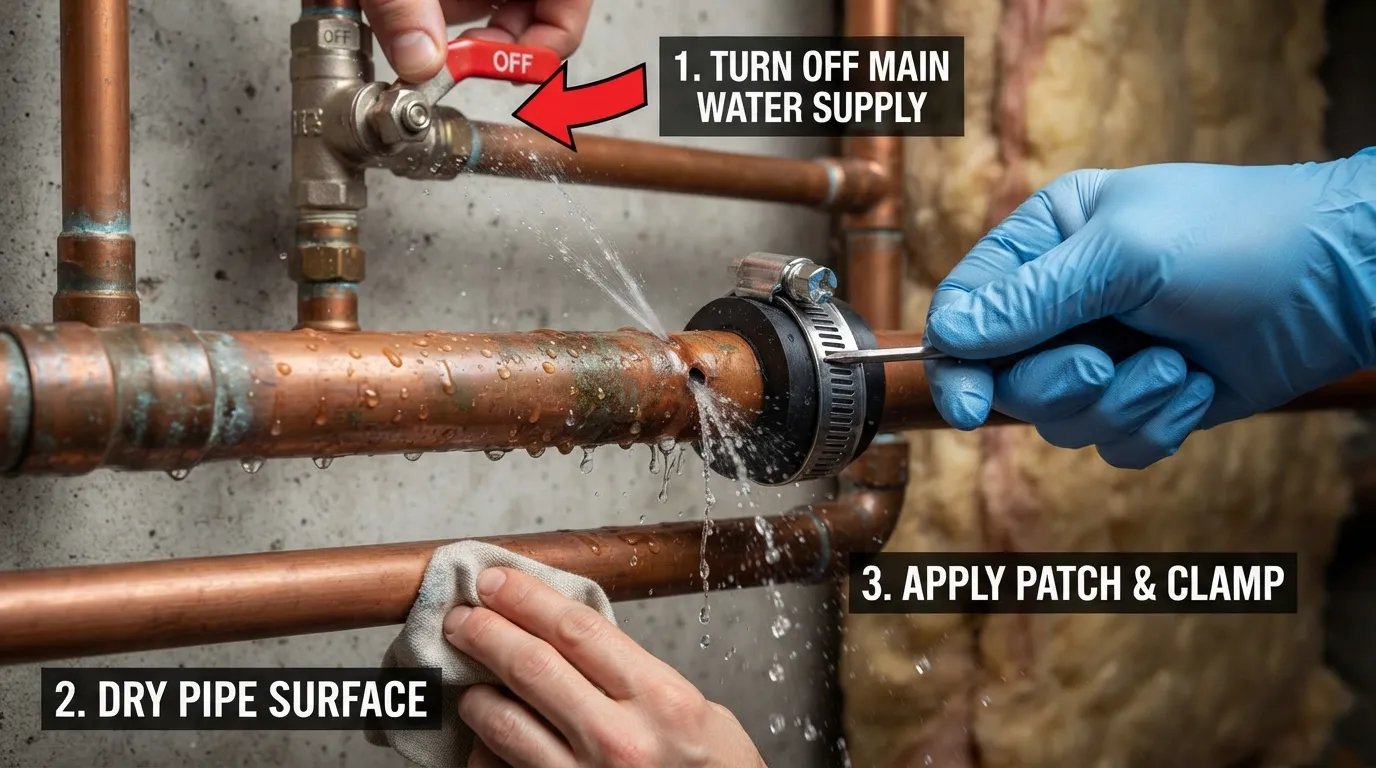
Discovering a pinhole leak in your copper plumbing demands swift action to minimize property damage. Before attempting any temporary repairs or calling a professional, secure your home’s water supply and assess the situation safely[cite: 1].
First 5 Steps Right Now
Execute these critical containment steps immediately upon spotting a leak:
- Shut Off the Main Valve: Locate and close your home’s primary water shutoff valve immediately to halt pressure[cite: 1].
- Drain the Line: Open the lowest household faucets to drain remaining water out of the affected supply pipes.
- Dry the Surrounding Area: Thoroughly wipe down the pipe surface around the pinhole to prepare for any emergency patch.
- Document for Insurance: Capture clear photos and videos of the leak and resulting water damage for your homeowner’s insurance claim.
- Contact a Professional: Call a licensed plumber to evaluate whether a localized repair or wider system repipe is necessary.
Will Duct Tape Stop a Pinhole Leak?
Applying standard duct tape to a pressurized water pipe is completely ineffective. Due to continuous internal pressure and moisture, duct tape will immediately saturate, lose adhesion, and blow out within minutes.
Will JB Weld or Epoxy Putty Fix a Copper Pipe Leak?
Specialized underwater epoxy putties or steel-reinforced compounds can successfully stem a pinhole leak if applied correctly, but preparation is vital.
- Surface Preparation: The pipe must be completely dry and scuffed with sandpaper down to bare, clean copper for the compound to bond.
- Potable Water Rating: Ensure the epoxy product is explicitly certified safe for drinking water lines before application.
- Temporary Nature: Epoxy acts strictly as a short-term band-aid and should not be relied upon as a permanent structural solution.
How to Fix a Leaky Copper Pipe Without Soldering
If you need to make a fast repair without breaking out a torch or sweating joints, mechanical fittings provide reliable temporary-to-semi-permanent options:
- Stainless Steel Repair Clamps: A rubber-lined clamp bolts directly over the pinhole, sealing the breach under mechanical pressure.
- Push-Fit Couplings: SharkBite or similar push-to-connect fittings allow you to cut out the damaged pipe section and snap in a replacement piece without soldering.
- Compression Sleeves: Brass compression rings tighten around cut copper sections to bridge minor gaps securely.
What Type of Putty or Repair Kit Should I Use?
When selecting emergency repair products, always verify compliance with plumbing standards. Look for certifications such as NSF/ANSI 61, which guarantees that the material will not leach toxic chemical contaminants into your home’s drinking water supply.
I Nicked a Copper Pipe but It Isn’t Leaking. What Now?
If a saw, drill bit, or fastener gouged your copper pipe during a home project without causing an immediate leak, do not ignore it. A deep nick thins the structural wall, creating a localized high-stress point that will inevitably develop into a pinhole leak under normal operating pressure.
Temporary Versus Permanent Fix: The Real Difference
Plumbing authorities sometimes conflict on the longevity of mechanical patches—some utilities view clamps as viable long-term fixes, while expert contractors like Mike Diamond treat them strictly as emergency stopgaps. Reconciling these viewpoints comes down to recognizing the difference between a temporary bridge and a permanent structural remedy:
- Temporary Bridge: Repair clamps and epoxy putties buy you valuable time, preventing immediate water damage while you schedule professional service.
- Permanent Cut-Out-And-Replace: True remediation requires cutting out the damaged section of pipe entirely and sweating in a fresh copper segment or certified fitting to restore system integrity.
Spot Repair, Epoxy Lining or Repipe? How Much Does It Cost?
When pinhole leaks start appearing in copper plumbing, homeowners face critical decisions regarding budget, disruption, and long-term infrastructure health. Choosing between a quick spot patch, epoxy lining, or a total system repipe requires evaluating both upfront costs and long-term risk.
How Much Does It Cost to Fix a Pinhole Leak in Copper Pipe?
Repairing an individual pinhole leak typically ranges from $150 to $550 for accessible lines. However, final pricing depends heavily on several key cost drivers:
- Accessibility: Exposed basement or crawlspace leaks sit on the lower end ($150–$350), whereas breaches hidden behind walls or beneath concrete slabs can drive costs past $1,000 due to demolition and access labor.
- Associated Repairs: Standard plumbing bills rarely include patching drywall, repairing flooring, or restoring landscaping after exploratory work.
- Emergency vs. Scheduled: Calling an after-hours emergency plumber can inflate standard labor fees by 1.5 to 3 times.
Regional Disclaimer: Labor rates and material costs fluctuate significantly depending on your local municipal market and geographic region.
Spot Repair Versus Epoxy Pipe Lining Versus Full Repipe
When One Leak Means It’s Time to Repipe
Finding a single pinhole leak can often be managed with a targeted spot repair. However, certain conditions signal that your entire plumbing network is failing:
- Multiple Leaks Per Year: Experiencing two or more pinhole leaks across different rooms within a 12-month window indicates systemic infrastructure degradation.
- Advanced System Age: If your copper plumbing is over 30 to 40 years old and served by aggressive water chemistry, patching one spot simply leaves vulnerable sections waiting to fail next.
- Escalating Maintenance Costs: Sinking hundreds of dollars repeatedly into temporary spot patches quickly outpaces the long-term economy of a comprehensive PEX or copper repipe.
Should an Old Copper Pipe Be Replaced?
Homeowner discussions on DIY and renovation forums frequently center on whether aging copper should be proactively replaced. Plumbing professionals and building inspectors generally agree that if your copper pipes show widespread thinning, pitting, or recurring joint failures, patching becomes a losing battle. Transitioning to modern cross-linked polyethylene (PEX) or fresh copper eliminates ongoing corrosion risks, secures home resale value, and provides decades of leak-free peace of mind.
Does Insurance Cover Pinhole Leaks? Who Pays?
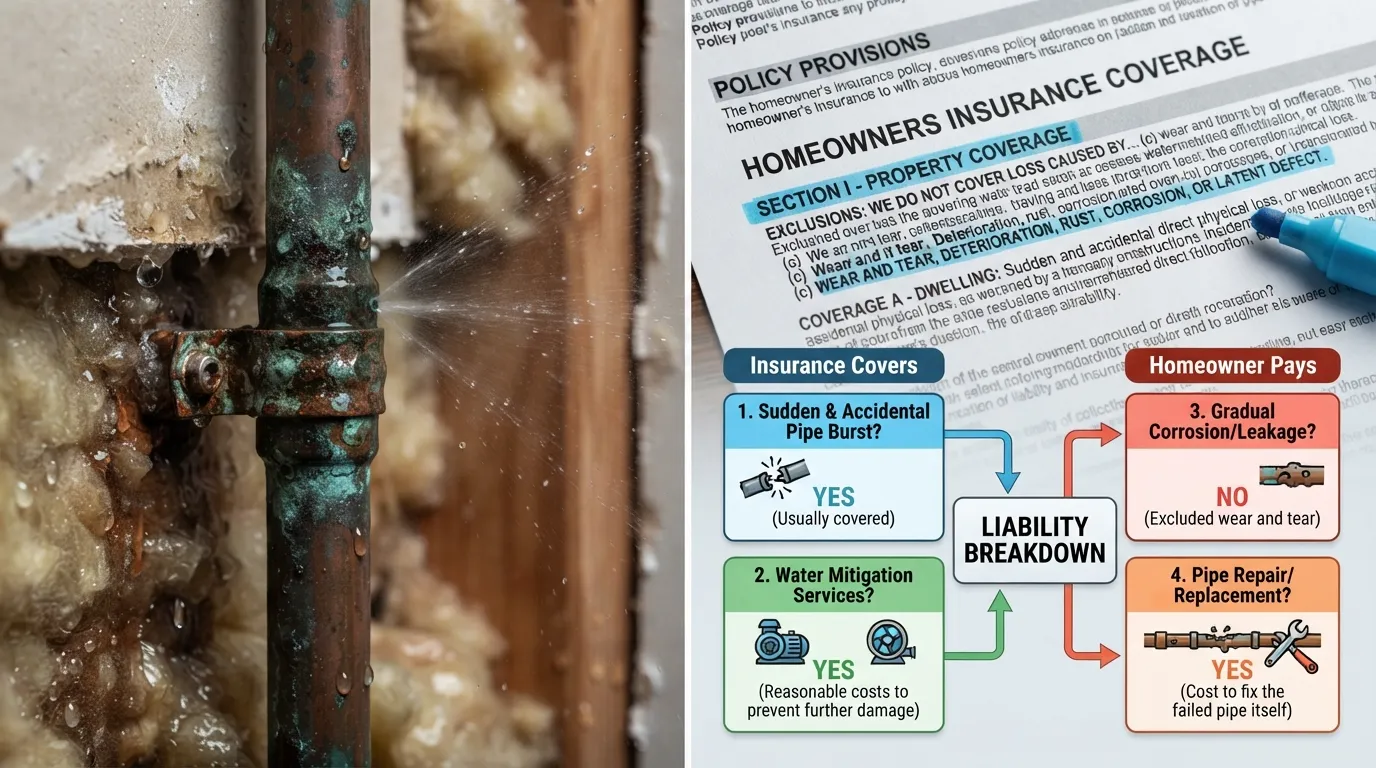
Navigating financial responsibility for plumbing failures can be complex. Understanding how insurance policies categorize water damage and knowing where utility responsibility ends helps homeowners manage unexpected repair expenses effectively.
What Homeowner’s Insurance Usually Covers Versus Excludes
Insurance coverage for pinhole leaks typically hinges on the distinction between sudden incidents and long-term degradation. Reviewing your policy wording carefully is essential before filing a claim:
- Sudden and Accidental Damage: Policies generally cover the resulting property damage caused by a burst pipe or a sudden pinhole spray (such as ruined drywall, warped hardwood flooring, or soaked insulation).
- Gradual Wear-and-Tear Exclusion: Insurers routinely exclude the cost of repairing or replacing the actual degraded pipe itself, classifying pipe corrosion as preventable maintenance or normal aging.
- Seepage and Neglect Clauses: If an inspector determines a leak went unnoticed for weeks due to homeowner neglect, the resulting mold and rot claims may be denied.
Utility Versus Homeowner Responsibility
Determining who pays for service line issues depends entirely on the location of the break relative to municipal infrastructure. Public water authorities operate under clear boundary guidelines:
- Municipal Responsibility: As outlined by utility providers like Butler County Water and Sewer, the water district maintains full responsibility for the main distribution lines up to and including the residential water meter.
- Customer Responsibility: Once water passes the meter and enters private property, all repair costs, service line maintenance, and interior water damage liabilities rest entirely on the homeowner.
How to Document a Leak for an Insurance Claim
If you plan to file a homeowner’s insurance claim for water damage resulting from a pinhole leak, rigorous documentation is crucial for approval:
- High-Resolution Photos and Videos: Capture wide shots of the damaged room and close-up footage of the leaking pipe before any emergency cleanup or demolition begins.
- Detailed Plumber Report: Request a signed written diagnosis from your licensed plumber explicitly describing the sudden nature of the failure and the extent of the damage.
- Timeline Tracking: Keep a precise log of when you discovered the leak, when utility shutoffs occurred, and when mitigation teams arrived.
Disclaimer: This information is for educational purposes and does not constitute formal legal or insurance advice. Always review your specific policy language and consult your insurance agent directly to confirm coverage terms.
How to Reduce the Risk of Pinhole Leaks

While property owners naturally want to eliminate the threat of unexpected plumbing failures, total prevention is difficult to guarantee. As municipal authorities like Butler County Water and Sewer note, because copper pitting depends on complex, microscopic variables, the realistic goal is risk reduction rather than absolute immunity.
Can You Actually Prevent Pinhole Leaks?
The short answer is no, you cannot completely proof an existing copper plumbing system against future pinhole leaks if the internal metal scale is already compromised. However, you can significantly lower the probability of premature failure by controlling external stressors, managing aggressive water chemistry, and eliminating installation flaws.
7 Ways to Lower the Risk of Pipe Failure
Proactive maintenance and mindful system management help minimize the triggers that accelerate copper degradation:
- Hire Licensed Installers and Control Flux: Ensure any new plumbing work is performed by professionals who use minimal water-soluble flux and thoroughly flush and ream lines.
- Install a Pressure Regulator: Keep your home’s water pressure within safe limits (typically 50 to 60 PSI) to reduce continuous physical stress on pipe walls and fittings.
- Eliminate Dead Legs: Remove abandoned or dead-end pipe branches during renovations to prevent stagnant water zones where corrosive environments brew.
- Flush Infrequent Lines: Regularly run water through guest bathrooms, utility sinks, and basement supply lines to keep water moving and maintain chlorine residuals.
- Analyze Your Water Report (CCR): Review your municipal Consumer Confidence Report annually or test private well water for aggressive pH, alkalinity, and sulfate levels.
- Use Smart Leak Detectors and Auto-Shutoff Valves: Install electronic water monitoring systems (such as Flo by Moog or Phyn) that automatically shut off your main supply the moment unusual continuous flow is detected.
- Shut Off the Main Valve When Away: Always close your main supply valve before leaving your home for extended vacations or trips to eliminate unattended disaster risks.
Do Water Softeners Help or Hurt?
The relationship between water softeners and copper corrosion involves an important scientific nuance. Softening hard water removes calcium and magnesium, which can sometimes reduce mineral scale protection if the water’s pH and alkalinity are not properly balanced. While softeners prevent hard mineral buildup and scaling, overly soft or acidic water can occasionally become more aggressive toward bare copper if municipal corrosion control treatments are inadequate. Balancing your water chemistry is always more critical than simply softening the supply.
Frequently Asked Questions
How Long Do Copper Pipes Last?
Copper pipes typically last between 50 and 70 years under normal operating conditions. However, their actual lifespan depends heavily on local water chemistry, installation quality, operating pressure, and whether aggressive chemical or microbial factors accelerate internal pitting corrosion prematurely.
Do All Copper Pipes Corrode?
Yes, all copper pipes undergo a baseline level of oxidation by forming a protective outer patina or oxide scale. While this initial oxidation shields the metal in balanced water, corrosive chemistry or installation flaws can turn this normal process into destructive, localized pitting.
Why Do Copper Pipes Turn Green?
Copper pipes turn green due to the formation of verdigris, a copper carbonate compound created when the metal reacts with moisture, oxygen, and acidic elements in the environment. While surface greening indicates exterior oxidation, it does not always mean an active internal pinhole leak.
Can You Get Lead Poisoning From Copper Pipes?
You generally will not get lead poisoning from modern copper pipes, but older homes built before 1986 often used lead-based solder at the joints. Over time, aggressive or acidic water chemistry can leach trace amounts of lead from these soldered connections into drinking water supplies.
How Much pH Can a Copper Pipe Withstand?
Copper pipes perform best within a neutral to slightly alkaline pH range of 7.0 to 8.5. When water pH drops below 6.5 (acidic) or climbs excessively high, it strips away the protective cuprous oxide layer, significantly accelerating metal dissolution and pitting failure.
Is a Pinhole Leak an Emergency?
Yes, a pinhole leak should be treated as an urgent plumbing issue because continuous pressurized water can quickly ruin drywall, warp flooring, and foster hazardous mold growth. Even a tiny stream behind a wall demands immediate water shutoff and prompt professional repair.
How Do I Best Maintain Copper Pipes and Fittings?
Maintaining copper plumbing involves keeping your home water pressure below 60 PSI, monitoring annual water quality reports for aggressive pH shifts, flushing rarely used fixtures, and installing smart leak detection devices. Routine inspections around visible joints also help catch early green scaling.
Conclusion and Key Takeaways
Pinhole leaks in copper plumbing can be stressful, but understanding the underlying mechanisms transforms a mysterious plumbing emergency into a manageable issue. By evaluating whether your leaks stem from trapped soldering flux, aggressive water chemistry, or localized flow dynamics, you can make informed decisions to protect your home.
Key Takeaways
- Multi-Factor Origin: Pipe failure is rarely driven by a single issue; it typically results from a combination of chemical, physical, and installation factors.
- Proven vs. Debated Triggers: Acidic flux residue and imbalanced water chemistry are well-documented culprits, whereas electrical grounding and stray current remain heavily debated.
- Verify Before Repairing: Always diagnose the exact root cause—such as joint proximity or velocity wear—before selecting a temporary patch or permanent solution.
- Single Versus Multiple Leaks: An isolated pinhole can easily be spot-repaired, but experiencing two or more leaks per year signals systemic infrastructure failure.
- Proactive Risk Management: While absolute prevention is difficult, maintaining proper water pressure, monitoring water quality reports, and flushing unused lines significantly lowers your long-term risk.
Your Next Step
If you are currently dealing with an active water issue, review the emergency steps in Section 8. If you suspect hidden moisture but see no visible puddles, perform the 10-minute water meter test outlined in Section 7. For recurring or widespread failures, evaluate your options using the cost and repair breakdowns in Section 9.
Last updated: September 2026. Content rigorously reviewed and verified by certified plumbing professionals and water treatment specialists.

Oscar Vance | Master Plumber & Drainage Expert
Meet Oscar Vance, a licensed master plumber sharing practical solutions on residential repairs, preventive maintenance, and thoughtful home upkeep.