How Long Does It Take to Learn HVAC?
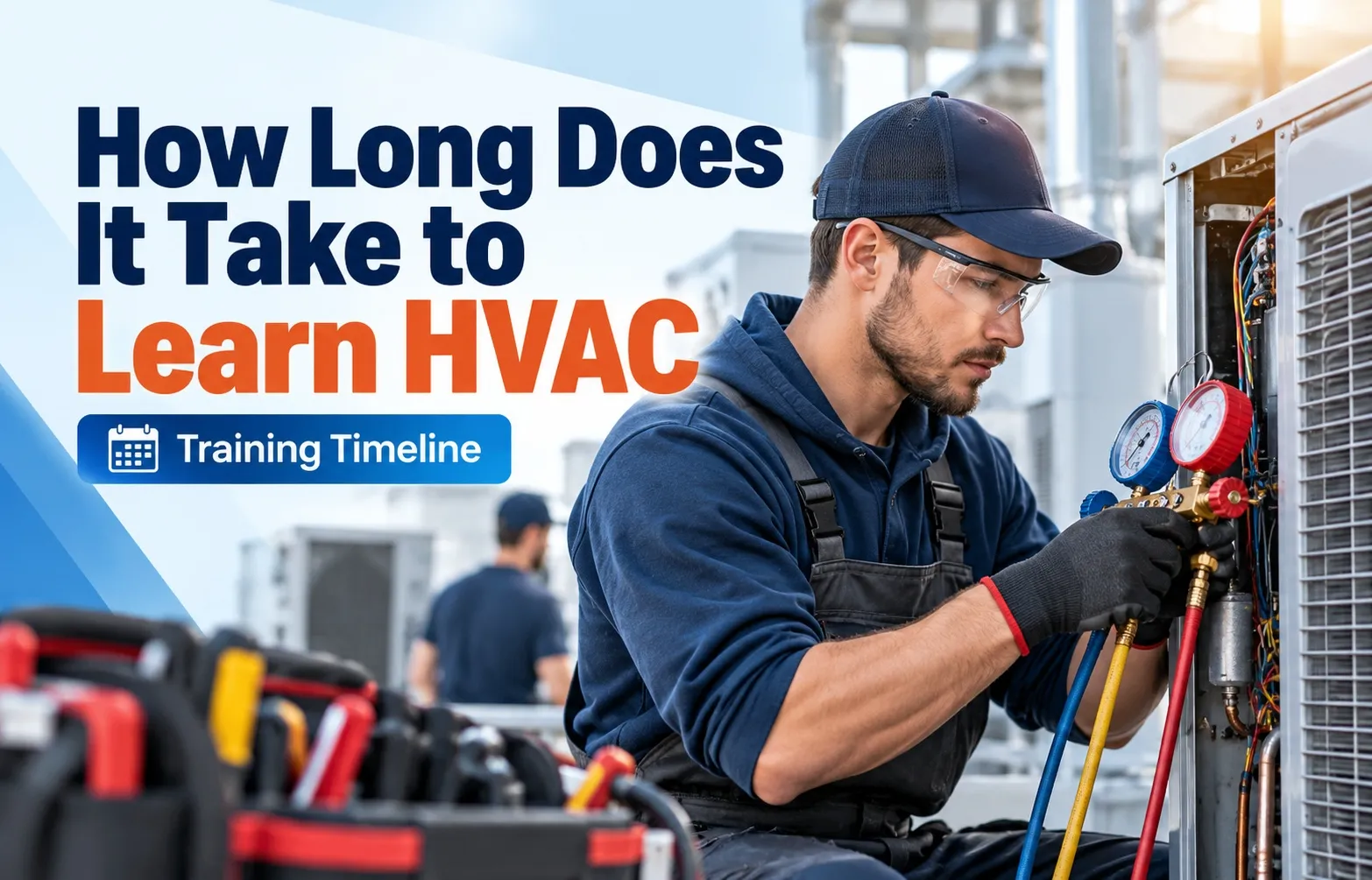 Learning HVAC takes anywhere from 6 months to 5 years depending on whether you choose a trade school certificate, a university degree, or a hands-on apprenticeship. While basic classroom education can be completed in under a year, reaching full field independence as a service technician typically requires 2 to 3 years of real-world experience.
The Direct Answer: How Long Does HVAC Training Really Take?
Entering the HVAC field requires choosing between academic programs and paid on-the-job experience. Most entry-level technicians earn their initial credentials in 6 to 18 months through vocational certificate programs, allowing them to enter the workforce quickly under supervision.
Mastering the trade involves distinct training phases that balance classroom theory with practical field application:
- Fast-Track Certificates (6 to 12 Months): Technical institutes cover core refrigeration cycles, basic electrical diagnostics, and heating fundamentals to prepare students for entry-level technician roles.
- Associate Degrees (2 Years): Community colleges blend technical HVAC training with advanced system design, business administration, and energy management coursework.
- Apprenticeship Programs (3 to 5 Years): Trade unions and contractors provide 3,000 to 8,000 hours of paid on-the-job training paired with mandatory evening classroom instruction.
- Regulatory Certifications (2 to 4 Weeks): Essential credentials like the EPA 608 certification can be studied for and completed rapidly alongside any primary educational path.
The 4 Primary Pathways to Learn HVAC
Choosing the right educational path determines how quickly you enter the field and the depth of technical expertise you acquire. Aspiring technicians can choose from vocational certificates, college degrees, structured apprenticeships, and short accelerated courses.
1. Certificate & Diploma Programs (6 to 18 Months)
Vocational colleges and technical institutes, such as Universal Technical Institute (UTI), offer focused diploma programs designed for rapid entry into the workforce. These programs concentrate heavily on core technical skills rather than general academic coursework.
- Core Focus: Intensive classroom instruction paired with practical, hands-on lab training on mock furnaces, air handlers, and refrigeration rigs.
- Pros: Fast completion timeline, structured schedules, and foundational preparation for entry-level hiring.
- Cons: Higher upfront tuition costs without immediate on-the-job earning potential during studies.
2. Associate Degree in HVAC Technology (2 Years)
Community and technical colleges provide comprehensive two-year associate degree programs that cover advanced commercial systems alongside residential heating and cooling. This path suits individuals aiming for management positions or specialized engineering roles.
- Core Focus: Deep dives into advanced HVAC theory, electrical schematics, blueprint reading, and thermodynamics.
- Pros: Comprehensive education, better eligibility for supervisory or commercial contractor tracks, and transferable college credits.
- Cons: Takes twice as long as certificate programs and involves general education requirements unrelated to daily field work.
3. Union & Non-Union Apprenticeship Programs (3 to 5 Years)
Apprenticeships combine formal classroom instruction with paid on-the-job training (OJT) under the direct supervision of master technicians. Sponsored by labor unions or independent contractors, this earn-while-you-learn model is widely respected by industry employers.
- Core Focus: Thousands of hours of real-world installation, preventative maintenance, and complex troubleshooting on active job sites.
- Pros: Zero tuition debt, earning an income while learning, and guaranteed job placement upon completion.
- Cons: Highly competitive entry requirements, physically demanding daily schedules, and longer commitment periods.
4. Accelerated Bootcamps & Online Hybrid Courses (6 Weeks to 3 Months)
Ultra-short training formats market quick certifications to career changers wanting fast results. While these bootcamps can teach foundational HVAC theory, they cannot replace years of physical practice.
- The Reality Check: A 6-week or online-only course is only sufficient for learning basic electrical concepts or prepping for certification exams. It is entirely insufficient for mastering physical diagnostics or independent field work without hands-on oversight.
- Best Use Case: Ideal as a supplementary refresher or a preliminary step before entering a formal apprenticeship or entry-level helper position.
Schooling vs. True Field Proficiency: The Reality Timeline
Graduating from trade school is only the starting point for HVAC professionals. While classrooms teach core principles and basic mechanical theory, building genuine field proficiency requires years of hands-on troubleshooting in extreme environments like scorching attics and frozen rooftops.
Phase 1: Entry-Level Tech / Helper (Months 0 – 12)
During the first year, new technicians operate primarily as helpers under direct supervision. Clean textbook blueprints quickly give way to rusted, modified, and complex real-world equipment.
- Core Responsibilities: Carrying tools, staging materials, and assisting lead technicians with residential and commercial equipment installations.
- Daily Tasks: Performing basic safety checks, routing ductwork for air distribution systems, and executing routine maintenance on standard gas furnaces.
- The Reality Check: Learning to endure physical challenges, including tight crawlspaces, heavy lifting, and extreme thermal conditions.
Phase 2: Independent Service Technician (Years 2 – 3)
By years two and three, technicians transition to handling routine service calls independently. This critical stage bridges initial education with active electrical diagnostics and independent problem-solving.
- Core Responsibilities: Running standalone maintenance and repair calls for heat pumps, air conditioners, and standard heating units.
- Daily Tasks: Using multimeters to trace wiring schematics, reading refrigerant pressure-temperature charts, and isolating component failures.
- The Reality Check: Diagnosing live equipment issues without senior oversight, requiring quick analytical thinking under customer pressure.
Phase 3: Proficient Lead Tech & Diagnostics Expert (Years 5+)
Reaching year five marks true field proficiency. Lead technicians can diagnose complex system failures swiftly, handling intricate commercial configurations and multi-zone residential setups with minimal assistance.
- Core Responsibilities: Managing large job sites, leading installations, and acting as the primary diagnostic authority for stubborn equipment issues.
- Daily Tasks: Executing advanced electrical diagnostics on variable-speed compressors, microprocessors, and sophisticated control boards.
- The Reality Check: Mentoring incoming apprentices while maintaining high efficiency and accurate repair timelines.
Phase 4: Master HVAC Specialist & Contractor (Years 10+)
At the decade mark, seasoned technicians often achieve official journeyman or master status. Many choose to launch their own independent contracting businesses or specialize in commercial mechanical engineering.
- Core Responsibilities: Securing state contractor licenses, overseeing business operations, and ensuring regulatory compliance.
- Daily Tasks: Consulting on large-scale commercial retrofits, building automation systems, and high-efficiency energy audits.
Mandatory Certifications & State Licensing Requirements
Completing educational coursework or hands-on training is only part of becoming an HVAC technician. Federal law and state regulatory boards dictate specific legal certifications and licenses required before a technician can buy refrigerants or perform independent installation and service work.
EPA Section 608 Certification (Type I, II, III, & Universal)
Under Section 608 of the Clean Air Act, any technician who maintains, services, repairs, or disposes of equipment that could release refrigerants into the atmosphere must hold official federal certification. Most students can study for and earn this credential within 2 to 4 weeks during or immediately following their training program.
The EPA Section 608 license is divided into four distinct categories based on equipment size and type:
- Type I: Covers small appliances containing five pounds or less of refrigerant, such as domestic refrigerators and window air conditioners.
- Type II: Covers high-pressure or very high-pressure appliances, including residential split-system central air conditioners, heat pumps, and commercial refrigeration units.
- Type III: Covers low-pressure appliances, such as large commercial chillers.
- Universal Certification: Granted to technicians who successfully pass all three individual exams, qualifying them to service all types of refrigeration equipment.
To ensure full legal compliance, technicians must follow all federal guidelines outlining proper EPA Section 608 Certification requirements for refrigerant recovery and safety standards.
Industry Certifications: NATE, HVAC Excellence, and OSHA 10
While federal EPA certification is legally mandatory, voluntary industry credentials validate your practical expertise and can accelerate career advancement:
- North American Technician Excellence (NATE): Highly respected nationwide, NATE testing measures real-world working knowledge in specialties like gas heating, air conditioning, and heat pumps. Techs usually sit for NATE exams after 1 to 2 years of field experience.
- HVAC Excellence Credentials: Offers employment-ready certifications for students completing trade school, validating baseline competence to potential employers.
- OSHA 10-Hour General Industry / Construction: Covers essential job site safety practices, chemical hazards, and electrical safety, taking roughly two days to complete online or in person.
How State Licensing Laws Impact Your Timeline (Texas vs. Georgia Examples)
State licensing regulations vary widely across the country and directly influence how fast you can progress from a supervised helper to an independent contractor or journeyman:
- Texas (Class A & B Licenses): Texas requires registered technicians to complete 24 to 36 months of verified field experience under a licensed contractor before taking the state licensing exam. Trade school graduation can often be applied toward a portion of these required experience hours.
- Georgia (Conditioned Air Contractor): Georgia mandates a minimum of two to four years of proven practical experience depending on whether you apply for a Class I (restricted to residential/light commercial) or Class II (unrestricted commercial) license, with formal educational degrees counting toward a maximum of two years.
Demystifying the Difficulty: Math, Physicality, & Key Challenges
Many aspiring technicians worry about the mathematical requirements or physical difficulty of entering the HVAC trade. While the trade demands both analytical problem-solving and physical stamina, modern diagnostic tools and simplified formulas make mastering these challenges achievable for anyone willing to learn.
How Much Math Is Actually Required for HVAC?
You do not need advanced calculus or complex algebra to succeed in HVAC. Most day-to-day calculations rely on basic arithmetic, simple algebra formulas, and straightforward charts.
Modern digital tools significantly streamline field calculations:
- Digital Manifold Gauges: Automatically calculate target superheat and subcooling without requiring manual math.
- HVAC Diagnostic Apps: Mobile applications calculate duct sizing, airflow CFM, and heat load requirements instantly.
- Reference Charts: Technicians rely on pressure-temperature (PT) charts to cross-reference system pressures without performing complex thermodynamics equations.
Core Math Formulas Used Daily (Ohm’s Law, Airflow, & Superheat)
Field calculations focus primarily on verifying electrical loads, system airflow, and refrigerant charge correctness:
- Ohm’s Law ($V = I times R$): Used alongside a digital multimeter to verify voltage, current, and resistance in electrical circuits.
- Temperature Split Calculation: Subtracting return air temperature from supply air temperature (targeting a 15°F to 20°F difference) to verify proper cooling performance.
- Airflow CFM & BTU Calculations: Determining required cubic feet per minute (CFM) based on system tonnage ($1 text{ ton} = 12,000 text{ BTUs} = 400 text{ CFM}$).
The Hardest Parts of Learning HVAC (Physical Demands & Electrical Theory)
The true challenge of learning HVAC lies in combining technical diagnostic skills with physical endurance in tough environments.
Key demands that technicians navigate daily include:
- Extreme Working Environments: Servicing gas furnaces and air handlers in unconditioned attics reaching over 120°F, or troubleshooting rooftop units in freezing winter conditions.
- Tight Physical Spaces: Navigating narrow crawlspaces, maneuvering heavy compressors, and carrying heavy equipment up ladders.
- Electrical Schematics & Diagnostics: Reading complex control board ladder diagrams to trace intermittent short circuits and component failures safely.
HVAC Career Progression & Earning Potential
Understanding the return on investment for learning HVAC involves analyzing how income scales alongside experience and technical capabilities. Earnings in this trade grow rapidly as a technician transitions from basic installation support to independent diagnostic troubleshooting and complex commercial system commissioning.
Salary Progression: From Apprentice to Master Tech
Compensation tiers in the HVAC industry directly align with a technician’s autonomy, certifications, and years of hands-on experience in the field.
Industry salary progressions typically follow four main experience milestones:
- Apprentice / Entry-Level Tech (0 to 2 Years): Earning entry-level hourly wages ranging from $18 to $24 per hour, focusing on preventative maintenance, installation assistance, and basic system checks.
- Journeyman Service Technician (3 to 5 Years): Earning between $25 and $36 per hour as independent troubleshooting capabilities, EPA certifications, and specialized diagnostic skills mature.
- Lead / Senior Specialist (5 to 10 Years): Earning $37 to $48+ per hour by managing installation teams, resolving complex electrical diagnostic issues, and overseeing system commissioning.
- Master Tech / Field Operations Manager (10+ Years): Earning salaried roles ranging from $85,000 to $120,000+ annually by supervising field operations, handling high-end commercial HVAC/R contracts, or managing service departments.
Can You Make $100,000 a Year in HVAC?
Reaching a six-figure annual income in HVAC is achievable without a four-year college degree, but it depends heavily on specialty, work hours, and location.
Technicians who regularly hit or exceed the $100,000 mark utilize specific career mechanisms:
- Overtime Pay & On-Call Shifts: Peak heating and cooling seasons demand emergency after-hours service calls, yielding 1.5x to 2x base hourly rates.
- Performance & Sales Incentives: Residential sales technicians receive performance bonuses or commissions when recommending equipment retrofits and system upgrades.
- Specialized Commercial HVAC/R: Technicians working on industrial chillers, supermarket rack refrigeration, and building automation systems command higher hourly rates due to technical complexity.
Fast-Tracking Your Earnings: Commercial vs. Residential vs. Business Ownership
Your chosen career specialization significantly shapes your long-term earning potential and day-to-day work structure.
- Residential HVAC: Provides rapid entry and year-round demand. Income potential accelerates through performance incentives, seasonal overtime, and transitioning into residential service management.
- Commercial & Industrial HVAC/R: Demands deeper technical knowledge in hydronics, chillers, and complex control systems, offering higher baseline hourly wages and strong union benefits without relying on sales commissions.
- HVAC Contractor / Business Ownership: Launching a licensed HVAC contracting business offers the highest income ceiling. Business owners who scale operations, manage crews, and secure commercial maintenance contracts often earn well beyond $150,000 annually.
Frequently Asked Questions
What is the $5,000 rule in HVAC?
The $5,000 rule is a repair vs. replace decision formula used by HVAC technicians. Multiply the age of the unit in years by the estimated repair cost. If the product exceeds $5,000, replacing the system is generally more cost-effective than repairing it. For example, a $600 repair on a 10-year-old furnace equals $6,000, signaling replacement.
Am I too old to learn HVAC at 25, 30, or 40+?
No, you are not too old to begin an adult career change into HVAC. Trade schools and apprenticeship programs regularly enroll students in their 30s, 40s, and 50s. Older adult learners often advance quickly because employers value mature work ethic, life experience, reliability, customer communication skills, and proven mechanical aptitude over raw age.
Can I learn HVAC online or through self-study?
You can learn HVAC theory, electrical schematics, and safety codes through online courses and self-study. However, complete self-study is insufficient for independent field work. HVAC requires physical hands-on training to master brazing copper tubing, handling recovery machines, wiring live electrical components, and running complex diagnostic troubleshooting safely on site.
How many hours a day are HVAC classes?
Daily HVAC class schedules vary based on the educational format you choose. Full-time vocational trade school programs typically run 4 to 6 hours per day, 4 or 5 days a week. Part-time night classes usually operate 3 to 4 hours per evening, 2 to 3 nights a week, accommodating working adults.

Oscar Vance | Master Plumber & Drainage Expert
Meet Oscar Vance, a licensed master plumber sharing practical solutions on residential repairs, preventive maintenance, and thoughtful home upkeep.