Executive Summary & The Bottom Line Cost Matrix
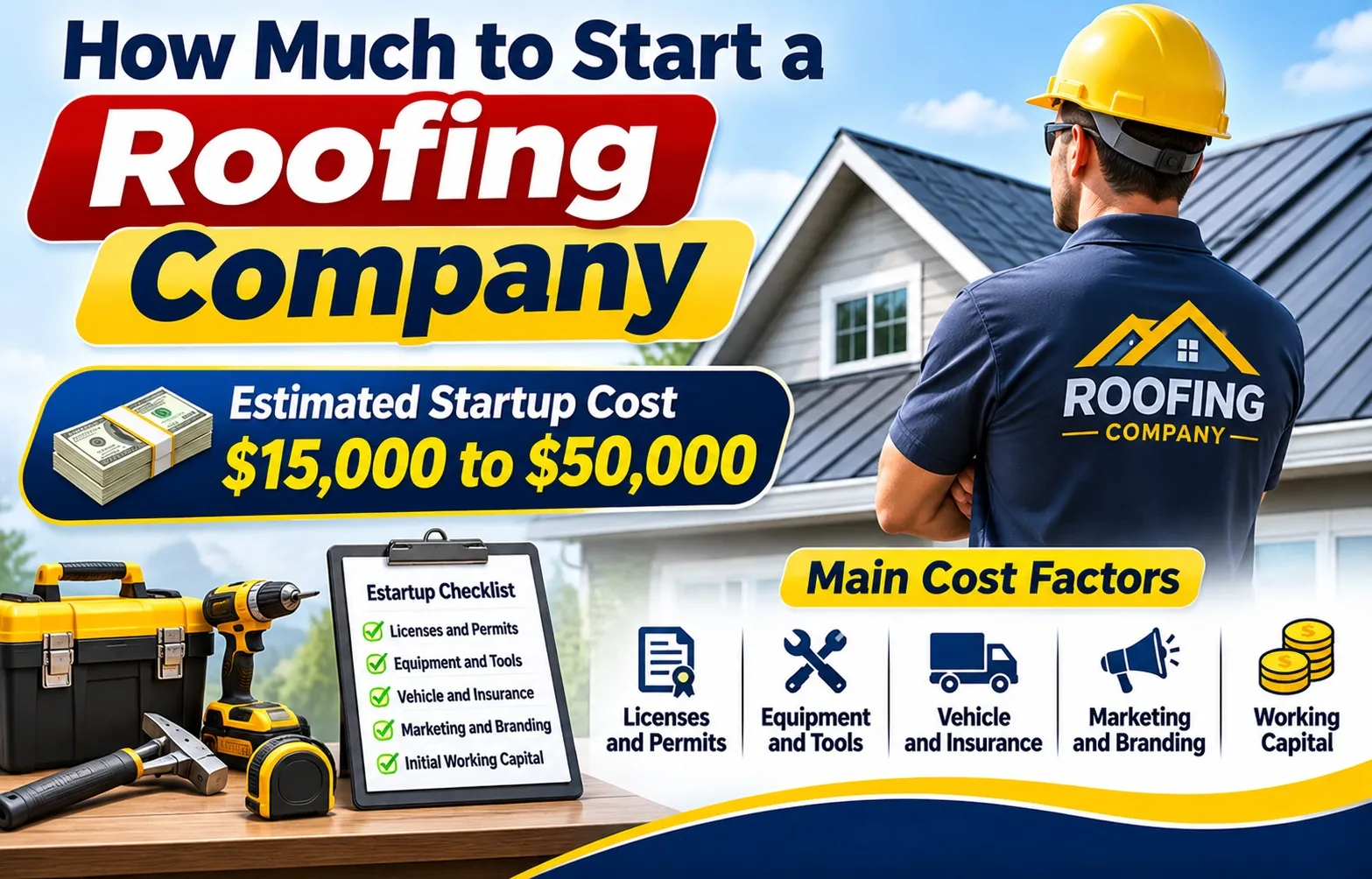 Starting a professional independent roofing company typically requires an initial investment ranging from $10,000 to over $65,000. The exact capital depends heavily on whether you launch as a lean solo subcontractor using existing tools or build a fully equipped local residential crew from day one.
Beyond initial equipment and licensing expenses, maintaining a healthy working capital buffer is mandatory. Roofing contracts require upfront material purchases and weekly labor payouts long before homeowner insurance claims or retail checks clear your business account.
- Legal & Regulatory: Securing state licenses, LLC formation, and mandatory contractor surety bonds.
- Insurance Protection: Binding high-risk general liability policies and workers’ compensation coverage.
- Field Equipment: Acquiring reliable transport, safety harnesses, nail guns, compressors, and dump trailers.
- Working Capital Float: Maintaining cash reserves to bridge the 30-to-90 day payment gap on material and labor costs.
Detailed Breakdown of Core Startup Expenses
Forming a legally compliant roofing entity requires registering an LLC, paying state contractor licensing fees, and acquiring surety bonds. These steps establish legal protection and prove operational credibility to local homeowners.
- Entity Formation: Registering your LLC or corporation ranges from $100 to $500 depending on your state.
- Contractor Licensing: State and municipal board exams, background checks, and licensing fees cost between $300 and $1,500.
- Surety Bonds: Insurance providers charge $100 to $2,000 annually for contractor license bonds, depending on your credit history.
General Liability & High-Risk Workers’ Compensation Insurance (Est. $2,500 – $25,000+/yr)
Roofing is classified as a high-risk trade, making robust insurance mandatory to cover property damage or bodily injury. Operating without proper coverage can expose your business to catastrophic financial liabilities.
- General Liability Insurance: Protects against property damage, water leaks during installation, and third-party injuries, costing $1,500 to $5,000 annually.
- Workers’ Compensation: Mandatory if you employ a crew. Underwriters evaluate specific workers’ comp class codes for roofers, leading to annual premiums between $3,000 and $20,000+.
Trucks, Trailers, and Safety Gear (Est. $10,000 – $50,000)
Equipping your field operation requires dependable transportation and rigorous safety gear to comply with federal regulations. Upfront equipment costs form the bulk of your physical startup inventory.
- Transport & Hauling: A reliable work truck and a utility or roll-off dump trailer account for $10,000 to $40,000 in purchases or down payments.
- Roofing Tools: Heavy-duty pneumatic roofing nailers, air compressors, and extension ladders require $2,000 to $5,000.
- OSHA Compliance Equipment: Fall-protection harnesses, anchor points, safety lines, and roof brackets cost $1,000 to $2,500.
Material Deposits and Roll-Off Dumpster Accounts (Est. $3,000 – $30,000)
Securing wholesale supply lines and waste management infrastructure ensures your jobs run smoothly without unexpected delays. Suppliers require initial cash deposits before extending open credit lines.
- Supplier Material Deposits: Opening accounts with distributors like ABC Supply requires upfront cash deposits or cash-on-delivery payments of $2,000 to $20,000 per active job site.
- Roll-Off Dumpsters: Setting up waste disposal accounts and paying for initial container drops costs $1,000 to $3,000 to manage shingle tear-off debris.
The Biggest Trap: Managing 90-Day Cash Flow & Payroll Float
Many new roofing contractors fail not from a lack of sales, but from severe cash-flow depletion. You must fund 100% of material purchases and weekly crew wages before collecting checks from homeowners or insurance adjusters.
Because major storm damage claims or retail insurance checks experience significant administrative delays, operating without cash reserves leaves businesses unable to buy materials for upcoming projects or pay weekly payroll.
The 90-Day Financial Runway Formula & Working Capital Buffer
Maintaining a dedicated working capital buffer bridges the financial gap during insurance claim payout lags. A healthy runway ensures your operations remain stable while awaiting mortgage company endorsements or carrier disbursements.
- Phase 1 (Days 1–30): Fund initial material deposits, dumpster rentals, and first-week crew wages out of pocket or credit lines.
- Phase 2 (Days 31–60): Complete installations and submit final invoices, while ongoing payroll and overhead continue to draw down cash reserves.
- Phase 3 (Days 61–90): Receive final customer payouts or insurance checks, replenishing your working capital buffer for the next project cycle.
Dealing with Material Suppliers: Net-30 Accounts Explained
Establishing commercial credit lines with major distributors is vital for scaling a contracting business without depleting personal savings. Transitioning from cash-on-delivery to structured trade credit protects your immediate cash reserves.
- Building Trade Credit: Suppliers evaluate your business credit history and bank references before opening commercial accounts.
- Net-30 Terms: These arrangements give you 30 days to pay for shingles and underlayment, aligning material expenses closer to when client payments clear.
- Personal Guarantees: New businesses often require a director’s personal guarantee until trade references and steady purchasing volumes are established.
State-Specific Regulatory & Cost Realities
Launching a roofing company in Florida requires navigating strict hurricane building codes and severe weather regulations. Contractors must strictly follow wind mitigation standards, impacting installation techniques and material requirements.
- Wind Mitigation Rules: Roof installations must feature reinforced roof-to-wall connections, secondary water barriers, and high-wind rated shingles.
- Insurance Premiums: Due to frequent tropical storms, general liability and workers’ compensation rates are among the highest nationwide.
- Licensing Boards: The Florida Department of Business and Professional Regulation (DBPR) requires rigorous state examination and background checks.
Operating in Texas: Navigating the Lack of State Contractor Licensing
Texas does not require a statewide general contractor or roofing license, which creates unique barriers to entry and consumer trust. While setup is faster, establishing credibility demands alternative accreditations.
- Voluntary Credentialing: Contractors often rely on voluntary designations like Roofing Contractors Association of Texas (RCAT) licensing to build market authority.
- Municipal Requirements: While the state lacks a unified license, major cities like Houston, Dallas, and Austin enforce distinct local permit rules.
- Bonding and Insurance: Because licensing checks are absent, local homeowners heavily scrutinize your general liability coverage and surety bonds.
California Requirements: C-39 License & Strict Cal OSHA Standards
California enforces some of the most rigorous environmental and labor standards in the industry. Operating here demands strict adherence to state licensing boards and workplace safety laws.
- C-39 Roofing License: The Contractors State License Board (CSLB) mandates passing trade and law exams, plus proving four years of journey-level experience.
- Cal/OSHA Safety Standards: Fall protection mandates are strictly enforced, requiring continuous safety training and certified anchor gear for all crew members.
- Environmental Compliance: Local disposal mandates require strict shingle recycling and adherence to state waste diversion regulations. For official safety guidelines, consult the OSHA Compliance Portal.
Lean Bootstrap Model vs. Full-Scale Launch
Launching a roofing business does not require a six-figure upfront investment in heavy machinery and a large permanent payroll. Operating on a lean bootstrap model allows solo entrepreneurs to enter the market with a tight budget between $10,000 and $18,000 by leveraging equipment rentals, outsourcing sub-crews, and prioritizing cash-flow management over fixed overhead.
How to Start Lean as a Solo Subcontractor ($10k – $18k Budget)
Starting with a lean roofing startup model focuses your initial capital exclusively on essential licensing, basic hand tools, marketing, and general liability insurance. Instead of purchasing expensive commercial trucks, specialized nailers, and tear-off equipment outright, you utilize local equipment rental yards and partner with experienced piece-rate subcontractors.
- Allocate Capital Wisely: Reserve your $10k–$18k budget for mandatory state licensing, liability insurance policies, initial digital marketing campaigns, and safety gear.
- Leverage Equipment Rentals: Rent trailers, heavy-duty air compressors, and specialized tear-off machines only for the duration of active jobs to eliminate depreciation and maintenance costs.
- Utilize Sub-Crews: Hire reliable, insured piece-rate labor crews to handle field execution while you focus entirely on sales, estimating, and project management.
- Maintain Low Overhead: Run operations from a home office and keep fixed monthly expenses minimal until cash flow from completed projects covers expansion.
When and How to Scale into a Full-Service Local Crew
Transitioning from a subcontractor model to scaling a roofing business with a full-service internal crew requires predictable, recurring cash flow and consistent project volume. You should make the transition when your monthly subcontracting coordination consistently generates high profit margins and your pipeline books jobs weeks in advance.
- Identify the Revenue Trigger: Begin the transition when your net profit consistently covers the fixed weekly payroll of two to three full-time, experienced crew members.
- Acquire Core Assets: Gradually invest in dedicated company vehicles, branded trucks, and professional-grade roofing equipment to reduce ongoing rental dependency.
- Establish Standard Operating Procedures: Document rigorous safety protocols, quality control checklists, and daily cleanup routines to ensure internal crews maintain high standards.
- Protect Profit Margins: Continuously monitor labor efficiency and material waste to ensure that transitioning to an internal workforce enhances your long-term business valuation.
Building Your Digital Infrastructure & Local Lead Gen Budget
Securing consistent roofing contracts requires allocating 5% to 10% of your startup capital—typically $2,500 to $5,000—directly toward digital infrastructure and local lead generation. Establishing an optimized online presence ensures homeowners searching for urgent roof repairs or full replacements discover your business before competitors.
Setting Up Your Service-Area Business (SAB) Online Profile
A roofing company operating without a public retail storefront must register as a Service-Area Business (SAB) to rank in local map packs. Proper Google Business Profile optimization combined with a fast-loading mobile landing page converts high-intent emergency searches into booked roof inspections.
- Configure Your SAB Profile: Hide your residential street address in your Google Business Profile settings and define your exact service radius by county, city, or zip code.
- Build a High-Converting Mobile Landing Page: Launch a streamlined website featuring click-to-call buttons, an instant roof estimate form, proof of licensing and insurance, and local project photos.
- Collect Verified Customer Reviews: Request five-star reviews with project photos from every completed job to build neighborhood trust and improve local map rankings.
- Maintain NAP Consistency: Ensure your business Name, Address (or service area), and Phone number match identically across your website, local directories, and social profiles.
Google Local Services Ads (LSAs) vs. Organic Local SEO
Balancing immediate paid visibility with long-term search authority prevents cash-flow gaps during your first six months of operation. Google Local Services Ads generate immediate phone calls on a pay-per-lead basis, while organic local SEO compounds over time to lower your customer acquisition cost.
- Prioritize Google Guaranteed Verification: Complete the background check, license verification, and insurance submission early so your LSA profile goes live immediately upon launch.
- Dispute Invalid Leads Promptly: Review your LSA dashboard weekly to dispute spam calls, out-of-area inquiries, or requests for services you do not offer to recover ad spend.
- Publish Location-Specific Service Pages: Create dedicated pages on your website targeting specific cities and roofing materials (such as asphalt shingle replacement or metal roofing) to capture organic search traffic.

Oscar Vance | Master Plumber & Drainage Expert
Meet Oscar Vance, a licensed master plumber sharing practical solutions on residential repairs, preventive maintenance, and thoughtful home upkeep.