5 Foolproof Ways to Tell If Your Ceiling Box Is Fan Rated
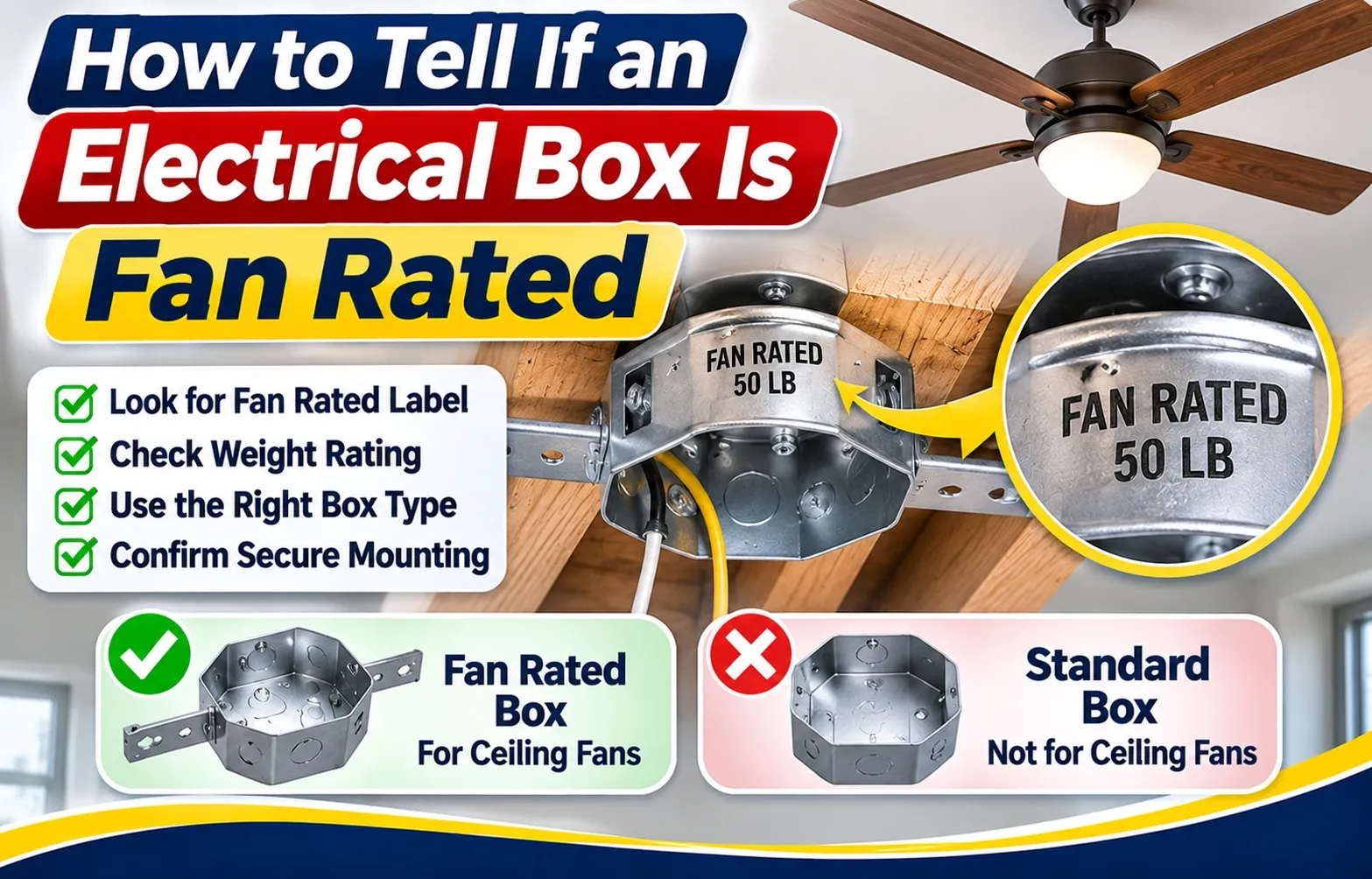 Manufacturers stamp safety certification marks directly onto the inner walls or backplate of certified junction boxes. Drywall mud and layers of ceiling paint frequently obscure these crucial markings in older installations.
- Scrape the Backplate: Gently clear away dried paint and joint compound using a flathead screwdriver or wire brush.
- Use Digital Zoom & Light: Illuminate the exposed metal with a smartphone flashlight and capture a close-up photo to read faded text.
- Verify Certifications: Look for clear markings indicating a UL Listing or ETL Listed stamp accompanied by the text “Acceptable for Fan Support.”
- Note Weight Ratings: Check for maximum weight capacities, distinguishing between standard 35 lbs weight limit models and heavy-duty 70 lbs weight limit boxes.
2. Measure the Mounting Screw Size (#10-32 vs. #8-32)
The physical diameter of the mounting screw holes provides an immediate indicator of whether the box can withstand operational vibration. Standard lighting fixtures rely on delicate fasteners, whereas ceiling fans demand heavy-duty hardware.
- Standard Lighting Fasteners: Standard light fixture boxes utilize thin #8-32 screws measuring approximately 5/32″ in diameter.
- Fan-Rated Hardware: Certified fan boxes require thicker #10-32 machine screws measuring approximately 3/16″ in diameter to manage intense structural stress.
- Thread Engagement & Mounting Ears: Screws must thread securely through mounting ears into heavy-duty steel posts or structural mounting brackets rather than thin sheet-metal tabs.
3. Perform the Physical Wobble & Rigidity Test
Ceiling fans generate constant dynamic vibration and lateral movement during operation. An unreinforced plastic or shallow metal box will quickly fracture under continuous rotational torque.
- Push and Pull Test: Firmly grasp the box or existing fixture and apply alternating push, pull, and twist pressure.
- Check for Deflection: A certified fan box exhibits zero flex or movement against the ceiling substrate.
- Identify Unsafe Mounts: Any box that shifts, bounces against drywall, or relies on plastic “old-work” flip-out wings must be replaced immediately.
4. Inspect the Structural Mounting Method (Joist or Brace Bar)
The load-bearing integrity of a ceiling installation depends entirely on what the junction box is bolted to behind the drywall. Visual inspection through screw holes reveals the hidden framework.
- Direct Joist Lagging: Verify if heavy wood screws or bolts secure the box directly into a wooden ceiling joist.
- Saddle Brackets: Look for a robust saddle bracket that wraps tightly over or around the structural framing member.
- Expandable Brace Bars: Many retrofit installations use an adjustable expandable steel fan brace bar wedged tightly between two parallel joists.
5. Check the Wiring Configuration (Secondary Clue Only)
Electrical wire counts inside the box can offer a contextual hint regarding switch controls, but they should never be treated as definitive proof of box rating.
- Multiconductor Cable: The presence of a 3-wire cable (such as 14/3 Romex containing black, red, white, and bare copper wires) indicates separate wall switches for a ceiling fan and light kit.
- Builder Shortcuts: Builders frequently run 3-wire cables into standard light boxes to enable future upgrades, rendering wiring an unreliable structural indicator.
- Verification Rule: Always prioritize physical stamping and structural mounting hardware over cable configurations when evaluating safety.
Standard Light Box vs. Fan-Rated Electrical Box
Understanding the critical structural and dimensional differences between standard lighting enclosures and certified fan-rated boxes prevents costly installation failures and structural hazards.
Red-Flag Boxes That Can Never Hold a Ceiling Fan
Attempting to mount a ceiling fan to an unrated or obsolete electrical box creates immediate structural hazards. Continuous dynamic load and vibration will rapidly compromise these fragile junction types.
- Plastic “Old-Work” Pop-In Boxes: Boxes featuring flip-out drywall wings rely entirely on weak drywall material, which shears off rapidly under rotational torque.
- Thin Nail-On Plastic New-Work Boxes: Standard residential plastic boxes secured by a single side-nail lack the rigidity and metal-to-structural framing connection required for vibration resistance.
- Shallow Pancake Boxes: Standard 1/2-inch shallow metal pancake boxes cannot handle motor weight unless explicitly engineered, deep enough, and UL-listed for fan support with direct joist lagging.
- Vintage Stamped Steel Boxes (1950s–1970s): Lightweight legacy junction boxes equipped with thin bent ears and single-screw tabs will snap or strip out under minimal operational movement.
Will a Plastic Electrical Box Support a Ceiling Fan?
Standard residential plastic PVC junction boxes will never support a ceiling fan because they lack internal steel structural reinforcement. However, certified heavy-duty molded polycarbonate or fiberglass fan-rated boxes safely support motorized fixtures when secured directly to ceiling framing or steel brace bars.
Distinguishing between standard and engineered plastic enclosures prevents dangerous ceiling collapses caused by continuous motor vibration.
- Standard PVC Enclosures: Standard blue or gray PVC boxes held exclusively by side nails or flimsy drywall tabs will crack and shear off under rotational torque.
- Polycarbonate & Fiberglass Fan Boxes: Modern engineered polymer boxes incorporate embedded steel mounting straps or direct-bolting brackets designed specifically for high dynamic loads.
- Structural Requirements: A plastic box is only fan-rated if its UL listing explicitly covers motor support and it is bolted directly to a joist or heavy brace bar.
Understanding Box Fill Capacity for Smart Fan Receivers (NEC 314.16)
National Electrical Code (NEC) 314.16 mandates strict cubic inch volume limits to prevent overheating and insulation damage. Many DIY installations successfully support the physical weight of a fan yet violate code because wireless remote receivers and extra wire bundles overcrowd the enclosure.
Overcrowded junction boxes create severe electrical hazards by pinching conductors and trapping thermal energy generated by smart fan modules.
- Calculating Box Fill: Every wire, wire nut, and internal clamp occupies a specific volume allocation governed by strict NEC 314.16 compliance guidelines.
- Remote Receiver Bulk: Modern smart fan receivers add significant volume, requiring deep electrical boxes rated for at least 21 to 30 cubic inches of capacity.
- Thermal Dissipation: Cramming receivers into shallow boxes restricts airflow around wiring harnesses, increasing the risk of thermal degradation and short circuits.
National Electrical Code (NEC) Rules for Ceiling Fan Boxes
NEC Article 314.27(C) mandates that outlet boxes acting as the sole support for ceiling-suspended paddle fans must be explicitly listed for that purpose, stamped with their maximum weight capacity up to 70 lbs, and installed in new construction wherever switched ceiling outlets are provided.
Complying with these rigorous electrical standards ensures structural safety and legal installation compliance across residential properties. You can review full regulatory frameworks directly through the NFPA 70 (National Electrical Code) resource portal.
- Listing Standards: Enclosures must comply with UL 514A for metal boxes or UL 514C for nonmetallic boxes, specifically certified for motor-driven fan support.
- Weight Capacity Limits: Certified boxes are rated for 35 lbs or 70 lbs; paddle fans exceeding 70 lbs require independent structural framing support.
- New Construction Mandates: Building codes require fan-rated boxes in all habitable rooms where ceiling outlets are installed, anticipating future fixture upgrades.
Why a Standard Box Fails Even If Your Fan Is Lightweight
Even a lightweight ceiling fan generates continuous dynamic rotational force and vibrational torque that rapidly fatigues standard lighting enclosures, eventually shearing #8-32 mounting screws and buckling sheet-metal tabs over months of normal operation.
- Dynamic vs. Static Load: While static weight refers to a stationary object, a running motor creates continuous multi-directional vibration and rotational torque.
- Fastener Limitations: Standard #8-32 machine screws and thin mounting ears lack the shear strength to absorb continuous vibrational oscillation.
- Gradual Fatigue and Collapse: Over time, unrated boxes experience metal fatigue or pull away from drywall tabs, leading to unexpected and dangerous ceiling fixture detachment.
What to Do If Your Electrical Box Is Not Fan Rated (No-Attic & Attic Fixes)
Discovering an unrated junction box during a fixture upgrade does not require tearing down finished drywall. An old-work ceiling fan brace kit allows you to retrofit a heavy-duty box directly through a standard 4-inch ceiling cutout.
- Retrofit Brace Bar Design: Systems like the Westinghouse Saf-T-Brace feature an adjustable steel bar with sharp metal teeth on each end.
- Insertion Through the Hole: Slide the collapsed brace bar through your existing electrical box hole into the cavity above the ceiling drywall.
- Rotating to Lock: Twist the bar from below to expand it tightly against adjacent ceiling joists until the spikes bite securely into the wood.
- Clamping the Enclosure: Slide the fan-rated box onto the U-bolt saddle and tighten the nuts to lock the assembly firmly in place.
Option 2: Mounting a Saddle Box Directly to an Exposed Joist
If your electrical opening happens to land directly underneath a wooden ceiling joist rather than between framing members, an expandable brace bar will not work. In this scenario, a specialized saddle fan box provides the required direct-framing connection.
- U-Shaped Saddle Design: The metal box features an integrated saddle bracket that wraps tightly over the bottom face of the joist.
- Direct Lag Screws: Heavy structural lag screws or bolts pass through the saddle bracket directly into the solid wood joist.
- Maximum Stability: This mounting style transfers the dynamic rotational torque of the ceiling fan directly into the building’s primary structural framing.
Option 3: Adding 2×4 Wood Blocking From the Attic
Properties with open attic access above the ceiling offer a traditional and extremely rigid installation method. Constructing custom wood blocking eliminates the need for retrofit expansion braces entirely.
- Installing 2×4 Blocking: Cut a piece of structural 2×4 lumber to fit snugly between two parallel ceiling joists directly above the fixture location.
- Securing From Above: Drive structural wood screws through the joists into both ends of the 2×4 block to create a rigid platform.
- Attaching a Heavy-Duty Box: Mount a standard joist-mount fan box directly to the bottom face of the new wooden block before running your electrical wiring.
Frequently Asked Questions
How can I tell if an electrical box is fan rated without removing the light fixture?
You can inspect the installation without completely disassembling the ceiling fixture by loosening the decorative canopy just enough to slide it down the downrod. Shine a smartphone flashlight inside to check the screw head sizes and inspect for stamped ratings.
- Lowering the Canopy: Loosen the side screws supporting the canopy shell, slide it downward, and view the mounting ears and box rim.
- Attic Inspection: Enter the attic space directly above the room to inspect the box mounting structure, brace bar, or joist attachment from above without disturbing wall switches.
- Historical Context: Homes built or extensively remodeled after modern NEC adoption are more likely to feature compliant hardware, though physical verification remains mandatory.
Can I use a pancake box for a ceiling fan?
You can only use a pancake box for a ceiling fan if it is a heavy-duty steel enclosure explicitly stamped “Acceptable for Fan Support” and lagged securely into a solid wood structural joist. Standard shallow pancake boxes used for wall sconces or flat lights will fail under motor vibration.
- Mandatory Stamp Verification: The metal inner wall must carry clear manufacturer certifications for motorized rotational loads.
- Solid Framing Attachment: Pancake boxes lack volume and must be screwed directly into solid wood framing rather than suspended on unsupported drywall.
How much weight can a fan-rated electrical box hold?
Standard fan-rated electrical boxes are engineered to support static and dynamic loads up to 35 pounds, while heavy-duty brace-bar or direct-joist mounted fan boxes are certified to safely support ceiling fixtures weighing up to 70 pounds.
- 35-Pound Capacity: Ideal for standard residential ceiling fans and low-profile paddle designs without heavy glass globe assemblies.
- 70-Pound Capacity: Required for heavy-duty commercial-grade fans, large timber blades, and multi-bulb light fixture kits.
- Exceeding Limits: Ceiling fans weighing over 70 pounds require independent structural framing support rather than relying solely on the electrical box.
When should I call a licensed electrician instead of DIYing?
You should hire a licensed professional if your property contains outdated wiring infrastructure, compromised ceiling structures, or complex electrical configurations that pose severe fire and shock hazards.
- Obsolete Wiring Types: Properties featuring ungrounded knob-and-tube circuits or oxidizing aluminum branch wiring demand expert intervention.
- Compromised Ceilings: Crumbling historic plaster, rotting wooden joists, or water-damaged drywall cannot safely anchor heavy vibrating motors without professional reinforcement.
- Grounding Deficiencies: The complete absence of an equipment grounding conductor inside the box creates a direct safety violation requiring professional rewiring.

Oscar Vance | Master Plumber & Drainage Expert
Meet Oscar Vance, a licensed master plumber sharing practical solutions on residential repairs, preventive maintenance, and thoughtful home upkeep.