Introduction & The Homeowner’s Dilemma
 Dealing with unexpected roof damage after a severe storm can quickly become an overwhelming experience. Homeowners are often forced to balance immediate property protection with complex financial decisions while managing visits from unverified door-to-door contractors.
Skepticism surrounding insurance-funded roof restoration is completely natural, as predatory operators frequently promise unrealistic outcomes. Understanding the structured boundary between your contractor and your insurance carrier is essential for protecting your property value and financial legal standing.
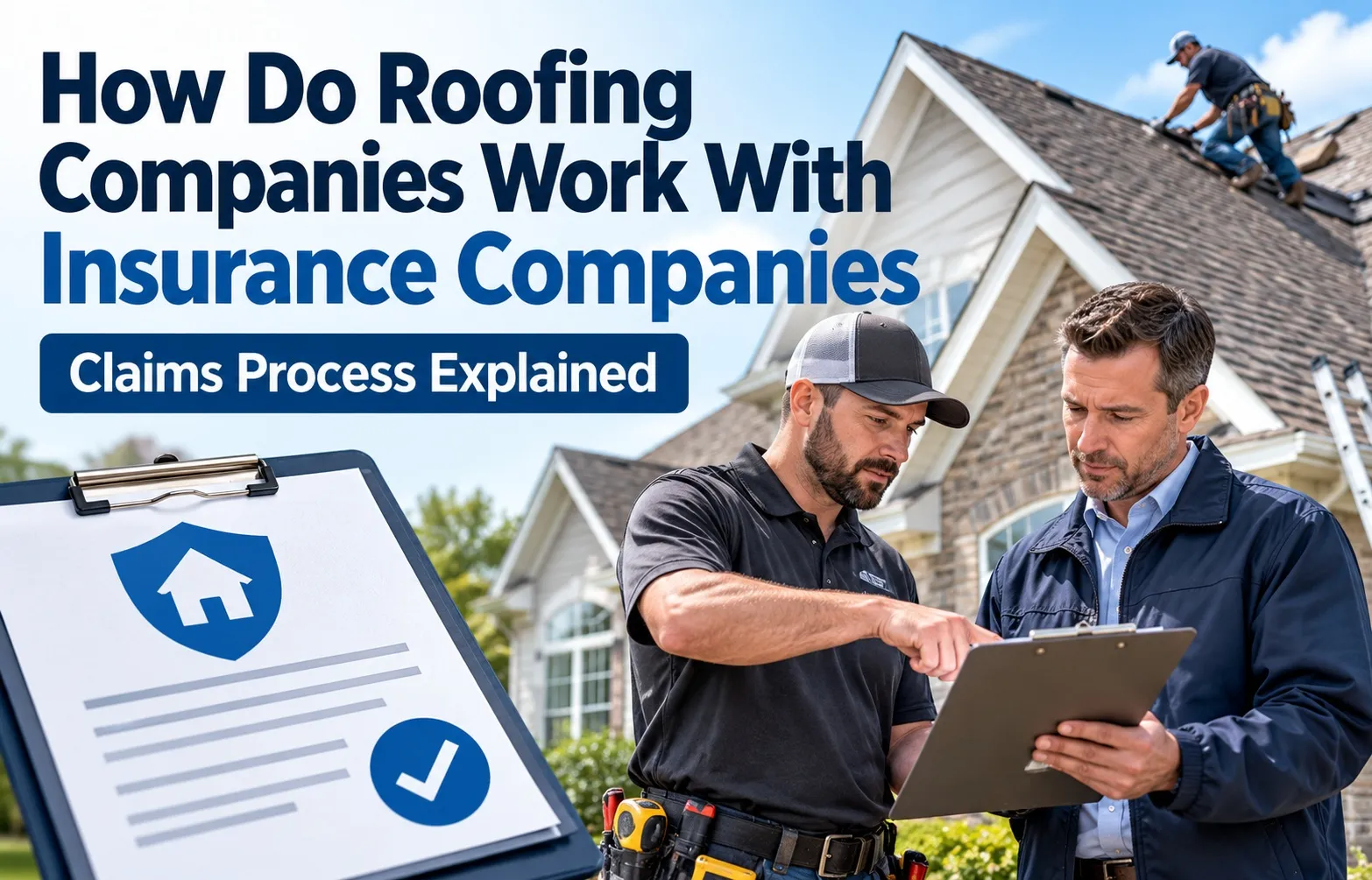
How Do Roofing Companies Work With Insurance Companies?
Roofing companies work with insurance companies by conducting detailed damage inspections, compiling photo-documented repair estimates using industry-standard pricing software, and meeting directly with insurance adjusters on-site to review the physical scope of work. While the roofing contractor documents technical construction needs, the insurance company independently verifies policy coverage, approves the claim, and releases funds.
To keep the restoration process smooth, compliant, and transparent, both parties operate under strictly defined roles:
- Roofing Contractor: Identifies physical property damage, prepares itemized repair estimates, documents local building code requirements, and executes physical repairs.
- Insurance Adjuster: Evaluates policy conditions, inspects reported losses, determines claim approval, and authorizes final payout disbursements.
- Strict Legal Boundaries: Contractors cannot legally act as public adjusters to negotiate policy terms, nor can they legally absorb, waive, or rebate a homeowner’s required insurance deductible.
Why Navigating Storm Damage Alone Is Risky
Filing a property damage claim without professional technical support often leads to significantly underfunded repairs. Insurance adjusters inspect dozens of properties weekly and may easily overlook subtle structural issues, such as compromised underlayment or soft-metal impact marks, without a dedicated contractor present to advocate for full restoration scope.
Homeowners who handle the claim process without professional guidance often face several distinct financial and structural hazards:
- Incomplete Scope Approvals: Missing secondary damage during initial adjuster visits can result in denied payouts for necessary line items like ice and water shields or drip edge installations.
- Out-of-Pocket Cost Spikes: Accepting an underfunded initial insurance payout forces property owners to settle for sub-standard materials or pay out-of-pocket for mandatory building code compliance upgrades later.
- Unintended Claim History Marks: Filing a claim before confirming actual, covered storm damage can result in an official zero-payout claim on your insurance record, which may negatively impact future premium rates.
The Critical First Decision: Who Do You Call First?
After a severe storm passes over your property, acting quickly is critical to preventing interior water leaks and structural deterioration. However, jumping straight to contacting your insurance company without verifying the actual extent of physical loss can create avoidable long-term financial consequences for your property records.
Determining whether your roof sustained legitimate storm damage requires an objective, ground-level assessment before initiating formal policy procedures. Understanding the operational distinction between an initial professional damage assessment and an official claim filing protects your standing with your carrier.
Roofer vs. Insurance Company: Whom to Call First After Storm Damage
You should always contact an independent, local roofing contractor first to perform a comprehensive pre-claim inspection before filing a claim with your insurance company. A professional damage assessment verifies whether your roof has suffered functional damage that exceeds your deductible threshold, saving you from filing unnecessary or uninsurable claims.
Use this decision matrix following a severe weather event to determine your best immediate course of action:
- Call a Roofing Contractor First If: You notice loose shingles on the ground, spot hail marks on gutters or siding, or want an unbiased professional evaluation to confirm if actual storm damage exists.
- Contact Your Insurance Company First If: Active water is pouring into living spaces, a tree has fallen directly onto the roof structure causing emergency structural instability, or a roofer has already completed a pre-claim inspection confirming clear covered damage.
The Risk of Filing a “Zero-Payout” Claim
Contacting your insurance company to open a claim triggers an official entry in your insurance record immediately—regardless of whether any physical damage is found or if any money is actually paid out by the carrier. If the adjuster inspects the property and finds no damage, or determines the repair cost falls below your policy deductible, the carrier closes the file as a zero-payout claim.
Filing a zero-payout claim introduces several avoidable risks to your overall policy standing:
- Compromised Claims History: Insurance databases track total claim filings rather than just payouts. Accumulating multiple zero-payout entries within a short timeframe creates a pattern of high activity on your loss history.
- Risk of Insurance Premium Hikes: Insurance carriers evaluate overall risk profiles during annual policy renewals. Frequent claim filings, even those resulting in zero dollars disbursed, can contribute to premium increases or non-renewal notices.
- Zero Financial Protection: You bear the permanent mark of a filed loss on your loss record without receiving any financial assistance toward property restoration.
- Risk-Free Professional Alternative: Having a licensed roofing contractor conduct an initial pre-claim inspection carries absolute zero risk to your insurance record while giving you clear photographic evidence of your roof’s physical condition.
Step-by-Step: The 6-Phase Roofing Insurance Workflow
Navigating an insurance roof claim requires following a structured, multi-phase sequence from the initial damage discovery to the final payment release. Understanding each sequential step ensures you maintain control of the restoration process and secure full coverage for your property.
Managing this professional workflow successfully depends on transparent collaboration between your contractor, your insurance carrier, and your mortgage lender. Each distinct phase addresses a specific legal, technical, or financial milestone in the repair lifecycle.
Step 1: Initial Professional Roof Inspection & Documentation
Comprehensive damage documentation forms the foundational proof required for successful claim approvals. Independent roofing contractors perform meticulous visual checks to capture precise digital evidence of storm-related destruction before you ever contact your carrier.
The initial documentation phase focuses on gathering verifiable physical evidence across all exposed exterior components:
- Date-Stamped Photos & Videos: Capturing high-resolution images of hail strikes on shingles, soft-metal dents on vents, and wind-uplift creases.
- Gutter & Siding Checks: Inspecting collateral damage on soft metals, downspouts, and window screens to prove the directional severity of the storm.
- Comprehensive Inspection Reports: Compiling detailed measurements, slope layouts, and structural notes into an organized package for your insurance file.
Step 2: Filing the Claim & Initial Adjuster Meeting
Initiating the formal claim officially alerts your insurance carrier to the documented property loss and triggers the carrier’s internal investigation process. The policyholder contacts the claims department to open a file and schedule an independent adjuster walkthrough.
During this preliminary filing and scheduling stage, homeowners should follow standard communication protocols:
- Opening the Claim: Providing the carrier with the date of the storm event and submitting the initial contractor report summary.
- Receiving Claim Numbers: Obtaining a unique claim identifier and the direct contact information for your assigned desk adjuster and field adjuster.
- Scheduling the Walkthrough: Setting a specific date and time for the field adjuster inspection, ensuring your roofing contractor can attend the appointment.
Step 3: Joint Onsite Inspection (Contractor + Adjuster)
Having your roofing contractor present during the adjuster’s onsite inspection eliminates missed damage and pricing discrepancies. The contractor collaborates directly with the adjuster to inspect flashings, pipe boots, and shingle matrices.
A joint onsite inspection guarantees that all storm impacts are thoroughly accounted for before the adjuster finalizes their evaluation:
- Collaborative Roof Walk: Both professionals access the roof together to review hail bruises, granule loss, and fractured fiberglass mats.
- Defending the Scope: The contractor points out hidden vulnerabilities, such as compromised valleys or damaged counter-flashings, that an adjuster might otherwise overlook.
- Establishing Consensus: Aligning both parties on the physical extent of the damage establishes a transparent baseline for the upcoming estimate review.
Step 4: Reviewing the “Scope of Loss” & Pricing Alignment
Once the claim is approved, the insurance company issues an itemized document detailing the authorized repair costs known as the scope of loss. Contractors review this breakdown to verify that material and labor line items match actual market expenses.
Insurance companies and professional contractors rely heavily on industry-standard pricing software to evaluate accurate repair costs:
- Xactimate Pricing Software: Utilizing standardized regional pricing databases that ensure material and labor costs reflect local market rates.
- Line-Item Verification: Checking every individual entry on the insurance statement, from waste factors to ridge cap materials, to ensure complete alignment.
- Resolving Discrepancies: Identifying missing items or undervalued components so adjustments can be addressed before physical construction begins.
Step 5: Handling “Supplements” During Tear-Off
Hidden damage or municipal code requirements uncovered during physical roof removal require formal supplement requests. Contractors submit supplemental photo documentation to secure additional funds for necessary structural upgrades.
Supplemental approvals commonly address essential building requirements and unforeseen structural deterioration discovered mid-project:
- Hidden Deck Rot: Submitting photos of water-damaged plywood sheathing that must be replaced to support a new roof structure.
- Code Upgrades: Integrating mandatory building code items required by local municipalities, such as ice and water shields, drip edge, or upgraded ventilation.
- Formal Supplement Requests: Transmitting itemized requests with supporting photo proof directly to the insurance carrier for review and approval.
Step 6: Roof Installation, Final Invoicing, & Depreciation Release
The final phase involves executing the physical roof replacement according to approved standards and disbursing funds in structured stages. Multi-party check endorsements require careful coordination between the homeowner, carrier, and mortgage lender.
The financial disbursement and project closure process follows a clear multi-step payment structure:
- Initial Check Disbursement: The carrier issues the first payment (Actual Cash Value minus your deductible) to begin the project.
- Mortgage Company Endorsement: If your home has a mortgage, the lender often must endorse checks before funds can be released to the contractor.
- Physical Installation: The roofing contractor completes the full replacement according to manufacturer specifications and local building codes.
- Final Invoicing & Depreciation Release: Once work is finished and certified, the carrier releases the remaining recoverable depreciation funds to settle the final invoice.
Understanding the Legal & Financial Boundaries
Navigating an insurance claim requires a clear understanding of the strict statutory limits and policy structures that govern residential restoration. Misinterpreting these regulations can expose homeowners to severe financial liabilities and potential insurance fraud investigations.
Both property owners and contractors must operate within explicit legal boundaries established by state insurance departments. Maintaining legal compliance ensures your claim proceeds smoothly while protecting your rights under your policy agreement.
The Law on Insurance Deductibles: Can a Roofer Waive It?
It is strictly illegal for a roofing contractor to waive, absorb, rebate, or offset a homeowner’s insurance deductible under any circumstances. State statutes across the country—such as Texas House Bill 2102, along with strict insurance codes in Florida, Colorado, and dozens of other states—classify deductible absorption as a class of insurance fraud punishable by heavy fines and potential criminal charges.
Homeowners should be fully aware of how deductible compliance laws protect consumer safety and market integrity:
- Mandatory Out-of-Pocket Expense: The deductible represents your contractually agreed-upon financial responsibility before insurance coverage applies. It must be paid directly by the policyholder to the contractor.
- Illegal Scheme Warnings: Offers such as “free roofs,” “sign-on allowances,” or inflated invoices designed to absorb deductible costs constitute fraudulent practices.
- Proof of Payment Verification: Insurance carriers increasingly require physical proof of deductible payment (such as canceled checks or bank statements) before releasing final recoverable depreciation funds.
- Regulatory Guidance: You can review consumer protection guidelines directly through the Texas Department of Insurance to understand statutory compliance rules.
Public Adjuster vs. Roofing Contractor: Who Can Negotiate Your Claim?
There is a distinct legal boundary between the technical services provided by a roofing contractor and the legal representation offered by a licensed public adjuster. Roofing contractors are licensed to inspect physical structures, provide detailed construction line-item estimates, and perform repair services based on local building codes.
Understanding these regulatory role distinctions prevents unauthorized representation issues during claim processing:
- Roofing Contractor Scope: Provides factual damage assessments, submits construction estimates using standardized market pricing, and communicates directly with adjusters on technical construction requirements. They cannot legally negotiate policy language or contract settlements on your behalf.
- Public Adjuster Scope: Operates under a specialized public adjuster license issued by the state. They are legally authorized to interpret policy language, negotiate claim settlements directly with the insurance carrier, and advocate on behalf of the insured for a fee.
- Consumer Protection Laws: State regulations strictly prohibit contractors from acting as public adjusters on claims for projects they are contracted to construct, avoiding severe conflicts of interest.
ACV vs. RCV Policies: How Your Insurance Check Is Calculated
The total payout for your roof replacement depends heavily on whether your insurance policy provides Actual Cash Value (ACV) or Replacement Cost Value (RCV) coverage. The structure of your policy determines how funds are calculated and disbursed across the lifecycle of your restoration project.
The basic financial formulations used by insurance carriers to calculate payouts are defined below:
Key financial factors to remember when evaluating your policy calculations include:
- Recoverable Depreciation: Under an RCV policy, the withheld depreciation amount is paid out once the contractor completes the work and submits the final invoice.
- Age Depreciation Adjustments: Older roofs under ACV endorsement receive smaller payouts because carriers apply higher annual depreciation factors based on material age.
Red Flags & Storm Chasers: How to Avoid Scams
Following severe weather events, affected neighborhoods are often inundated by transient sales crews offering high-pressure restoration promises. Protecting your home and your insurance funds requires recognizing the operational warning signs of predatory contractors before signing binding agreements.
While prompt action after storm damage is essential, rushing into a contract with an unverified company can lead to poor workmanship, voided manufacturer warranties, and unresolved legal liability. Vetting contractors against strict local standards safeguards your property investment.
How to Spot Out-of-State “Storm Chasers”
Out-of-state “storm chasers” are opportunistic contractors who track severe weather maps to systematically canvass storm-damaged regions. These door-to-door sales operations secure rapid contract signatures, rush temporary installations using unskilled labor, and relocate to the next storm zone long before long-term workmanship defects manifest.
Homeowners can identify transient storm-chasing operations by watching for these common behavioral patterns:
- Unsolicited Door-to-Door Pressure: Pushing homeowners into signing immediate “contingency contracts” or “assignments of benefits” on the spot before a thorough damage assessment is completed.
- Out-of-State License Plates & Temporary Signage: Operating vehicles with out-of-state plates or lacking permanent, branded local business address markings.
- Unrealistic Promises to Waive Deductibles: Offering gift cards, “sign allowances,” or illegal side-agreements to cover your mandatory policy deductible.
- Unenforceable Workmanship Warranties: Offering long-term labor warranties backed by a company that will no longer exist in your state when leaks develop months later.
Checklist for Choosing a Trusted Local Roofing Contractor
Selecting a established, locally rooted contractor ensures your project complies with municipal building codes and remains fully supported by verifiable warranties. Thoroughly verify a contractor’s physical presence and credentials before granting permission to perform roof restoration work.
Use this 5-point vetting checklist to evaluate any roofing company before signing a project agreement:
- Verifiable Local Physical Address: Confirm the contractor operates a permanent physical office and warehouse within your local region, rather than relying solely on a P.O. Box or temporary hotel address.
- Active State & Municipal Licensing: Verify active licensing directly through your state contractor licensing board and local municipal building authority.
- Comprehensive Insurance Coverage: Require direct certificates of insurance for both General Liability and Worker’s Compensation coverage issued straight from the insurance agency to you.
- Factory Manufacturer Certifications: Ensure the installer holds certified status with major shingle manufacturers (such as GAF, Owens Corning, or CertainTeed), which authorizes them to offer extended non-prorated system warranties.
- Verifiable Local Customer References: Request recent local installation addresses and references within your immediate community to confirm a proven track record of quality workmanship.
Frequently Asked Questions
Homeowners navigating insurance roof claims frequently encounter technical policy language and complex regulatory guidelines. Direct answers to common questions help clarify expectations during the inspection and settlement process.
Addressing these common scenarios ensures you maintain clear communication with your adjuster and receive appropriate coverage under your policy terms.
What Should You NOT Say to a Roof Insurance Adjuster?
When communicating with an insurance adjuster, avoid speculating on the age of your roof, offering opinions about pre-existing leaks, or attributing damage to wear and tear. Stick strictly to factual, observable storm details and direct your technical questions to your contractor.
To avoid unintentionally compromising your claim evaluation during an adjuster interview, follow these communication guidelines:
- Do Not Speculate on Timeline: Avoid making estimated guesses like “It’s been leaking for months.” Instead, state clearly: “I noticed water entry immediately following the recent storm event.”
- Do Not Claim Pre-Existing Neglect: Avoid statements such as “I knew I needed a new roof anyway.” Keep conversation focused entirely on the recent storm impact.
- Do Not Admit Pre-Existing Damage: Refrain from blaming old maintenance issues; allow the physical evidence gathered during the professional inspection to speak for itself.
What Is the 25% Rule in Roofing?
The 25% rule in roofing is a common building code requirement enforced by many state and local municipalities. Under this regulation, if more than 25% of a roof system or roof section is damaged within a 12-month period, the entire roof section must be brought up to current building codes, often necessitating a complete roof replacement rather than a localized patch repair.
Key implications of the 25% building code rule for insurance claims include:
- Mandatory Full Replacement: If storm damage exceeds the 25% threshold on a roof slope, building inspectors will not approve spot repairs, forcing the insurance policy to cover a full system replacement if Ordinance or Law coverage applies.
- Code Upgrade Requirements: Requires all associated components—such as drip edge, underlayment, and ridge ventilation—to meet current local building safety standards.
What Happens If the Insurance Estimate Is Too Low?
If your initial insurance estimate is too low to cover actual construction expenses, your roofing contractor will submit a formal supplement request backed by itemized Xactimate pricing data. The supplement process provides detailed line-item proof of current local material, labor, and code requirements to bridge the pricing gap.
When handling an underpaid insurance claim, contractors utilize standardized line items to justify necessary cost adjustments:
- Compare Line Items: The contractor compares the adjuster’s scope of loss against local market rates in Xactimate software to identify missing labor or material line items.
- Submit Supporting Evidence: Detailed photos of code compliance needs, steep-slope factors, or complex valley flashing are sent to the desk adjuster.
- Secure Supplemental Approval: The carrier reviews the submission and issues an adjusted scope of loss reflecting the approved funds.
Will Insurance Cover a 20-Year-Old Roof?
Insurance carriers will cover a 20-year-old roof if it sustains direct physical loss from a covered storm peril, such as hail or severe wind uplift. However, the final check amount depends heavily on whether your policy provides Replacement Cost Value (RCV) or Actual Cash Value (ACV) coverage.
The impact of roof age depreciation varies significantly across policy types:
- Replacement Cost Value (RCV): The insurer pays the full cost to replace the aged roof with new materials, withholding age depreciation initially and releasing it upon completion (minus your deductible).
- Actual Cash Value (ACV): The carrier calculates heavy roof age depreciation and pays only the current depreciated value of the 20-year-old shingles, leaving the homeowner responsible for the remaining balance.

Oscar Vance | Master Plumber & Drainage Expert
Meet Oscar Vance, a licensed master plumber sharing practical solutions on residential repairs, preventive maintenance, and thoughtful home upkeep.