How to Get a Roofing License in Florida: Essential Prerequisites
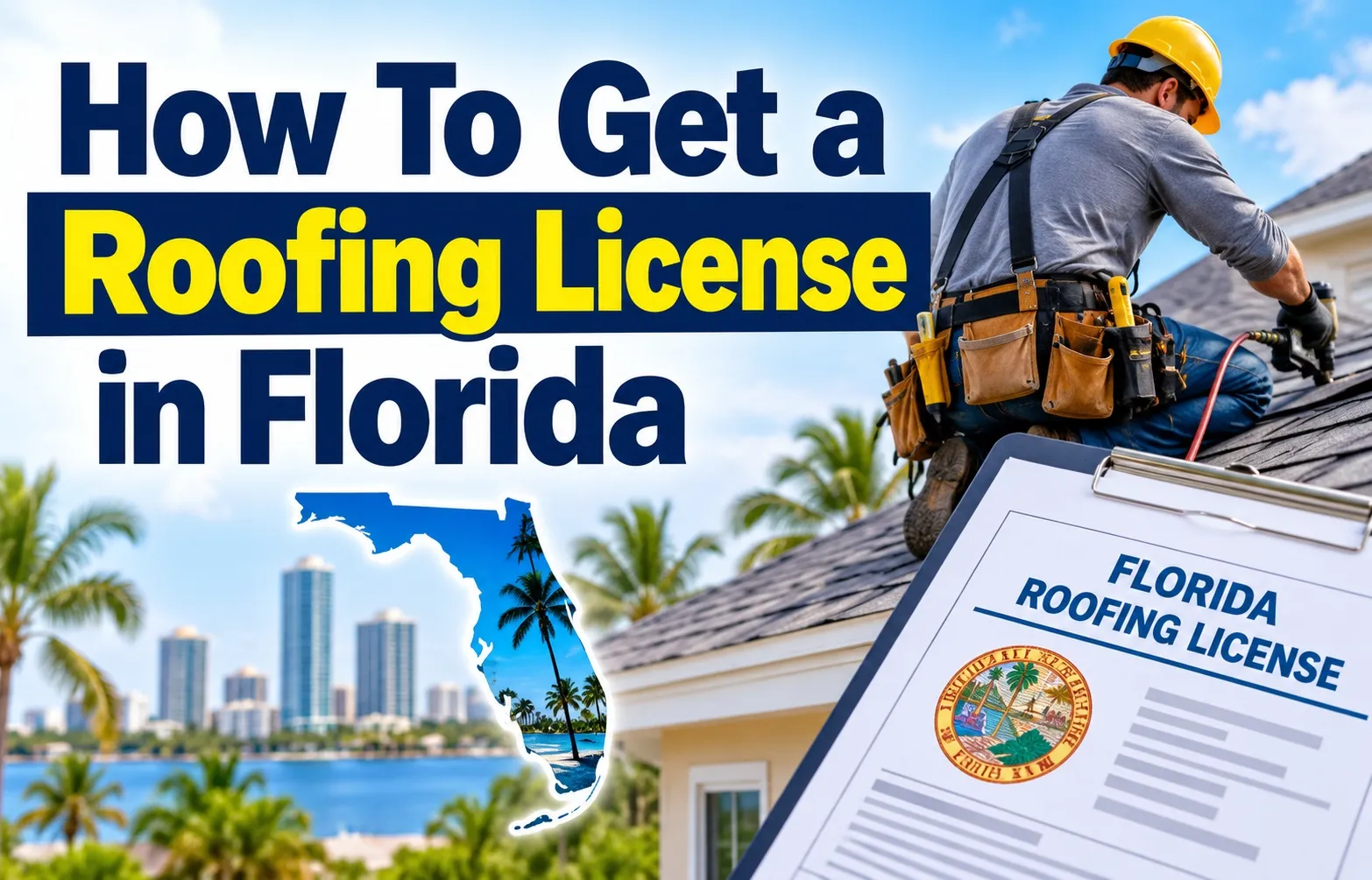 To obtain a roofing license in Florida, you must submit an application to the Construction Industry Licensing Board under the Florida Department of Business and Professional Regulation (DBPR). Candidates must be at least 18 years old, pass two state certification exams, prove four years of trade experience, maintain a FICO credit score of 660 or higher, and pass a Level 2 background check.
Quick-Glance Eligibility Requirements
Meeting the foundational requirements before starting your application prevents costly delays during the DBPR board review process.
- Age Requirement: Applicants must be at least 18 years of age at the time of application submission.
- Trade Experience: A minimum of four years of verifiable roofing trade experience is required, with at least one year serving in a supervisory capacity as a foreman or crew leader.
- Financial Responsibility: Candidates must submit a personal credit report demonstrating a FICO Score of 660 or higher to satisfy financial stability criteria.
- Background Screening: Applicants must complete Level 2 Livescan Fingerprinting through an approved vendor to clear state and federal criminal history checks.
- Official Documentation: Review all prerequisites on the Official DBPR Roofing Contractor Application Checklist before scheduling examinations.
Certified (CCC) vs. Registered (CCC-R) Licensing: Key Differences
Florida classifies roofing licenses into two distinct operational categories depending on your business goals and geographic scope.
A Certified Roofing Contractor (CCC) license grants the legal authority to execute residential and commercial roofing projects across all 67 Florida counties without local testing restrictions.
A Registered Roofing Contractor (CCC-R) license limits contractor operations strictly to specific cities or counties where the applicant holds a local certificate of competency.
Mastering the Open-Book Exams: Pearson VUE Testing Strategy
Passing the Florida roofing contractor exams requires mastering reference indexing and time management, as both tests are open-book. Candidates must achieve a minimum 70% passing score on two separate computer-based examinations administered through Pearson VUE and Professional Testing, Inc.
Business & Finance Exam vs. Roofing Trade Knowledge Exam Breakdown
The state licensing process requires passing two independent tests that evaluate both administrative management and technical construction competencies.
- Business & Finance Exam: Consists of 120 multiple-choice questions with a strict 6.5-hour time limit, covering accounting, tax laws, labor regulations, and construction law.
- Roofing Trade Knowledge Exam: Contains 80 multiple-choice questions with a 5-hour time limit, evaluating installation standards, structural plans, and safety compliance.
- Passing Standard: Both exams require a minimum passing score of 70% to qualify for state licensing board approval.
The Book Tabbing & Highlighting System (How to Pass Open-Book Testing)
Open-book exams do not mean open-internet or open-notes; candidates must bring approved physical manuals into the testing center. Relying purely on memory or searching books blindly will cause candidates to run out of time.
- Approved Book Tabs: Use permanently adhered, commercially manufactured permanent index tabs to divide open-book reference manuals by chapter and major topic.
- Highlighting Rules: Permitted highlighting must be done with standard transparent highlighters; hand-written notes or loose-leaf papers inside the books are strictly prohibited.
- Mastering the Index: Successful test-takers practice cross-referencing code sections and tables during pre-exam study to locate answers within two minutes per question.
Registering with Pearson VUE / Professional Testing, Inc.
Exam registration and scheduling are handled directly through third-party testing coordinators after receiving DBPR approval.
- Application Authorization: Applicants must first submit their examination application to the DBPR and receive approval eligibility before booking test dates.
- Testing Vendor Portal: Schedule exam dates online through the Pearson VUE and Professional Testing, Inc. candidate portal at authorized regional testing centers.
- Retake Policy: Candidates who fail an exam must wait the mandatory cooling-off period before paying re-examination fees and rescheduling.
Insurance, Application Submission, and Full Cost Breakdown
Submitting a successful Florida roofing license application requires proving active insurance coverage, completing DBPR portal filings accurately, and budgeting for initial regulatory expenses. Missing insurance documentation or submitting incomplete application fees will result in processing delays or board rejection.
Required Coverage: Public Liability, Property Damage, and Workers’ Compensation
Florida law mandates that roofing contractors maintain active liability coverage and workers’ compensation protection before a license can be issued or activated.
- Public Liability & Property Damage: Roofing contractors must carry minimum policy coverage amounts of $100,000 for public liability and $25,000 for property damage.
- Workers’ Compensation Coverage: Contractors must secure workers’ compensation insurance covering all employees or file an official Workers’ Compensation Exemption Certificate through the Florida Division of Workers’ Compensation within 30 days of license issuance.
- Certificate Holder Designation: All insurance certificates must explicitly name the Florida Department of Business and Professional Regulation (DBPR) as the official certificate holder.
Step-by-Step DBPR Portal Application Filing Guide
Navigating the DBPR online portal correctly speeds up application processing times and prevents administrative deficiency notices.
- Create DBPR Online Account: Register an account on the official DBPR online portal and navigate to the Construction Industry Licensing Board application section.
- Upload Supporting Documents: Submit passing exam score reports from Pearson VUE, Level 2 Livescan electronic fingerprinting receipt, FICO credit report, and verified experience affidavits.
- Pay Required Fees & Submit: Complete the online submission form and remit the non-refundable application fee using a credit or debit card.
Complete Cost Breakdown & Processing Timeline Table
Budgeting for the licensing process involves fixed state application costs, background check fees, examination pricing, and mandatory insurance premiums.
Real-World Florida Roofing Regulations & FAQs
Operating a roofing business in Florida requires strict adherence to state construction codes, insurance regulations, and permit laws. Ignorance of state statutes can lead to civil fines, criminal charges, and contract invalidation.
What Happens If You Do Roofing Work Without a License or Permit in Florida?
Performing roofing repairs, total replacements, or structural improvements without a valid DBPR license or mandatory building permit carries severe legal and financial consequences.
- Unlicensed Contracting Penalties: Under Florida Statute 489.127, practicing unlicensed contracting is classified as a first-degree misdemeanor for a first offense, punishable by up to $1,000 in court fines and 1 year in jail. Subsequent violations during a declared state of emergency escalate to a third-degree felony.
- Civil Administrative Fines: The DBPR Construction Industry Licensing Board can issue administrative citations and civil fines up to $10,000 against unlicensed individuals.
- Permitting Violations & Stop-Work Orders: Executing a job without securing local municipal building permits results in immediate Stop-Work orders, double permit fee penalties, mandatory tear-outs of non-inspected work, and potential code enforcement liens against the property owner.
What Is Florida’s 15-Year Roof Rule and How Does It Impact Contractors?
Florida’s 15-Year Roof Rule (Florida Statute 627.7011) directly influences homeowner roof replacement timelines, shaping market demand for licensed contractors.
- Insurance Non-Renewal Protection: Under Florida law, property insurance companies cannot deny or refuse to renew a homeowner’s policy solely based on a roof being 15 years of age or older, provided an authorized inspection proves the roof has at least 5 years of remaining useful life.
- Authorized Inspection Requirement: Licensed roofing contractors are explicitly authorized to conduct these roof life inspections and issue formal condition reports to satisfy insurer mandates.
- Partial Replacement Exemption (SB 4-D): Under Florida Statute 553.844(5), if a roof was built or replaced after March 1, 2009 (complying with the 2007 Florida Building Code or later), contractors are only required to repair or replace the damaged portion—eliminating the old rule that forced a 100% full roof replacement if more than 25% of the surface was damaged.
Real-World Florida Roofing Regulations & FAQs
Operating a roofing business in Florida requires strict adherence to state construction codes, insurance regulations, and permit laws. Ignorance of state statutes can lead to civil fines, criminal charges, and contract invalidation.
What Happens If You Do Roofing Work Without a License or Permit in Florida?
Performing roofing repairs, total replacements, or structural improvements without a valid DBPR license or mandatory building permit carries severe legal and financial consequences.
- Unlicensed Contracting Penalties: Under Florida Statute 489.127, practicing unlicensed contracting is classified as a first-degree misdemeanor for a first offense, punishable by up to $1,000 in court fines and 1 year in jail. Subsequent violations during a declared state of emergency escalate to a third-degree felony.
- Civil Administrative Fines: The DBPR Construction Industry Licensing Board can issue administrative citations and civil fines up to $10,000 against unlicensed individuals.
- Permitting Violations & Stop-Work Orders: Executing a job without securing local municipal building permits results in immediate Stop-Work orders, double permit fee penalties, mandatory tear-outs of non-inspected work, and potential code enforcement liens against the property owner.
What Is Florida’s 15-Year Roof Rule and How Does It Impact Contractors?
Florida’s 15-Year Roof Rule (Florida Statute 627.7011) directly influences homeowner roof replacement timelines, shaping market demand for licensed contractors.
- Insurance Non-Renewal Protection: Under Florida law, property insurance companies cannot deny or refuse to renew a homeowner’s policy solely based on a roof being 15 years of age or older, provided an authorized inspection proves the roof has at least 5 years of remaining useful life.
- Authorized Inspection Requirement: Licensed roofing contractors are explicitly authorized to conduct these roof life inspections and issue formal condition reports to satisfy insurer mandates.
- Partial Replacement Exemption (SB 4-D): Under Florida Statute 553.844(5) and Senate Bill 4-D, if a roof was built or replaced after March 1, 2009 (complying with the 2007 Florida Building Code or later), contractors are only required to repair or replace the damaged portion—eliminating the old rule that forced a 100% full roof replacement if more than 25% of the surface was damaged.
Real-World Florida Roofing Regulations & FAQs
Operating a roofing business in Florida requires strict adherence to state construction codes, insurance regulations, and permit laws. Ignorance of state statutes can lead to civil fines, criminal charges, and contract invalidation.
What Happens If You Do Roofing Work Without a License or Permit in Florida?
Performing roofing repairs, total replacements, or structural improvements without a valid DBPR license or mandatory building permit carries severe legal and financial consequences.
- Unlicensed Contracting Penalties: Under Florida Statute 489.127, practicing unlicensed contracting is classified as a first-degree misdemeanor for a first offense, punishable by up to $1,000 in court fines and 1 year in jail. Subsequent violations after a prior finding of guilt or violations during a declared state of emergency escalate to a third-degree felony.
- Civil Administrative Fines: The DBPR Construction Industry Licensing Board can issue administrative citations and civil fines up to $10,000 against unlicensed individuals. Additionally, contracts entered into by an unlicensed contractor are legally unenforceable.
- Permitting Violations & Stop-Work Orders: Executing a job without securing local municipal building permits results in immediate Stop-Work orders, double permit fee penalties, mandatory tear-outs of non-inspected work, and potential code enforcement liens against the property owner.
What Is Florida’s 15-Year Roof Rule and How Does It Impact Contractors?
Florida’s 15-Year Roof Rule (Florida Statute 627.7011) directly influences homeowner roof replacement timelines, shaping market demand for licensed contractors.
- Insurance Non-Renewal Protection: Under Florida law, property insurance companies cannot deny or refuse to renew a homeowner’s policy solely based on a roof being 15 years of age or older, provided an authorized inspection proves the roof has at least 5 years of remaining useful life.
- Authorized Inspection Requirement: Licensed roofing contractors and certified building inspectors are authorized to conduct these roof life inspections and issue formal condition reports to satisfy insurer mandates.
- Partial Replacement Exemption (SB 4-D): Under Florida Statute 553.844(5) and Senate Bill 4-D, if a roof was built or replaced after March 1, 2009 (complying with the 2007 Florida Building Code or later), contractors are only required to repair or replace the damaged portion—eliminating the old rule that forced a 100% full roof replacement if more than 25% of the surface was damaged.
Florida Roofing Regulations & FAQs
Operating a roofing business in Florida requires strict adherence to state construction codes, insurance regulations, and permit laws. Ignorance of state statutes can lead to civil fines, criminal charges, and contract invalidation.
What Happens If You Do Roofing Work Without a License or Permit in Florida?
Performing roofing repairs, total replacements, or structural improvements without a valid DBPR license or mandatory building permit carries severe legal and financial consequences.
- Unlicensed Contracting Penalties: Under Florida Statute 489.127, practicing unlicensed contracting is classified as a first-degree misdemeanor for a first offense, punishable by up to $1,000 in court fines and 1 year in jail. Subsequent violations after a prior finding of guilt or violations during a declared state of emergency escalate to a third-degree felony.
- Civil Administrative Fines: The DBPR Construction Industry Licensing Board can issue administrative citations and civil fines up to $10,000 against unlicensed individuals. Additionally, under Florida Statute 489.128, contracts entered into by an unlicensed contractor are legally unenforceable.
- Permitting Violations & Stop-Work Orders: Executing a job without securing local municipal building permits results in immediate Stop-Work orders, double permit fee penalties, mandatory tear-outs of non-inspected work, and potential code enforcement liens against the property owner.
What Is Florida’s 15-Year Roof Rule and How Does It Impact Contractors?
Florida’s 15-Year Roof Rule (Florida Statute 627.7011) directly influences homeowner roof replacement timelines, shaping market demand for licensed contractors.
- Insurance Non-Renewal Protection: Under Florida law, property insurance companies cannot deny or refuse to renew a homeowner’s policy solely based on a roof being 15 years of age or older, provided an authorized inspection proves the roof has at least 5 years of remaining useful life.
- Authorized Inspection Requirement: Licensed roofing contractors and certified building inspectors are authorized to conduct these roof life inspections and issue formal condition reports to satisfy insurer mandates.
- Partial Replacement Exemption (SB 4-D): Under Florida Statute 553.844(5) and Senate Bill 4-D, if a roof was built or replaced after March 1, 2009 (complying with the 2007 Florida Building Code or later), contractors are only required to repair or replace the damaged portion—eliminating the old rule that forced a 100% full roof replacement if more than 25% of the surface was damaged.

Oscar Vance | Master Plumber & Drainage Expert
Meet Oscar Vance, a licensed master plumber sharing practical solutions on residential repairs, preventive maintenance, and thoughtful home upkeep.